US Secretary of State Marco Rubio highlighted Greece’s pivotal role for the United States, describing it as a key ally for energy independence, regional stability, and NATO. In an interview with Matthew Boyle of Breitbart News, the top US diplomat stressed that Greece deserves a strong ambassador with access to the American president and his full confidence, emphasizing that the change in leadership at the US Embassy in Athens does not represent a downgrading of Greek-American relations.
Read also: Kimberly Guilfoyle absent from video posted by the US Embassy in Athens from Rubio’s visit to Greece
Rubio on Greece: A very important country and a great ally
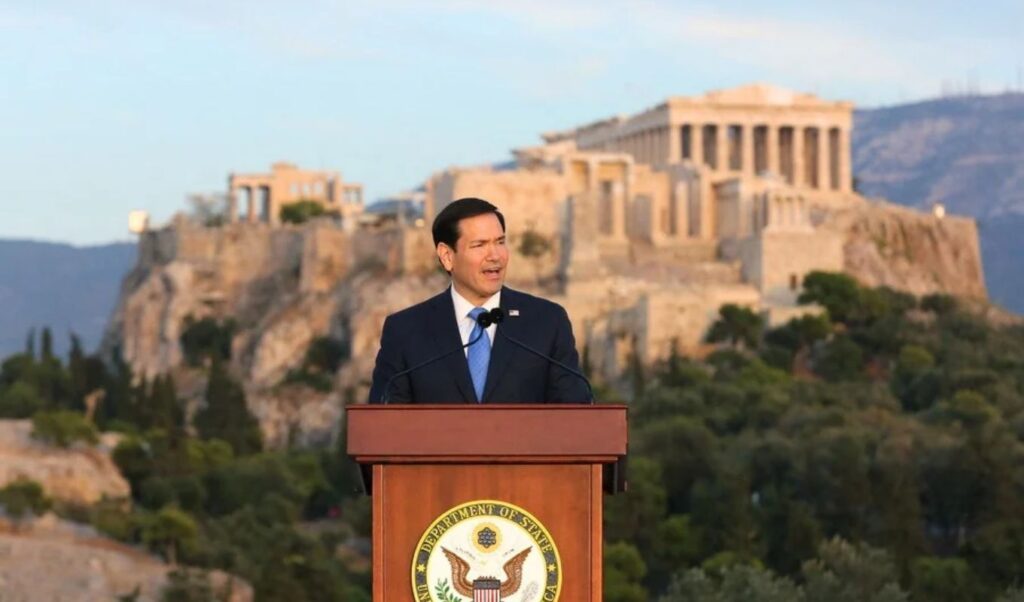
Marco Rubio placed particular emphasis on Greece’s capacity to produce and transport energy between Europe, Africa, and the Middle East. Referring to his speech at the Pnyx, with the Acropolis as a backdrop, he drew a connection between US foreign policy and the shared cultural heritage of the Western world.
Addressing the selection of a successor to Kimberly Guilfoyle in Athens, Rubio clarified that at the time of the interview, the process was still in its early stages. He noted that it would take time to identify the right person and complete the confirmation process. “Greece is an important country, very important. It is a great ally of the United States,” he said. “It has helped us in so many ways and is important to our future.”
He underscored that Greece is a cornerstone for key American priorities, including energy independence, regional stability, and NATO. “Greece deserves a strong and good ambassador who has access to the president and his trust,” he stressed, assuring that in the interim, Washington would ensure that the right team was in place at the embassy.
“None of this should be interpreted as a downgrading of our relationship with Greece. On the contrary, I consider it so important to us that it is essential that the person there has the full backing and confidence of the president,” he said. He explained that the goal is to select an ambassador worthy of Greece and the significance of the bilateral relationship.
Greece’s energy role
Rubio highlighted both Greece’s geographic position and its openness toward energy exploration, arguing that this combination creates significant opportunities. “I believe Greece is in a particularly unique position, both geographically and politically,” he said. He noted that the country is open to energy exploration, approaches it with enthusiasm, and appears to have broad public support for it.
He also emphasized Greece’s importance as a corridor for the construction of pipelines and energy transport infrastructure, pointing out that harnessing energy depends on the ability to move it — whether oil and natural gas or electricity.
“It has always been the link between Europe, Africa, and the Middle East,” he said of Greece. “Beyond energy production, it can help transport it northward into Europe and southward to Israel, the Middle East, and beyond.” In his view, geography now gives Greece advantages in the energy sector, much as it has historically done in trade and other economic activities.
Criticism of European energy policy
The US Secretary of State argued that the international crisis served as a stark reminder of energy’s critical role in everyday life, industry, and defense. He criticized policies that sought to discourage the use of fossil fuels by driving up their cost, as well as the inadequate development of domestic energy sources across Europe.
He recalled Donald Trump’s warnings during his first presidential term about Germany’s dependence on Russian energy and argued that this dependence influenced Moscow’s calculations ahead of the invasion of Ukraine.
“Their dependence on Russian energy is one of the reasons Putin invaded Ukraine — because he believed he could, because he believed Europe would do nothing about it,” he said.
He also assessed that European countries are beginning to draw lessons from the crisis, but will need time to reverse two decades of energy policy choices. He further linked high electricity and transportation costs to economic stagnation in many of those countries.
The Pnyx speech and Western heritage
Reflecting on his speech at the Pnyx, Rubio said its message lies at the heart of the approach he seeks to embed in US foreign policy. “We are the inheritors. We inherited from Greece and Rome, and ultimately through Europe, many of the values upon which our country rests today,” he said.
He argued that American institutions and values are the product of thousands of years of history, and that recognizing this heritage does not constitute an attack on other civilizations. “Every civilization should be proud of itself,” he said, adding that in his view, the West has become apologetic about its history and achievements — with consequences for foreign policy as well.
On the things Americans now take for granted — from prosperity to their form of government — he remarked: “They come from a shared history that we need to rediscover and embrace. That is what we are doing here, in this country, under President Trump. We want more Western leaders to do the same.”
He said he is seeing growing receptiveness from other leaders, particularly in private conversations. However, he acknowledged that translating this disposition into policy takes time, as fears persist of criticism from the far left, the media, academia, and the entrenched bureaucracy.
He predicted that more leaders will publicly express these views and win elections, thereby influencing their countries’ stance toward shared Western interests.
Russian diesel and American interests
On Ukraine and Russia, Rubio defended the temporary easing of sanctions on Russian diesel in order to increase its supply on the global market.
He explained that the decision is aimed at serving the needs of the American economy, even if it may benefit other countries as well. “If there is a conflict between what is good for them and what is good for us, we must always choose what is good for us,” he said, referring to the primacy of American national interest. The decision, he added, was made “not because it is bad for Ukraine or good for Russia, but because it is good and important for America.”
Regarding prospects for ending the war, he identified the dispute over control of Donetsk as a central obstacle in negotiations. He noted that Russia demands the entire region, while Ukraine considers the defensive line it holds there critical to its security. He stated that the US remains ready to mediate a deal, while acknowledging the difficulties involved. “We would like the war to end, but we also have other priorities around the world that we are focused on,” he noted.
When asked about holding elections in Ukraine, he said the issue is not without significance, but is not the primary reason the war continues. He also expressed frustration over Ukrainian strikes on vessels in the Black Sea that he said were carrying oil belonging to American companies, clarifying that he does not believe Ukraine deliberately targeted them. He added that President Trump is also angered by Russian missile attacks striking residential areas and killing civilians in Kyiv.
Iran and freedom of navigation in the Strait of Hormuz
On Iran, Rubio argued that US operations have degraded the conventional military capabilities that Tehran, in his assessment, sought to use as a shield for developing a nuclear weapon. He noted that the US military presence is now focused on protecting freedom of navigation through the Strait of Hormuz, while sanctions and a blockade against Iran continue.
According to him, in the ten days preceding the interview, approximately 13 to 14 million barrels of oil were passing through the Strait per day on average, with US forces escorting and protecting vessels from attack.
Rubio acknowledged that Iran continues to fire on ships, but argued that the flow of oil to the international market has been largely restored. He also maintained that, due to the blockade, Iran is the only country unable to move a single barrel of oil through the Strait of Hormuz. He added that economic pressure is limiting the resources Tehran can allocate to its armed forces and to organizations such as Hezbollah and Hamas.
More broadly on the Middle East, he described the Iranian regime as a primary driver of war and instability in the region. He acknowledged the importance of the Palestinian issue, but argued that addressing Tehran’s role is a central prerequisite for resolving the region’s conflicts.