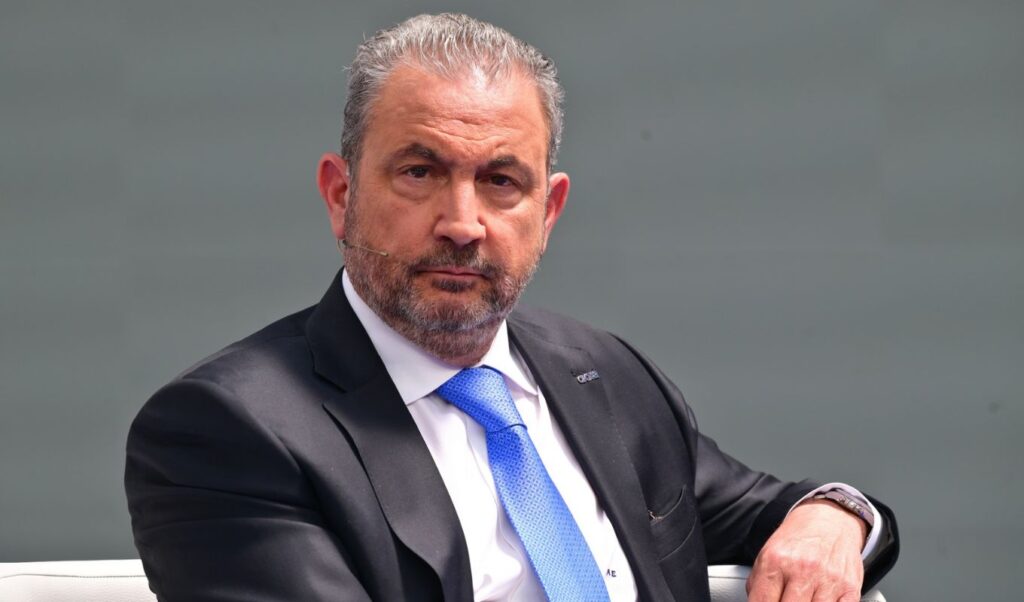
Alexandros Exarchou, President and CEO of AKTOR and Atlantic SEE LNG, spoke about the business initiative behind the Vertical Corridor natural gas pipeline, Turkey’s role in the project, the ambitions of American energy companies, and former U.S. Ambassador Kimberly Guilfoyle, among other topics.
Read also: Alexandros Exarchou: Sounding the alarm for the EU on the energy crisis ahead of winter — AKTOR’s strategy, the “Vertical Natural Gas Corridor” & the new FSRU unit in Corinth
Exarchou: The Vertical Corridor, the obstacles, and Turkey’s role
Speaking in an interview on the “Direct” programme on Protothema, Alexandros Exarchou stated that certain business interests are actively working against the advancement of the Vertical Corridor project. He placed particular emphasis on agreements reached with Albania and Bosnia, ongoing discussions with Romania, Bulgaria, and Ukraine, and the strategic importance of Greek infrastructure for the transportation of American natural gas. He also addressed the partnership with Venture Global and the broader outlook for the Vertical Corridor, framing its development as a key step in Europe’s gradual independence from Russian gas.
Exarchou also commented on Wall Street Journal reports concerning former U.S. Ambassador Kimberly Guilfoyle and Christos Marafatsos, attributing the framing of events to political and business motivations. He made clear that the Vertical Corridor initiative had been set in motion before Guilfoyle’s arrival in Athens, and stressed that all contacts were conducted transparently and in full compliance with established procedures. As he put it: “I followed all the procedures — suspicious dealings don’t happen in public.”
He further noted that his involvement in the Vertical Corridor project predated both the appointment and arrival of Kimberly Guilfoyle in Greece, stating: “I met her on the very first day she arrived. I had never seen her before.” He clarified that the initial contacts for the project had been made directly with the U.S. government, without the ambassador’s involvement.
According to Exarchou, Guilfoyle subsequently played an active role in advancing the American side of the deal, helping to finalize negotiations with Venture Global on the twenty-year LNG supply contract. She also advocated in Washington for the importance of long-term commitments to secure American natural gas supplies for the European market.
“Everything was done in the open”
Regarding Kimberly Guilfoyle‘s trip to Davos aboard his private aircraft, Mr. Exarchou confirmed that he had fully complied with all applicable procedures on his end. On the question of whether Guilfoyle had declared the trip to the State Department, he said he had no personal knowledge of the matter, but accepted her assurance that she had met all relevant reporting obligations.
He stated that their meetings abroad were focused exclusively on the Vertical Corridor and took place publicly, emphasizing: “Everything was done in the open.” He explained that the visibility of contacts and signings was also a deliberate objective of the American side, as part of its broader strategy to promote the project.
Regarding Christos Marafatsos, the AKTOR chief clarified that the group works with three lobbyists in the United States, all within the framework of lawful and declared professional relationships, with the primary aim of attracting American investment capital. He explained that engaging multiple partners is intended to broaden the group’s reach within U.S. investment and business circles. On Marafatsos’s contribution to the Vertical Corridor, he noted that while the two had discussed the project, the business initiative had already been set in motion independently of their collaboration. He made clear that the project would have moved forward “with or without him.”
Exarchou also expressed frustration at the way the Wall Street Journal article portrayed Marafatsos’s relationship with AKTOR, pointing out that he is an independent professional with multiple clients — not an exclusive partner of the group.
He further underlined a clear distinction between AKTOR and Atlantic SEE LNG, noting that AKTOR is not directly involved in the trading of liquefied natural gas, but holds a stake in Atlantic SEE LNG, which is the corporate entity that enters into the relevant commercial agreements. He clarified that he signed the American LNG agreements in his capacity as CEO of Atlantic SEE LNG, not AKTOR.
The WSJ article as political targeting
Mr. Exarchou attributed a political motive to the Wall Street Journal article, describing it as “a hit against the Republicans ahead of the elections.” He also argued that competing business interests contributed to the narrative that was constructed. In his view, the article’s reference to AKTOR rather than Atlantic SEE LNG served that narrative more effectively. He noted, however, that even the reports in question did not characterize the relationships or activities at issue as unlawful.
When asked who does not want the Vertical Corridor to proceed, he pointed to rivals of Venture Global in the U.S., as well as to suppliers who would prefer a different country as a transit route for natural gas. In this context, he raised the role of Turkey, noting that Greece, as a European Union member state, is bound by the EU regulatory framework — a constraint that does not apply to Turkey in the same way.
He also observed that the controversy had produced one unintended benefit for the project: it prompted both the Greek and U.S. governments to reaffirm their commitment to advancing the Vertical Corridor. He added that Guilfoyle’s departure from the embassy does not affect the progress of the agreements.
How the American LNG deal came about
Describing the origins of the business initiative, Mr. Exarchou explained that Atlantic SEE LNG’s activity involves the purchase and distribution of American LNG, leveraging existing infrastructure. The idea, he said, was born last September, sparked by contacts that followed a visit by U.S. Secretary Doug Burgum and the assessment that a ban on Russian gas would create significant demand in the European market.
The critical challenge was securing long-term commitments. American companies needed contracts of sufficient duration to finance the development of their infrastructure, while Europe had been hesitant about such agreements — particularly when American LNG was more expensive than Russian pipeline gas.
Mr. Exarchou said he approached DEPA, believing that a state-owned company with its own track record would be the most suitable partner. The first supply agreement, he noted, runs from 2030 to 2050. He also assessed that the United States is now seeking to lock in a stable share of future European imports through long-term contracts — even in the event that sanctions against Russia are eventually lifted.
The agreements with Albania and Bosnia
According to Mr. Exarchou, Atlantic SEE LNG has signed agreements with Albania and Bosnia and has secured the offtake for the volumes it has committed to purchase. He clarified that the company is not active in the Greek market and that the Greek state has neither purchased any volumes nor made any related commitment.
Specifically regarding Albania, he described the agreement as “fully binding” with no conditions affecting its validity. He explained that the conditional clause relates to the Albanian state’s guarantee for the state-owned company. On Romania, he noted that an intention to cooperate has been expressed and that discussions will resume when the appropriate governmental conditions are in place. He also referenced talks with Bulgaria and Ukraine.
On infrastructure, he assessed Revythoussa and Alexandroupolis as sufficient for current needs, and linked the further development of the project to collaboration with Motor Oil on the Dioryx Gas facility and the FSRU unit in Corinth.
The energy crisis and pointed remarks about Europe
Mr. Exarchou warned of difficult conditions in the European energy market this winter, arguing that Europe was too slow to secure the necessary volumes of natural gas from the United States. In his view, limited supply options and competition for available cargoes are keeping prices elevated, with no clear path to de-escalation in sight. Combined with high oil prices, he cautioned that inflationary pressures on European economies could intensify.
He drew a comparison with a deal concluded before the war in Iran, observing that prices then considered high are now the prices many would have been glad to have locked in. He argued that the EU will be forced to purchase volumes at significant cost, and called for a coordinated European response — including financial instruments such as a Eurobond — to avoid passing the cost of delayed action on to citizens.
As he put it: “This isn’t something you can tackle with bicycles and turning off lights” — dismissing such measures as wholly inadequate. In the same vein, he offered a positive assessment of Prime Minister Kyriakos Mitsotakis’s interventions with European partners on these issues.
The need for political stability
On the subject of the Greek economy, Mr. Exarchou argued that the country is now reaping the rewards of seven years of sustained effort. He noted that significant American capital has been interested in investing in Greece and continues to be so, adding that up until the end of July he was observing particularly strong demand from foreign investors.
He did, however, express concern about developments in European bond markets — singling out France, which he described as “the sick man.” He assessed that rising borrowing costs, combined with energy pressures, could derail growth, and stressed that answers must be found at the European level. He noted that the problem is not of Greece’s making and that Greece is in a stronger position, but cannot remain insulated from developments across the eurozone.
He placed particular emphasis on political stability, noting that at investment roadshows he regularly fields questions about governance prospects. “It would be a shame if, due to a political inability to maintain a stable government, we were to lose everything we have achieved,” he said.
The Motor Oil partnership
Closing, Mr. Exarchou touched on the agreements with Motor Oil concerning THALIS and HELECTOR — covering the waste management and water sectors — as well as the collaboration on the Dioryx Gas project and the FSRU unit in Corinth. That infrastructure, he noted, has the potential to play a significant role in the success of the Vertical Corridor, with the goal of finalizing the relevant agreement by the end of the year.