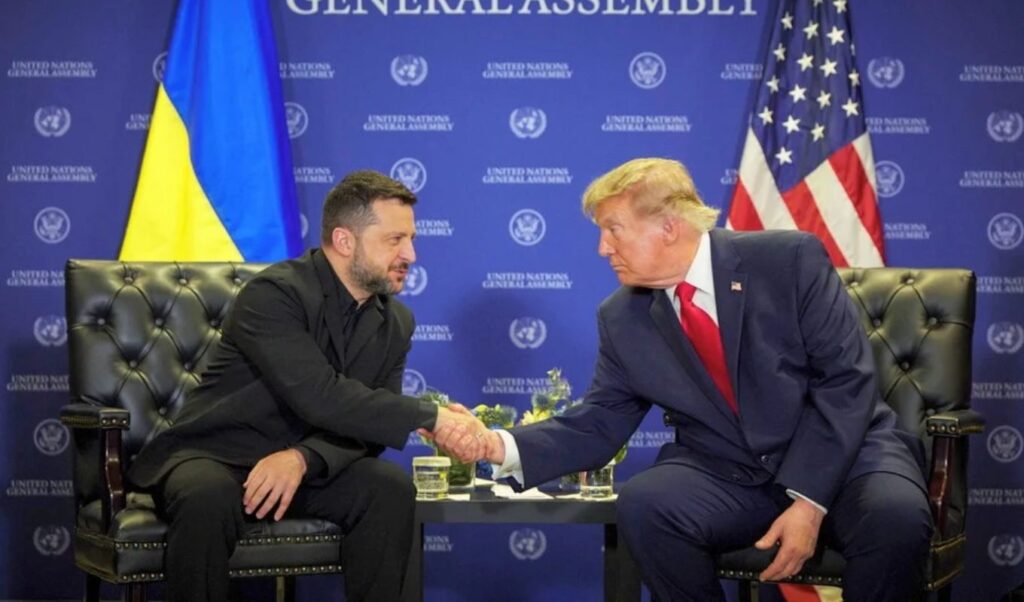
The relationship between Donald Trump and Volodymyr Zelensky appears to have reached a breaking point, as their latest confrontation raises serious concerns about the future of American support for Ukraine. As the New York Times notes in its analysis, this new crisis runs deeper than previous ones and threatens to strip Kyiv of military capabilities that remain vital to countering the Russian invasion.
The new crisis and its implications for Ukraine
The American president has never hidden his distrust of Zelensky, nor his inclination to engage with Vladimir Putin. Yet despite his recurring clashes with the White House, the Ukrainian president had until now managed to maintain a degree of American support — participating in Washington’s peace initiatives and repeatedly expressing gratitude toward Trump for his “strong leadership.” This time, however, the situation appears markedly different. With the US midterm elections approaching, the two leaders find themselves locked in a crisis that analysts warn could have serious consequences for both Ukraine and American foreign policy.
Trump on Zelensky:
Zelensky is not a good guy for us to deal with.
They're not going to settle with Zelensky. He doesn't want to settle. He says he wants to settle, but he doesn't.
I'm not a big fan of Zelensky. They've destroyed Ukraine. pic.twitter.com/NeM3b7cOGS
— Clash Report (@clashreport) October 16, 2026
The week that pushed US-Ukraine relations to the edge
For Kyiv, the past week brought a relentless succession of setbacks. Trump blamed rising diesel prices on Russia’s war against Ukraine, even though energy experts largely attribute the spike to the war the United States launched against Iran.
The American president then moved to temporarily lift sanctions on Russian diesel sales in an attempt to bring fuel prices under control. According to the New York Times, this move is unlikely to achieve its intended economic goal — while simultaneously offering Moscow a significant lifeline.
Next came the unilateral announcement of an “energy ceasefire,” which Trump presented as an agreement to limit strikes on energy infrastructure. The newspaper’s analysis suggests this initiative served Russia’s interests far more than Ukraine’s. Trump went even further, openly calling for new presidential leadership in Ukraine and publicly questioning Zelensky’s legitimacy.
Zelensky’s response this time was markedly sharper. Visibly furious, he effectively accused his American counterpart of aligning with Russia, even as Russian strikes continued to kill Ukrainian civilians.
Defying Trump’s energy ceasefire announcement, Zelensky declared that Ukraine would resume attacks on Russian oil refineries. When journalist Piers Morgan asked whether he believed his country was “losing” the United States, Zelensky’s reply was a single word: “Yes.”
Trump, for his part, told Newsmax that “Zelensky is not a good guy for us to deal with.”
The Ukrainian military’s alarm over “unexplained” Starshield restrictions
The confrontation took on an even more serious dimension when the Ukrainian military reported sudden and unexplained restrictions on the use of Starshield — the military version of the Starlink satellite system operated by Elon Musk’s SpaceX. The network is critical for battlefield communications and the coordination of a wide range of military operations.
According to the New York Times, the restrictions affected drone launches as well as a series of other operational activities carried out by Ukrainian forces. Musk, who maintains an intermittently close and at times combative relationship with Trump, implied that only the US military — and ultimately the president himself — has the authority to impose such restrictions on Starshield’s use.
Musk also publicly sided with those calling for Zelensky to be replaced as Ukraine’s president.
The developments triggered a response in Washington as well, with a bipartisan group of US senators calling for a formal investigation into the restrictions.
The prospect of losing access to critical satellite services is considered especially dangerous for Kyiv, as it could significantly hamper the conduct of military operations.
The worst-case scenario: a full cut-off of US military aid
According to the New York Times analysis, the worst-case scenario for Ukraine would be a decision by Trump and the Pentagon to suspend military assistance to Ukrainian armed forces. Although Ukraine has significantly expanded its domestic defense production, it remains dependent on the United States in several critical areas.
One of these is military intelligence that enables the early detection of Russian missile attacks and supports Ukrainian operations against medium-range targets. Equally important is American assistance in the area of military equipment — even when weapons systems are purchased with funding from European allies.
Ukraine needs American spare parts for its F-16 fighter jets, missiles designed to home in on enemy radar systems, and above all, Patriot interceptor missiles. These systems form the backbone of Ukraine’s defense against Russian ballistic missile strikes on its cities.
A suspension of this aid could significantly weaken Ukrainian forces at a time when, according to the newspaper, they have been performing well on the front lines. It would also leave cities that face daily missile and drone attacks far more exposed, sharply increasing the risk of civilian casualties.
“We will die because we won’t have time to reach the shelters,” warns Ukrainian military analyst
The importance of American intelligence is underscored by Oleh Katkov, a military analyst and editor-in-chief of a Ukrainian outlet covering defense and technology. “We will die because we won’t receive warnings about ballistic missile attacks,” he cautions. Without timely alerts, he explains, civilians will not have enough time to reach shelters — and without Patriot missiles, Ukraine will lose the ability to intercept incoming strikes.
Similar concerns are raised by Nico Lange, a former official at the German Defense Ministry and a fellow at the Munich Security Conference. He points out that while European nations do provide Ukraine with some intelligence, they cannot fully substitute for America’s early warning capabilities.
This is especially true for missile launches from ships in the Black Sea and for ballistic weapon attacks.
If Ukraine loses both early warning intelligence and Patriot missiles, Russia will gain a dramatically enhanced ability to strike targets with little effective resistance.
Two S-400 missile strikes on Kyiv with no early warning
A preview of what this could look like in practice emerged, according to the New York Times, during the very same week. Ukrainian officials reported that they received no advance intelligence from their allies ahead of two waves of missile attacks on Kyiv — one on Tuesday and another on Wednesday.
The missiles reached their targets almost simultaneously with the activation of air raid sirens. Ukrainian authorities used careful diplomatic language, stating they had not been warned by their “partners” — an implicit reference to the United States. However, it remains unclear exactly why no advance warning was issued.
One possible explanation is that the attacks were carried out using S-400 missiles, which can cover relatively short distances at extremely high speed, leaving minimal time for alert systems to respond.
Ukrainian officials did note that they received normal advance warning for other ballistic attacks during the same period. Despite the uncertainty surrounding these specific incidents, their timing — coinciding with the Starshield restrictions — deepened fears that military cooperation with the US may be entering a new and far more uncertain phase.
New York Times: Ukraine has reduced its dependency, but still needs the US
The New York Times notes that Ukraine’s position today is fundamentally different from what it was in the early years of the war. When Trump returned to power, he announced that the policy of isolating Russia needed to end and proceeded to reverse key pillars of American foreign policy.
That was followed by his contentious meeting with Zelensky at the White House, during which the Ukrainian president was publicly reprimanded — for not wearing a suit and, according to Trump’s aides, for failing to show sufficient gratitude for American support.
Zelensky subsequently managed to repair relations with Washington, but American policy had already shifted. The United States stopped providing Ukraine with free weapons, instead requiring Kyiv and its Western allies to pay for military supplies.
In the period that followed, Ukraine significantly developed its own defense industry, reducing its dependence on certain American weapons systems. This development has given Zelensky greater room to push back against Trump’s pressure. “Trump’s leverage through cutting off material supplies to Ukraine is now very limited,” argues Nico Lange.
As he explains, the prevailing assumption that Ukraine would automatically lose the war without American aid no longer fully reflects current realities. Nevertheless, there are critical areas where American support remains irreplaceable.
Kyiv’s deep concern over Patriot missiles
One of the sharpest sources of anxiety in Kyiv is the prospect of losing the supply of Patriot interceptor missiles. Solomiya Bobrovska, a member of the Ukrainian Parliament’s Defense Committee and deputy head of Ukraine’s delegation to NATO, warns that such a decision would have severe consequences for the country’s air defenses. Global stocks of these missiles have been significantly depleted — largely due to the war in Iran — while Ukraine continues to receive only a small number each month. Bobrovska stresses that Kyiv and its allies must urgently seek alternative solutions to reduce future dependence on the United States. She makes clear, however, that Ukraine has no intention of abandoning its fight. “If you want to hear from me the words ‘peace’ and ‘surrender,’ that is simply not an option,” she states.
Zelensky’s smile: a wordless answer in Brussels
The depth of mistrust between the two leaders was captured in a striking moment at Zelensky’s press conference in Belgium on Friday. When a journalist asked whether he believed Trump was using him as a scapegoat for his own domestic political problems, the Ukrainian president chose not to answer immediately. He smiled quietly, paused at length, and waited — drawing laughter from the room. He then leaned toward the microphone and said: “That is my answer.” The moment, as the New York Times observed, gave unusually vivid expression to Zelensky’s frustration — one he made no serious attempt this time to conceal.
“A lose-lose situation,” says former EU diplomat
Where this confrontation ultimately leads remains deeply uncertain. Balázs Jarábik, a former European Union diplomat based in Kyiv and now an analyst at R.Politik, believes the conflict serves none of the parties involved. “It is a lose-lose situation,” he says, arguing that the trajectory is bad for Trump, bad for Zelensky, and bad for the Europeans.
Analysts warn that a prolonged standoff could benefit Russia by undermining coordination between Ukraine and its Western allies. At the same time, a complete suspension of American military aid could prove politically damaging for Trump himself, who is already facing criticism from within his own Republican Party over his handling of the Ukraine file.
Harry Nedelcu, a senior figure at the European advisory firm Rasmussen Global, believes the period leading up to the American midterm elections will be decisive. As he sees it, Trump wants to demonstrate to American voters that he is working to lower fuel prices, while simultaneously fending off criticism from his own party. From a geopolitical standpoint, however, Nedelcu describes the American posture as a “stab in the back” and a “geopolitical betrayal.”
The central conclusion of the New York Times analysis is that the crisis between Trump and Zelensky has now moved well beyond the realm of personal animosity. What is truly at stake is whether Ukraine will continue to have the American operational support it needs to withstand Russian attacks.
And while Kyiv has built considerably greater military self-sufficiency than it once had, the potential loss of critical intelligence, satellite services, and air defense missiles could have immediate consequences — both on the battlefield and for the safety of millions of Ukrainian civilians.