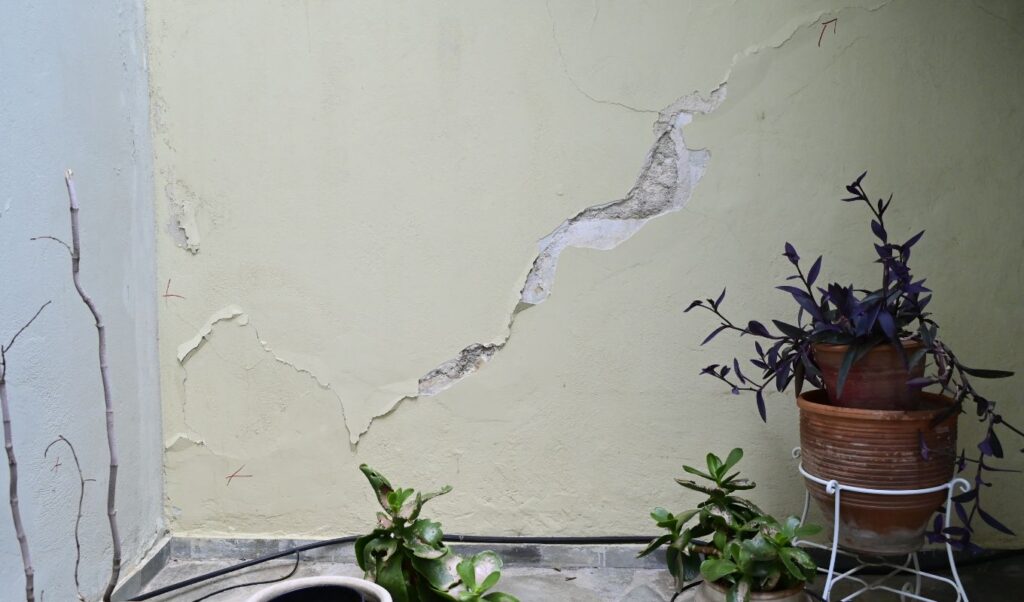
Anxiety over the structural resilience of apartment buildings in Kypseli in the event of an earthquake, unanswered questions about the exact causes of ground subsidence, and deep uncertainty surrounding property repairs continue to cast a shadow over the daily lives of many residents in the area — five months after the Line 4 metro tunnel boring machine (TBM) was brought to a halt. Despite assurances from the Ministry of Infrastructure and Transport that none of the inspected buildings has been deemed unsafe for occupancy, those affected are demanding definitive technical answers and a concrete timeline for the restoration of their properties.
Kypseli: “They didn’t give us clear answers about anything”
“They didn’t give us clear answers about anything,” Alexandros Koutroулaris, a member of the Kypseli Residents’ Initiative, told parapolitika.gr, in his assessment of the press conference held on Monday (12/10) at the Ministry of Infrastructure and Transport.
He highlighted one particularly critical issue that, he argued, was not adequately addressed during the briefing: the buildings’ ability to withstand a potential seismic event. Citing interim reports from the Technical Chamber of Greece (TEE) that have come to residents’ attention, he noted that these documents record a reduction in the load-bearing capacity of structural columns — a finding that, in his view, raises serious questions about how the apartment blocks would perform in an earthquake.
“We need an answer on what actually caused this”
For Koutroулaris, it is equally essential to establish precisely what triggered the ground subsidence and the extensive damage that appeared in buildings along the tunnel route. As he pointed out, this was the central question he himself raised at the press conference.
During the briefing, he addressed the ministry’s political leadership and representatives of the companies involved in the project, posing the question directly: “Do you intend to restart work without having provided an answer as to what went wrong — what the cause was?”
The residents’ representative also questioned whether the inspections carried out to date are sufficient to draw definitive conclusions. He argued that the examinations conducted by the TEE are based on sampling, whereas comprehensive surveys and full-scale studies are required in order to determine the necessary interventions.
In the same vein, he expressed frustration at the absence of a specific timeline, asking when the studies would be completed and when the repairs would follow. Commenting with evident sarcasm on what had been presented, he suggested it all seemed likely to happen “this time next year.”
Another issue he raised concerned the exact depth of the tunnel at the disputed point in Kypseli. According to Koutroулaris, despite repeated questions put forward during the press conference, no concrete answer was given.
Residents, however, appear determined to keep up the pressure. The Initiative’s representative warned that a further legal challenge cannot be ruled out “when the time comes.”
“We sleep with whistles and torches”
The sense of insecurity experienced by families in the area was also described by Charis Kontrochristou, another member of the Kypseli Residents’ Initiative, who lives with her children in one of the affected apartment buildings. A single mother, she explained after the press conference that their daily life has been fundamentally altered, as fear over the condition of the building has turned even their nightly rest into a state of constant readiness.
“We sleep with whistles, with torches, with a small bottle of water. That is something no one can give us back,” she said, describing the psychological toll the situation has taken.
Even more striking was her account of how she has tried to explain events to her children. “I told my children they need to be ready at any moment, that we might even need to jump from the balcony. We live on the ground floor,” she noted, laying bare the full weight of her anxiety.
“We are asking for data, we are asking for timelines, and of course for peace of mind,” she stressed, concluding that residents remain “in a state of alert.”
How the subsidence in Kypseli occurred
According to official data presented by the Ministry of Infrastructure and Transport, problems began to be recorded in March 2026, during the tunnel boring process between Kypseli station and Dikastiria (Courts) station. The project’s monitoring system detected surface subsidence greater than anticipated, which caused cracks to appear in buildings along the tunnel alignment. The TBM was halted repeatedly for inspections and technical adjustments, until on 8 May it was stopped as a precautionary measure and has remained in the same position ever since.
As was explained, Kypseli had already been identified during the initial design phase as one of the most geotechnically challenging areas along Line 4. Special protective measures and a dense network of ground movement monitoring had accordingly been put in place. Nevertheless, according to the ministry, the technical reports produced to date converge on the assessment that at certain points along the route the soil was significantly more permeable than in the surrounding areas. As a result, the face pressure applied by the TBM proved locally insufficient, leading to ground loss that manifested at the surface as subsidence. A full investigation into the causes has not yet been completed, as the findings of additional independent assessments are still awaited.
The ministry also confirmed that in certain buildings, measurements exceeded pre-set alarm thresholds, clarifying that these thresholds are designed to trigger timely inspections and protective measures and that exceeding them does not automatically mean evacuation is required.
According to the official briefing, in the majority of areas where tunnel construction has already been completed, subsidence has stopped. No new subsidence has been recorded since the TBM was halted, while the buildings directly above the point where the machine has stopped are being monitored with increased frequency.
Twenty buildings with damage — what the expert assessments have found
A total of 87 buildings fall within the zone of influence of the tunnelling works and are being monitored individually. In 20 of these, damage of varying extent and severity has been recorded. Initially, Attiko Metro requested expert assessments from the Technical Chamber of Greece for 14 buildings, with a further six subsequently added. Interim reports have already been delivered for the first 14, identifying the required interventions, while final reports — which may specify additional works — are still pending.
According to the official briefing, in the vast majority of cases the damage involves cracks in walls, plaster and joints — that is, in non-structural elements of the buildings. However, in certain cases the expert assessors requested more detailed examination and additional protective measures.
The ministry asserts that no expert assessment has declared any building unfit for use and that, based on current data, no need for evacuation has arisen.
Particular attention is being paid to the apartment blocks located directly above the point where the TBM has been halted, as these have recorded the greatest subsidence and the tunnel beneath them has not yet been completed. Separate studies are being drawn up for these specific buildings in order to determine the necessary protective measures before work resumes.
Repairs at no cost to residents
Regarding the restoration of damage, the ministry announced that properties in three buildings have already been fully repaired, with the consent of the owners, while works in the remaining buildings will proceed on the basis of the TEE expert assessments. All costs will be covered by the construction joint venture AVAX-GHELLA-ALSTOM, with no financial burden falling on owners or tenants.
Works are set to begin as soon as agreement is reached with the owner on the scope of the repairs, with the possibility of review provided in the event of disagreement.
The President of the Technical Chamber of Greece, Giorgos Stasinos, argued that once the interventions are complete, the buildings will be in a safer condition than they were before the TBM passed beneath them. “When the works are finished, the buildings will be safer than they were before the TBM passed through,” he stated.
For his part, the CEO of the AVAX Group, Konstantinos Mitzalis, assured that the construction joint venture has already secured a sufficient number of crews to intensify restoration works as soon as the required procedures are completed.
Christos Dimas: “Safety is a non-negotiable priority”
At the press conference, Minister of Infrastructure and Transport Christos Dimas acknowledged residents’ concerns, emphasising that their safety is the primary priority. “Safety is a non-negotiable priority for the state and for all parties involved in the project,” he stated, noting that the period during which the TBM has been halted has been used to catalogue the damage, investigate the causes and design additional protective measures. He added that all measurement data has been handed over to the Municipality of Athens and is available to interested property owners regarding their own buildings.
“The time has been used productively — damage in each building has been recorded and assessed individually, the identification of causes has been entrusted to internationally recognised independent experts, and the measures that will allow tunnelling to resume without further damage have been designed,” he said. The minister made clear that the restart of tunnelling will only take place once the required technical documentation is in place and the adequacy of the protective measures has been confirmed.
The Secretary General for Infrastructure, Dimitris Anagnopoulos, also stressed the need for safety to take precedence over the schedule, underlining that works will not resume until all necessary measures have been implemented. Deputy Minister of Infrastructure and Transport Nikos Tachiaos described Line 4 as the most significant public transport infrastructure project currently under construction in Greece, while acknowledging the responsibility of all parties involved towards the citizens affected by its delivery.
Independent reviews and the Cambridge assessment
Three levels of technical review are envisaged for the full investigation of the causes and the determination of the conditions for restarting works.
• The first concerns the Technical Chamber of Greece’s expert assessments of the condition of the buildings and the necessary interventions.
• The second concerns the evaluation by Professor Vassilis Marinos of the National Technical University of Athens (NTUA), acting as adviser to Attiko Metro, regarding the causes of the subsidence and the methodology for continuing the tunnelling.
• The third level involves an additional independent assessment by Lord Robert Mair, Emeritus Professor at the University of Cambridge, with internationally recognised expertise in underground construction and tunnelling beneath buildings in urban environments.
According to the CEO of Attiko Metro, Christos Fafoutis, the additional assessment will examine the causes of the subsidence, the impact on buildings, the adequacy of the proposed measures and the conditions for resuming tunnelling. Also participating in the technical investigation, on behalf of the contractor, are NTUA Emeritus Professor Michalis Kavvadas and mechanical engineer Lars Babendererde, Vice President of the International Tunnelling and Underground Space Association. The ministry committed to making the final findings — along with the definitive TEE expert assessments — publicly available in their entirety.
When will the TBM restart?
Despite the announcements regarding the next technical steps, no specific restart date for the TBM was given.
The proposal currently under evaluation envisages two key changes to the tunnelling process. First, ground reinforcement ahead of the machine will be carried out before excavation begins; at the same time, stricter operating parameters and enhanced checks at every stage will be applied.
The initial phase of the restart is planned to proceed in small, controlled steps with continuous real-time monitoring of ground movements. If any measurement exceeds the pre-set thresholds, the machine will stop immediately and a fresh assessment will follow before work continues.
In parallel, buildings along the remainder of the TBM’s route have been surveyed and the necessary protection studies are being drawn up.
As was emphasised, the aim is to move the machine away from its current position as quickly as possible, given that it is situated beneath occupied buildings and is also due for scheduled maintenance. However, the restart will only take place once the independent assessments confirm that the protective measures are adequate. Prior to that, a detailed briefing will be provided to the Municipality of Athens and to local residents.
The route will not change — delays remain an open question
The ministry’s political leadership ruled out any change to the Line 4 alignment, clarifying that the route has been fixed since 2017 and that a large portion of the tunnel has already been built. As was noted, the technical reports do not raise the question of rerouting. What is under review is the methodology by which tunnelling will continue, so as to minimise the risk of further subsidence.
The question of the overall impact on the project’s schedule, however, remains open. According to the ministry, the extent of any potential delay and the possibility of absorbing it will be determined after the restart. Line 4, in its first section from Alsος Veikou to Goudi, is expected to serve approximately 340,000 passengers per day, while studies estimate it will reduce private car journeys by around 53,000 per day.
For the residents of Kypseli, however, the issue is not simply a matter of when the TBM will start moving again or when the project will be completed. It is, above all, a question of when definitive answers will be provided about the damage their homes have sustained, when the repairs will be finished and when they will be able to feel safe inside their own homes once more. Until then, the uncertainty persists — with those affected demanding from the authorities not merely reassurances, but full technical documentation, transparency and concrete action.