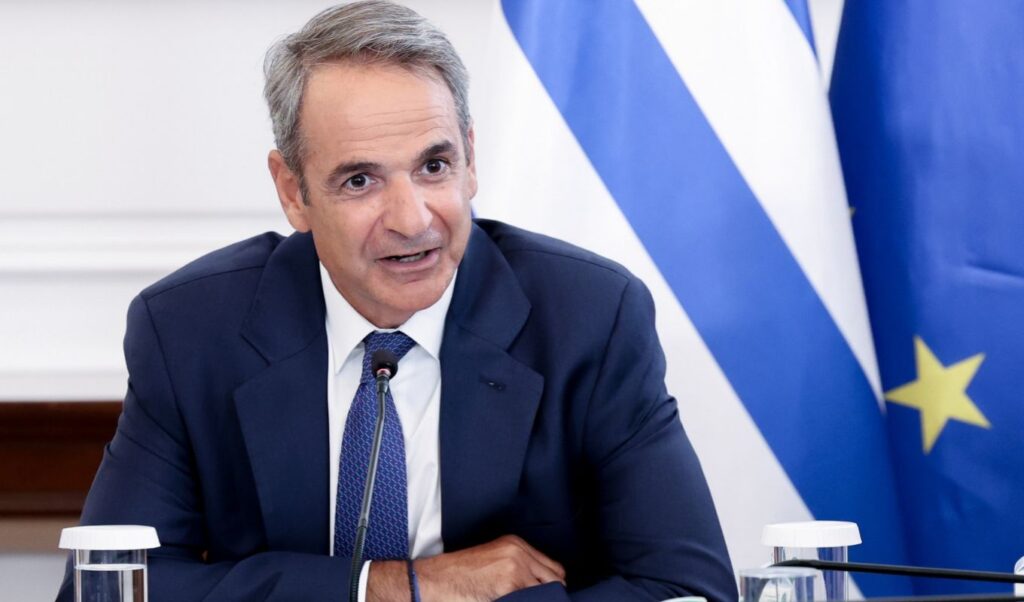
“Greece is consolidating its position as a pillar of stability in an unstable region, as a reliable partner, and as a bridge for cooperation between Europe, the United States, the Middle East, and the countries of the Arab world and the Gulf,” writes Prime Minister Kyriakos Mitsotakis in his regular Sunday post, prompted by the visit of U.S. Secretary of State Marco Rubio to Athens.
Mitsotakis: “Greece is consolidating its position as a pillar of stability in an unstable region”
In his regular weekly review, the Prime Minister addresses energy issues, stressing that “we are moving forward with direct electricity subsidies for energy-intensive industries,” as well as subsidies for fishing fuel, and noting that the European Commission has approved — specifically for Greece — the extension of the national escape clause to cover energy resilience expenditures.
Kyriakos Mitsotakis’ full weekly review:
“Often, the significance of a piece of news lies not only in what happened, but in what it reveals about a country’s position and its role in international developments. The visit of U.S. Secretary of State Marco Rubio to Athens was one such occasion. It highlighted the importance Greece has gained in a region where geopolitical balances are shifting and partnerships are taking on ever greater weight. It also highlighted the depth of the Greece-United States relationship, which is taking on real substance across an expanded range of cooperation areas, as demonstrated by the 6th Round of the Greece-U.S. Strategic Dialogue: from defense and security, energy and shipping, to investment, regional cooperation, and technology. Greece is consolidating its position as a pillar of stability in an unstable region, as a reliable partner, and as a bridge for cooperation between Europe, the United States, the Middle East, and the countries of the Arab world and the Gulf.
Athens and Washington share a common goal: to further deepen bilateral cooperation with more practical and tangible substance. Two of the most important areas where this is reflected are energy and defense. In the energy sector, the Vertical Corridor strengthens Greece’s prospects of becoming a natural gas transit hub to the European market, while also creating opportunities for greater utilization of American LNG. The energy dimension of this cooperation is directly linked to Europe’s supply security and the diversification of its energy sources and routes. In the area of defense, cooperation spans from the F-16 upgrade to the Viper configuration and the integration of F-35s into the Hellenic Air Force, to long-term defense procurement programs and Greece’s participation in the U.S. National Guard State Partnership Program with the State of Florida. These are different facets of a relationship that connects the modernization of the Greek Armed Forces with interoperability and closer cooperation between the two countries. Finally, I want to congratulate the Foreign Minister and his entire ministry team for the excellent organization of the visit and the strategic dialogue.
Before moving on to what happened this week, I thought it might be time to slightly change the structure of the review. This initiative, which began in November 2022, was conceived as an opportunity to communicate each week, in a more direct way, what is moving forward in our country — small and large changes, decisions, projects, and interventions that don’t always fit into the fast news cycle, but matter for daily life and for our overall trajectory. I believe this remains useful. However, I know — because citizens I meet tell me so — that its length is often tiring. So today I’m trying a new “formula”: shorter, cleaner, and closer perhaps to how it started. We’ll see if it works better this way. I’d love to hear your thoughts too.
So, let’s take a look at what happened this week.
– I’ll start with energy, where we are moving forward with direct electricity subsidies for energy-intensive industries, making use of the new European state aid instruments. The intervention is estimated to remove a €95 million burden from Greek production. The measure applies to sectors such as food, paper products, plastics, and cement — products directly linked to production, transport, and ultimately to shelf prices for every household.
– In Crete, following the extreme weather event, our first priority is to support people quickly and help them get back on their feet. On-site damage assessments have already begun, with state support covering 100% for affected residences and 70% for business equipment. At the same time, we are activating tax, insurance, and banking relief measures, along with ELGA support for plant and livestock capital. Additionally, through the state aid mechanism, €97.8 million in resources are being allocated to municipalities and regions for infrastructure repair and strengthening works affected by natural disasters.
– On the subject of what happened in Crete, let me emphasize how critical the 112 emergency line is for the timely evacuation of citizens from high-risk areas. The next step we are taking to make it even more modern and interoperable is the new e112 system: the ability to communicate with authorities via text or video, a silent notification button, and independent access for people with hearing or speech impairments. The system will connect police, fire service, EKAV, and the coast guard in real time.
– We are doubling the fishing fuel subsidy for the period April–August, up to €0.32 per liter, to support our fishermen. I should note that we are already exploring additional support options for the sector, but I will have more to share on that toward the end of the month.
– In education, the University of Patras has launched a new English-language undergraduate medical program — the 16th English-language program at a Greek public university — while 200 English-language postgraduate programs are already running. Interest was strong, with 168 applications from 23 countries. I am pleased to see our public universities opening up more to the world, attracting young people, academics, and researchers from abroad.
– Another National Health System (NHS) upgrade project has been completed, this time in Kalymnos: a fully renovated Cardiology Clinic, alongside the recently renovated emergency department of the hospital. The project was funded by the Recovery Fund, with a donation from siblings Katerina and Ilias Kathopouli for the clinic’s equipment.
– To support regional development, several significant interventions were advanced this week: €2 million for housing doctors and teachers in Agios Efstratios, Amari, and Western Samos; €5.13 million for student dormitories in 20 municipalities; and €6 million for the hospitals of Volos, Karditsa, Trikala, and Larissa. At the same time, work has begun on an irrigation network in Nea Mesimervia, a contract was signed for flood protection works in Kalamata, a tender was announced for the upgrade of the “Miltos Tentoglou” Sports Center in Grevena, and the upgrade of Karpathos Airport is progressing.
– In Skouries, Chalkidiki, the “Hellas Gold” investment was inaugurated — a $2 billion project for a new gold and copper mine built to strict environmental standards. More than 5,000 people worked in its construction, and 3,000 permanent jobs will be created during its operation. Importantly, the agreement gives priority to workers and suppliers from Chalkidiki, so that the benefits of this development remain visible and rooted in the local community.
– The European Commission approved — specifically for Greece — the extension of the national escape clause to include energy resilience expenditures. This gives us additional investment space of nearly €1 billion through 2028, without putting pressure on our fiscal targets. These resources will fund interventions such as heat pumps and solar water heaters for 100,000 beneficiaries, clean energy storage, and energy upgrades for schools and public buildings.
– A significant success for the Hellenic Police and the Financial Crimes Subdivision of the Greek FBI was the dismantling of an organization that, according to authorities, allegedly defrauded e-EFKA and was involved in extensive tax evasion, causing more than €5 million in damages to the public. Eight arrests have already been made, and investigations are ongoing. At the same time, the competent authorities filed criminal complaints against 18 influencers, rappers, and content creators for promoting illegal gambling on social media. The fight against lawlessness does not stop.
– Another step was taken this week toward the upgrade of “Georgios Karaiskakis” Stadium, the historic home of Olympiacos. This is a private investment of €250 million, aimed at building a new 53,000-seat stadium worthy of the club’s history. The necessary legislative initiatives are being set in motion, so that construction work can begin in May 2027.
Let me close with the draft Budget for 2027, which was submitted this week. The Greek economy is projected to grow — for the seventh consecutive year — at a rate higher than the Eurozone average: 2% in 2026 and 2.3% in 2027. This is what allows us to support society, repay debts ahead of schedule, and maintain reserves for whatever a difficult winter may bring. We have achieved a great deal in recent years. And precisely because of that, we have a responsibility not to lose our way, but to continue with the same seriousness — so that what we have accomplished becomes the foundation for what still needs to be done.”
How do you find the review in this new format? I hope it’s more helpful this way. As always, I look forward to your comments. Have a great day!