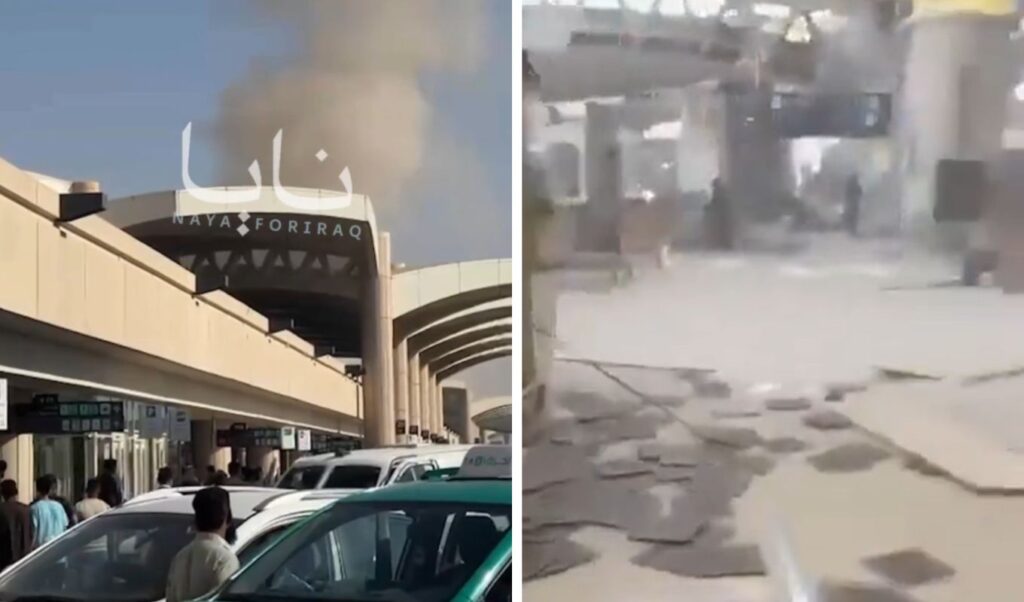
Tensions are escalating across the Middle East as the Houthis struck Riyadh’s airport on Saturday (10/10), killing 12 people — including one American — and wounding 309 others. Saudi Arabian authorities described it as the deadliest attack on the kingdom in over a decade, blaming the Yemeni rebel movement Ansarallah — also known by the surname of its leaders, the Houthis — which is aligned with Iran.
Houthis strike Riyadh airport
The coalition spokesman, Saudi Colonel Nouri al-Malki, described the strike as a “war crime,” noting that the target was a passenger terminal and that both travelers and airport workers were among the dead and wounded. Some of the 309 injured are in critical condition.
⚡️Video reportedly from Riyadh airport today
At least 12 killed and hundreds injured in a Houthi attack pic.twitter.com/FrLAfFfJ1A
— War Monitor (@WarMonltor) October 11, 2026
Saudi authorities posted on platform “X”: “The attack targeting King Khalid International Airport in Riyadh (…) resulted in 12 deaths, including four Saudi nationals, two Bangladeshi nationals, one American, one Egyptian, one Argentine, one Syrian, one Palestinian, and one Sudanese national.”
“Dangerous escalation”
Meanwhile, UN Special Envoy for Yemen Hans Grundberg condemned the attack as a “dangerous escalation,” warning that such actions pose a serious threat to regional security, perpetuate the cycle of violence, and severely undermine efforts to restore peace in Yemen.
UN Secretary-General António Guterres said he was “shocked” by the attack, which he “strongly condemned,” reminding all parties that attacks on “civilians or civilian infrastructure violate international law.”
The scale and frequency of rebel strikes against Riyadh in recent days is unprecedented since 2014, when the war between Ansarallah and the forces of Yemen’s internationally recognized government escalated into a full-scale conflict. The Saudi-led military coalition intervened in the Yemen war in March 2015.
Aeropuerto Internacional de Riad, Arabia Saudita es desalojado luego de un ataque desde Yemen, varias ambulancias han llegado al lugar.
El grupo Ansar Allah habían advertido que aviones podían despagar o aterrizar solo con su permiso. pic.twitter.com/Qgml5479dS
— Caoz (@Caoz_ES) October 10, 2026
Trump’s fury over the strike
US President Donald Trump declared that what happened in Saudi Arabia was unacceptable. “What happened in Saudi Arabia is not acceptable,” the White House occupant told reporters, adding that he intends to speak by phone very soon with Crown Prince Mohammed bin Salman, the kingdom’s de facto ruler.
🇸🇦🇺🇸🚨 URGENTE: Un estadounidense falleció tras el ataque al aeropuerto Rey Khalid de Riad.
Las autoridades saudíes reportaron 12 fallecidos y más de 300 heridos, varios en estado crítico. Las víctimas mortales eran de ocho nacionalidades. pic.twitter.com/Nx3x7yc20C https://t.co/gjjARbTbUI
— Global Network News 🌎 (@GlobalNetw33) October 10, 2026
US Secretary of State Marco Rubio also condemned the recent Houthi attacks on Saudi Arabia, including the Riyadh airport strike, which reportedly killed at least 12 people — among them one American citizen — and wounded hundreds more. The top US diplomat described the attack as a flagrant disregard for human life, calling for an immediate end to the strikes and expressing Washington’s full support for Riyadh and the Saudi people.
🇸🇦 Columnas de humo se elevan desde el edificio número 3 del aeropuerto internacional de Riad. pic.twitter.com/jI4UOYKOPd
— Noticias y Geopolítica (@GuerrasyGPcr) October 10, 2026
Ships struck in Oman and the Strait of Hormuz
Tensions are also rising on the maritime front of the US-Iran standoff. The US military announced that it struck a Panama-flagged cargo vessel in the Gulf of Oman after its crew, according to US Central Command (CENTCOM), ignored warnings and attempted to breach the naval blockade of Iranian ports.
A US fighter jet struck the stern of the vessel M/V Ocean Molica, also known as Arika Sun, completely disabling its propulsion system without injuring any crew members. CENTCOM also stated that the ship had departed from an Iranian port and attempted to cross the blockaded zone. The US military had reinstated the blockade of Iranian ports in the Gulf on July 14.
A further incident was recorded in the Strait of Hormuz, where a tanker heading toward the exit of the passage was struck on its port side by a projectile of unknown type, causing a fire to break out. According to the UK Maritime Trade Operations (UKMTO) — an advisory body under the British Ministry of Defence — the crew is safe, while there was no clear information on potential environmental impact or the vessel’s identity.
It is worth noting that attacks on commercial shipping in the region have intensified once again in the context of the wider Middle East conflict, which, according to available data, began on February 28 with the US-Israeli strike against Iran.
The Strait of Hormuz — one of the world’s most critical shipping lanes for hydrocarbon trade — remains at the center of the Washington-Tehran confrontation. Iran has effectively restricted passage through the strategically vital waterway by leveraging threats and attacks on vessels, while the US has responded with a naval blockade of Iranian ports and strikes against Iranian civilian ships.