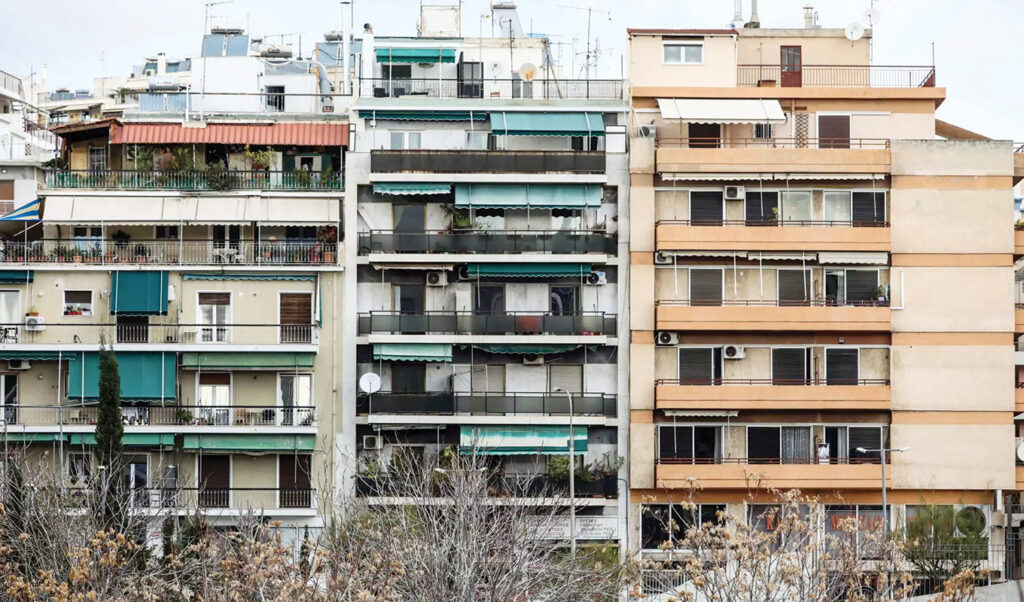
Parapolitika 90.1 FM has opened the file on the cost of living, documenting the expenses of everyday life. Supermarkets, housing, energy, transportation, dining, and household budgets were all placed under the spotlight through official data and expert analysis.
With rental prices soaring, the housing issue has become one of the biggest headaches for citizens. As Themis Bakas, president of the Panhellenic Network of Real Estate Agents E-RealEstates, explained — also predicting further increases — the average asking rent for an apartment of up to 50 sq.m. above the ground floor in Athens ranges between €550–600 per month, reaching €650–700 in better neighbourhoods or renovated properties. For an 80–90 sq.m. home in the southern suburbs, 9 out of 10 cost more than €800 per month. In central Athens, 7 out of 10 homes are rented for more than €700. “For properties between 80 and 110 sq.m., above the ground floor, with at least two bedrooms, built after 2000, we are recording a 39.59% increase in asking rental prices from 2022 to 2026,” he added.
Parapolitika 90.1 investigation: Rising costs, the housing crisis, and beloved habits that have become luxuries
In the same vein, Christina Iakovidou, president of the Association of Common Expenses Enterprises, noted that “some apartment buildings already have unpaid common charges” and conveyed citizens’ anxiety over rising heating costs, as the final price announcement is still pending. She recalled that last year a tonne of heating oil cost €1,200–1,300 and estimated that this year it will climb to €1,950–2,000, while “so far there have been no orders placed.” Turning to the pressing issue of food prices, Apostolos Raftopoulos, president of the Union of Working Consumers of Greece, spoke about price hikes in feta cheese — which currently starts at €12.50 and reaches up to €18 per kilogram — with 15,000 tonnes missing from the market relative to demand. At the same time, beef prices have risen by 8.5% to 10%, a trend expected to continue and drag along lamb and goat prices as well.
A feta shortage of around 30,000 tonnes was cited by Michalis Sarantis, president of the National Interprofessional Organization of Feta, who attributed it to sheep and goat pox. As for the price increase, he said it would be driven mainly by “the higher prices that dairy producers will pay to livestock farmers.”
Even Greeks’ beloved beverage, coffee, has not been spared. Tasos Giankoglou, president of the Hellenic Coffee Association, noted a roughly 25% increase in shelf prices compared to two years ago, attributing it primarily to the effects of climate change in Brazil and Vietnam, combined with rising demand from China and India.
The rising cost of living is impacting several sectors, with farmers also feeling the pressure. According to Charalampos Kasimis, emeritus professor at the Department of Agricultural Economics and Development at the Agricultural University of Athens, the energy crisis has pushed approximately 67,000 farmers out of the profession. Based on data from ELSTAT, last year producer prices fell by 8.4% while production costs rose by 4.7%. At the same time, Professor Kasimis was critical of the EU’s actions, stressing that there are significant contradictions in its approach.
Meanwhile, according to Leonidas Skoulos, a member of the OASA Workers’ Union, more and more drivers are leaving their cars behind and choosing to commute by public transport for economic reasons — inevitably causing overcrowding. This, according to Skoulos, should prompt the relevant authorities to review service frequency, especially at a time when driver shortages are being recorded.
Takis Theodorikakos: Additional measures may be required
Development Minister Takis Theodorikakos, speaking to Parapolitika 90.1, said that new government measures may be needed. As he stressed, supermarkets are now too expensive for many citizens, referencing the hostilities in the Middle East and their impact on product prices due to rising fuel costs. He went on to recall that a 9.5% reduction was applied across 1,740 product codes, translating into savings of €40 for the average household. “I was the first to come out and say that this is obviously not a substantial or major shift in tackling the high cost of living — but for households that are struggling, €40 a month is a positive step,” he emphasised.
Regarding the situation in the energy sector, he noted that the issue needs to be re-examined from scratch, and concluded by stressing the importance of government intervention — underlining that if this situation continues through the winter (which is likely), additional measures will be required.
Giannis Tsoukalas: A new rise in energy prices is possible
The head of the State Budget Office in Parliament, Giannis Tsoukalas, raised the prospect of a new increase in energy prices while discussing inflation and commenting on the national budget.
In more detail, he spoke of revisions, adding that “we are among the few countries capable of drafting such a budget.” Of particular concern, however, is his forecast of a further energy price increase. As he explained, the inflation recorded in September is being pushed higher by rising energy costs, noting that it is not expected to close much below 4% — a level that will put pressure on private consumption. “Based on the latest data, we are likely to see another increase in energy prices,” he stressed, while leaving a small window of optimism with a reference to the US midterm elections.
Finally, he revealed what he considers the greatest risk to the Greek economy: losing fiscal stability — stressing that “we must remain committed to this path.”
Giorgos Kavvathas: Dining out also up by 20%
The rising cost of living for Greek citizens extends to the food service sector as well. According to Giorgos Kavvathas, president of the General Confederation of Professionals, Craftsmen and Merchants of Greece (GSEVEE), speaking to Parapolitika 90.1 FM, prices in the dining and hospitality sector have risen by approximately 20% over the past two years. He identified energy costs as the primary driver of this situation, directly affecting operating costs and forcing business owners to revise their menus and pricing.
According to Kavvathas, the sector recorded steady revenue growth from 2019 through 2024. However, 2025 saw a negative turnover of 3.4%, and the first half of the current year recorded a further 4.5% decline. According to the president of GSEVEE, data for the third quarter of 2026 suggest that a further drop in turnover is also likely.
Published in the Parapolitika newspaper