New Democracy remains firmly in first place with a wide lead in the Regional Unit of Chania, despite some erosion compared to its 2023 election results. These findings come from the “To the Point” poll, conducted on behalf of the newspaper Haniotika Nea, capturing voting intentions, political trends, and the key issues weighing on local society.
Read also: Interview poll: New Democracy leads with 29.6%, minor losses for ELAS dropping to 15.4%, PASOK rises to 14% — which proposal passes the “reality test”
“To the Point” poll for Chania — Full party breakdown
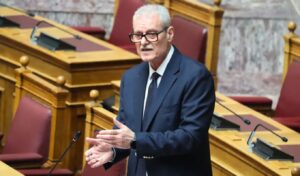
When asked how they would vote in the next national elections — whenever those may be held — respondents were presented with a list of political parties and chose accordingly. New Democracy came in first with 24.2%, maintaining a commanding lead of 13.1 percentage points over PASOK–KINAL, which placed second with 11.1%. KKE (Communist Party of Greece) ranked third at 7.7%, while ELAS – Tsipras Party came in fourth at 7.6% — a difference of just 0.1 percentage points, too slim to indicate any meaningful advantage.
Hope for Democracy – Karystianou received 5%, Greek Solution polled at 4.8%, SYRIZA at 4.2%, Course of Freedom at 3.3%, and Niki at 1.2%. Another 4.1% indicated they would vote for “another party,” a figure that reportedly includes the rumored new party of former Prime Minister Antonis Samaras.
17.5% of respondents declared themselves undecided, while 5.5% declined to answer and 3.8% said they would not vote at all. Combined, undecided voters and non-respondents account for 23%.
These figures reflect voting intentions specifically within the Regional Unit of Chania and under the particular scenario outlined in the survey. They do not constitute a nationwide electoral projection and should not be used to draw conclusions about parliamentary seat distribution.
The key issues facing the local community of Chania
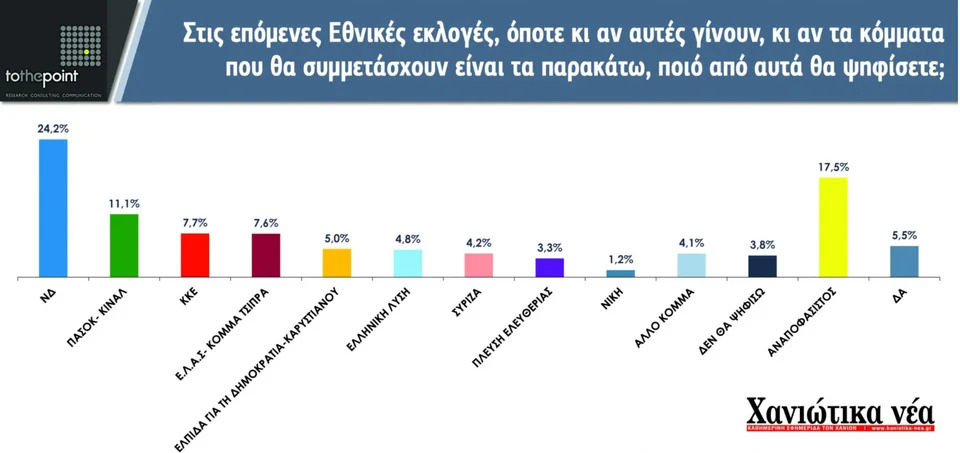
The same survey asked residents to rank the most important challenges that need to be addressed in the Chania region over the next five years.
Housing affordability and high rents emerged by a wide margin as the top concern for the region’s future. This was followed by the need to retain residents in rural villages and boost productivity in the prefecture’s interior, as well as the growing problem of overtourism, cited by 29.2% of respondents.
Further down the list came the protection and sustainable management of natural landscapes, the planning and oversight of energy infrastructure projects, and finally, the persistent issue of water scarcity.