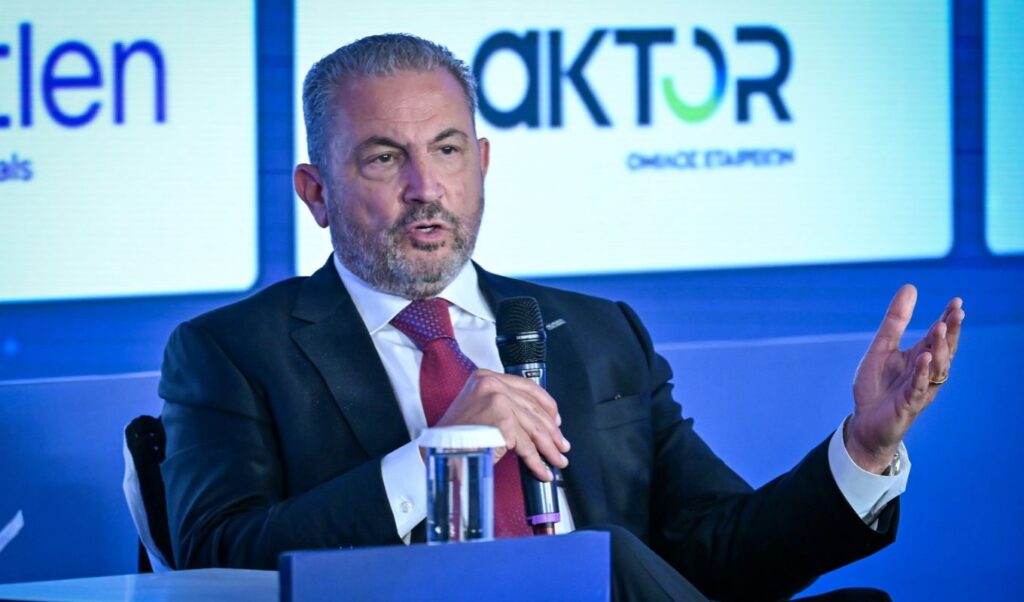
The warning issued by Alexandros Exarchos about the difficult winter ahead for the natural gas market didn’t take long to be vindicated. Just days after the president and CEO of the AKTOR Group told the Financial Times that the European Union would be forced to put the brakes on the strict implementation of its methane regulation, the European Commission announced it is considering postponing that implementation. The development reflects, in the clearest possible terms, the pressure Europe faces from explosive LNG demand, dwindling reserves, and fierce global competition for available cargoes.
Read also: Exarchos: How AKTOR, with low debt and €1.1bn in the bank, is building toward €600m EBITDA
Alexandros Exarchos had spoken last Wednesday, September 23, with Financial Times journalist Verity Ratcliffe, as part of her report on the outlook for the international LNG market ahead of the 2026–2027 winter. His assessment was that market conditions would compel Europe to reconsider the strict enforcement of Regulation 1787/2024 on methane, as fossil fuel importers would face additional compliance obligations and costs at a time when natural gas is becoming increasingly scarce and expensive.
What Alexandros Exarchos told the Financial Times
A European Commission spokesperson’s statement yesterday — confirming that a delay to the regulation’s entry into force is being planned — effectively validates that assessment. The framework, whose primary objective is to curb methane emissions across the fossil fuel supply chain, had been due to take effect from January 1, imposing significant obligations on importers. As early as last Friday, EU Energy Commissioner Dan Jørgensen had told Bloomberg News that Brussels was considering a one-year postponement of the provisions applying to imported fuels.
A double problem
The Brussels decision follows interventions by several member states, including France, as the international energy landscape has been further strained by the situation in the Strait of Hormuz and rising prices. For Europe, the problem is twofold: it needs more LNG to meet winter demand, while simultaneously facing intensifying competition from Asia.
The warning bell
This is precisely the central alarm being sounded by the Financial Times report. Europe is heading into winter with natural gas reserves at their lowest levels in 15 years, while Asian economies are competing for ever-larger volumes of LNG. The result is a global scramble for available cargoes, where the buyer offering the highest price stands the best chance of securing supply.
Pressure reflected in prices
Prices are already reflecting this pressure. On the Asian Platts JKM market — effectively the regional equivalent of Europe’s TTF benchmark — LNG has climbed to nearly $30 per MMBtu, compared to just under $25 in Europe. In energy terms, this translates to approximately €90/MWh in Asia versus around €75/MWh in Europe. And analysts see room for even greater upward pressure. Countries such as India and Pakistan have now adapted to higher and more volatile prices, and appear willing to purchase multiple LNG cargoes. This represents a significant shift from 2022, when comparable price spikes produced very different behaviour across Asian markets.
An additional risk factor
The prospect of China aggressively entering the spot market adds yet another risk factor. If Chinese purchases increase substantially, or if shipping costs fall, cargoes currently headed for Europe could be redirected to Asia. In a more adverse scenario, should the conflict in the Gulf persist, Platts JKM prices could reach $35/MMBtu — approximately €105/MWh. Against this backdrop, the shift toward long-term LNG contracts is taking on added significance. Asian countries are seeking to lock in volumes for the coming years so as not to depend on the ruthless competition of the spot market.
The substance of Alexandros Exarchos’s intervention
Long-term agreements offer greater price stability, while the anticipated increase in global LNG production capacity — primarily in the United States — creates prospects for greater supply in the years ahead. This is precisely where the core of Exarchos’s intervention lies. European energy policy now faces a difficult balancing act: on one side, the imperative for stricter environmental rules and reduced methane emissions; on the other, the need to secure sufficient and affordable natural gas for households and businesses.
What Brussels is acknowledging
The postponement of the regulation signals that Brussels now recognises that in a market where every additional cost can be passed on to final energy prices, the timing of new rules matters enormously. At the same time, as the Financial Times report makes clear, the methane regulation could act as an additional barrier to signing long-term LNG agreements, as importers would face uncertainty over future compliance obligations.
A timely warning vindicated
This turn of events vindicates, on this specific issue, the timely warning issued by Exarchos. The LNG market is demonstrating that energy security is no longer simply a matter of securing volumes — it is equally a matter of timing, price, and flexibility. And for Europe, entering winter with low reserves and facing increasingly aggressive international competition for LNG, the decisions being made today will largely determine just how expensive energy will be in the months ahead.
Originally published in Apogevmatini