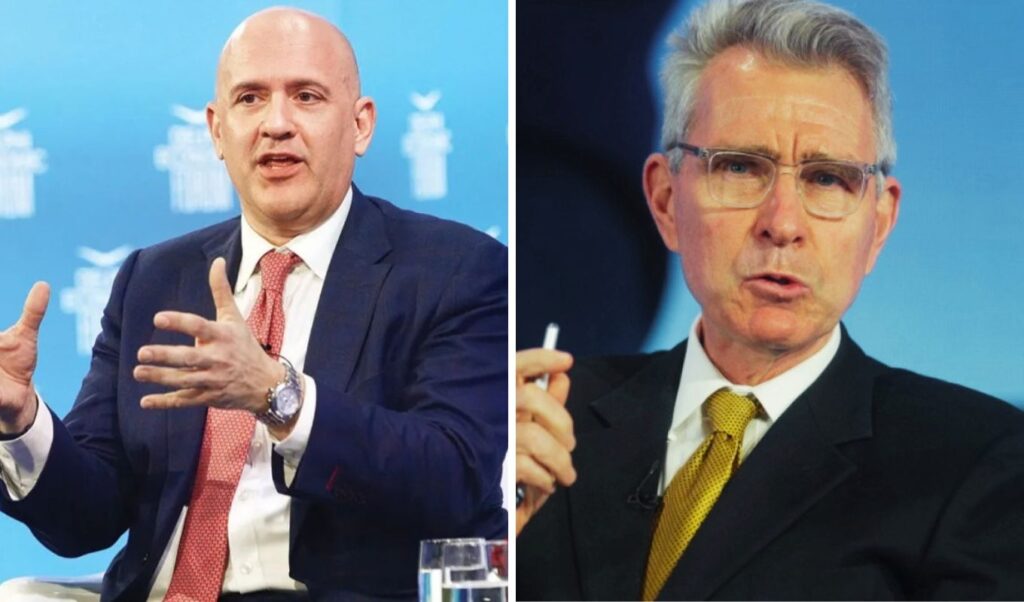
Former US Ambassador to Athens Jeffrey Pyatt and Eddie Zemenides, Executive Director of the Hellenic American Leadership Council (HALC), have both voiced strong support for deepening relations between Greece and the United States, with particular emphasis on the Vertical Corridor and Greece’s pivotal role in the energy landscape of southeastern Europe — and Europe as a whole — as the continent works to achieve independence from Moscow’s energy grip.
“As I strongly advocated throughout my time in Athens, and as Under Secretary of State for Energy Resources — supporting American companies every step of the way — there is undeniable strategic and economic logic behind the Vertical Corridor,” Pyatt wrote on X. He went on to add: “This is especially true as Europe completes the full phase-out of Russian natural gas — a long-sought goal of US foreign policy — which becomes even more critical in light of the full-scale invasion of Ukraine and Russia’s escalating hybrid attacks against Europe.” Pyatt also referenced the Wall Street Journal report that sparked considerable debate in Greece, noting that “the WSJ reporting speaks for itself, but let’s not lose sight of the benefits that have accrued to Greece and the US from our closer energy cooperation on issues ranging from LNG and de-lignification to battery storage and regional interconnections.”
“A close relationship”
Government spokesman Pavlos Marinakis was asked to comment on an exchange described in the WSJ report — between the US Ambassador and the Minister of Environment and Energy — which the article’s author interpreted as a threat by Kimberly Guilfoyle directed at the Greek government, prompting a sharp reaction from Stavros Papastavrou. Marinakis responded: “The issue of threatening the Greek government was never raised, nor would anything of the sort ever be tolerated.” He emphasized that the Greece-US relationship is today “closer and more stable than ever,” pointing to ongoing energy cooperation and noting that ExxonMobil and Chevron are investing alongside Greek companies in energy resource exploration. He also stressed that the Vertical Corridor is a critically important project that strengthens energy security and elevates Greece’s role in supplying energy to third countries. “The Greek government is working to enhance the country’s energy and geopolitical standing and to serve the national interest — it does not involve itself in commercial or business rivalries,” the government spokesman stated.
Eddie Zemenides, in a post of his own, highlighted Greece’s role in helping Europe break free from Russian natural gas dependency: “Southeast Europe and the Eastern Mediterranean are strategic convergence points — but make no mistake: great power competition is playing out in these very arenas. To its credit, the Greek Prime Minister’s government has consistently prioritized energy diplomacy and worked to create more options. Washington, Brussels, and Athens must remain vigilant and ensure that geopolitical and long-term economic considerations remain front and center. Anything less is a geostrategic failure.”