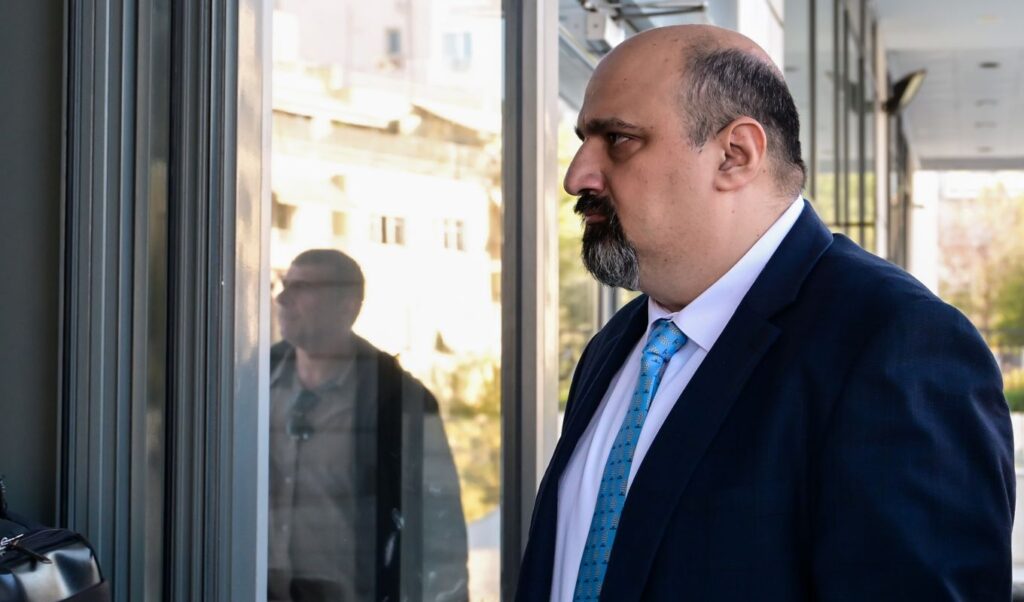
A ruling by the Judicial Council — operating under the ministerial accountability law — is expected this autumn, most likely in October, on whether former Deputy Prime Minister Christos Triantopoulos and his co-defendants will be referred to trial before the Special Court. The case concerns the alleged tampering of the Tempi train crash site, a disaster that claimed 57 lives.
Earlier this summer, Deputy Prosecutor of the Supreme Court Dimitris Mitroulias formally proposed that the former deputy minister be referred to the Special Court on misdemeanor charges of breach of duty. The prosecution’s proposal also called for four additional individuals to face trial as alleged participants in Triantopoulos’ actions, including former Thessaly Regional Governor Kostas Agorastos. The deputy prosecutor further recommended that the then-Secretary General of Civil Protection, as well as the heads of the Larissa traffic police and fire service at the time of the incident, also stand trial before the Special Court.
By contrast, three lower-ranking fire service officers were proposed for acquittal on the specific charges, with their case files to be forwarded to the Larissa prosecutor’s office for further investigation into whether additional offenses may arise in connection with alleged deficiencies in the expert examination.
In his proposal, the prosecutor stressed that, without the authorization of the competent judicial and investigative authorities, orders were given to intervene at the crash site — spreading gravel on the road and covering part of the ground with crushed asphalt. Regarding the former deputy minister, he noted that despite having an obligation to prevent these actions, Triantopoulos took no steps to stop them.
The deputy prosecutor of the Supreme Court also stated that Triantopoulos and Agorastos “aimed, by obstructing the collection of evidence, to unlawfully interfere with the ongoing investigation — from which criminal liabilities for specific individuals had emerged in connection with the train disaster — with the dual purpose of harming the state and the functioning of justice, while also securing unlawful moral benefit for the perpetrators of the offenses under investigation.”
The defendants, however, reject all charges against them, maintaining that they never ordered any tampering with the crash site or any intervention that could have influenced the investigation. On the other side, the victims’ families — who have formally joined the proceedings as civil parties supporting the prosecution — continue to demand that the charges be upgraded from misdemeanor to felony level, arguing that the actions attributed to those involved had serious consequences for the collection of critical evidence and, by extension, for bringing the truth to light.
Meanwhile, the main criminal trial concerning the train tragedy is already underway before the Three-Member Court of Appeal for Felonies in Larissa, where witnesses — predominantly victims’ relatives — are currently giving testimony. At the same time, a separate investigation led by Supreme Court investigative judge Ilias Giarenis is ongoing, examining the potential criminal liability of former Transport Minister Kostas Ach. Karamanlis and seven former secretaries general of the Ministry of Transport and Infrastructure during the period 2016–2023. The former minister is being investigated on misdemeanor charges of breach of duty.