Greek diplomacy is now assessing the outcomes of the United Nations General Assembly in New York, shifting its focus to the next critical milestones in Greek-Turkish relations. At the same time, Russian Foreign Minister Sergei Lavrov’s statements regarding the possible transfer of Turkey’s S-400 missile systems to a third country have opened a new chapter of diplomatic maneuvering.
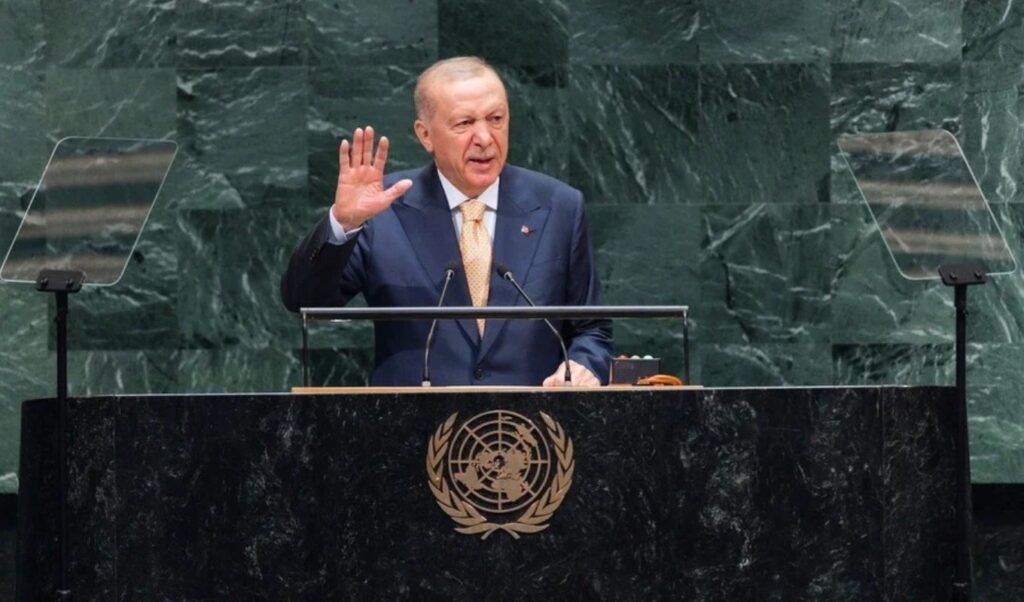
The noticeably softer tone of Recep Tayyip Erdogan‘s speech in New York, compared to recent precedent, was well received by the Greek side, which is positively evaluating the Turkish president’s “careful and measured” address to the UN General Assembly, according to authoritative diplomatic sources. At the same time, those sources note that they are “waiting for Ankara’s next moves on the open fronts ahead of us” — while not overlooking the heightened tensions of recent months or the persistent friction points that have yet to disappear.
According to international relations scholar and military academy professor Dr. Giannis Papafloratos, Erdogan’s temporarily moderate stance can be attributed to two key factors: his presence on American soil, where he was seeking Turkey’s reinstatement in the F-35 program, and his efforts to advance the candidacy of his trusted ally Feridun Sinirlioglu for the position of UN Secretary-General. As he explains to parapolitika.gr: “On one hand, Mr. Erdogan is trying to project a moderate face — possibly because he was on American soil and did not want to torpedo any prospect of Turkey’s return to the F-35 program. He may also have wanted his trusted associate Feridun Sinirlioglu to be promoted within the UN to the position of Secretary-General. Therefore, he needed to present a favorable image to the international community. On the other hand, there is a stream of statements — issued on every historical occasion by the Turkish Foreign Ministry and Defense Ministry, which is unusual in itself — that distort the truth, attack our country, and repeatedly call on us to distance ourselves from Israel, which they label a ‘genocidal state’ while insulting its leadership.”
Meanwhile, despite ongoing provocations, communication channels between Athens and Ankara remain open. The impromptu meeting between Greek Foreign Minister Giorgos Gerapetritis and his Turkish counterpart Hakan Fidan in New York confirmed that structured dialogue, Confidence Building Measures (CBMs), and the positive agenda will continue. However, Greek diplomacy is now bracing for two major stress tests in the Greek-Turkish relationship. Athens has made clear that planning for the survey and laying of the electricity interconnection cable between Greece and Cyprus is proceeding on schedule and will not be affected by fluctuations in Turkish rhetoric — with the relevant NAVTEX notices to be issued as soon as the request is submitted by the construction company.
Furthermore, the anticipated introduction of legislation ratifying the “Blue Homeland” doctrine in the Turkish parliament constitutes the second focal point of heightened attention for Greek diplomacy.
The post-UN landscape has also brought the geopolitical backdrop of Turkey’s S-400 systems back into focus — systems that remain a key obstacle to Turkey’s reintegration into the F-35 program. On the sidelines of the UN General Assembly, Sergei Lavrov stated officially for the first time that Moscow is open to considering the transfer of the Russian S-400 systems from Turkey to a third country. The Russian foreign minister made clear that Russia’s explicit approval would be strictly required, along with firm guarantees that the systems would not end up in Ukraine or in any unfriendly state. According to the Russian TASS news agency, Turkish Foreign Minister Hakan Fidan also confirmed the ongoing intensive negotiations, stating that “Turkey continues talks on the re-export of the S-400 systems it acquired from Russia in 2017.”
Dr. Papafloratos highlights to parapolitika.gr that “this statement carries a dual reading. Some might interpret it as a signal that developments are already underway and that Russia is on board. Others, however, could read it as an indirect threat or warning from Moscow to Turkey not to take any action without Russian approval. After all, Mr. Lavrov said nothing that wasn’t already known. In the international arena, when you purchase a weapons system and wish to resell it or move it outside your territory, you are always required to obtain the approval of the manufacturing country. That is standard practice. What Mr. Lavrov was essentially calling for was that there be no repeat of what he claimed certain European states had done — purchasing weapons from third-world countries and subsequently transferring them to the Ukrainian front against Moscow.”
Ankara believes that removing the S-400 systems is the primary obstacle to lifting the American CAATSA sanctions, as well as the related Congressional legislation. Turkey is therefore eager to resolve the issue before the US midterm elections, fearing a less friendly Congress. Behind the scenes, speculation about a potential recipient country initially pointed to the United Arab Emirates — an option that appears to have stalled following Israeli intervention, according to Turkish media — and subsequently to Egypt, where preliminary Greek diplomatic contacts are believed to have taken place in an effort to prevent such an outcome.