Greece is preparing to assume the presidency of the UN Security Council this Thursday, October 1st, amid an extremely challenging geopolitical climate and a particularly complex international environment — all while Greek-Turkish relations are once again moving to the forefront. “With Turkey, it is necessary to maintain open channels of communication and dialogue on the basis of International Law and good neighborly relations. After all, we are condemned by geography to live side by side,” wrote Kyriakos Mitsotakis in his regular Sunday Facebook post, while also stressing that meaningful dialogue “cannot coexist with unilateral actions that violate international law.”
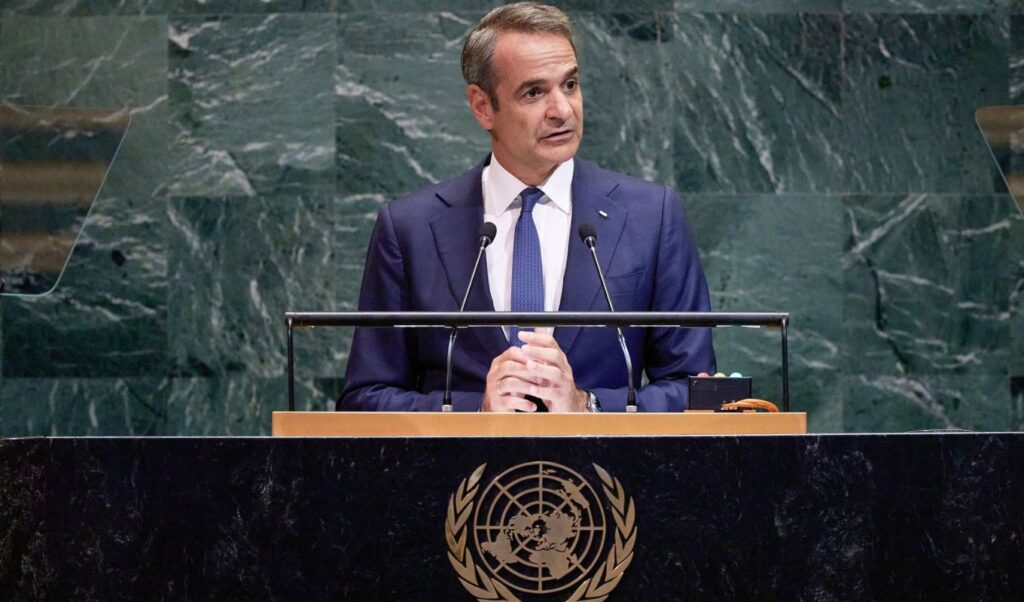
Among the highlights of the Prime Minister’s five-day visit to the United States was his address to the UN General Assembly and the carefully chosen messages he directed at Turkey and President Recep Tayyip Erdoğan, following a period of renewed turbulence in what had been relatively calm waters. The Prime Minister explained his approach to the international audience, stating that “over the past three years, we have been making a continuous effort to improve our relations, rebuild trust, and maintain open channels of communication in order to prevent an escalation of tensions that could lead to unwanted crises.”
He emphasized, however, that “given the broader regional challenges, the situation urgently requires a shared understanding of how we move forward” — and publicly set two clear “red lines” for the Turkish president as prerequisites for the continuation and progress of bilateral relations: full respect for International Law and the principles of good neighborly relations. He further added two additional conditions: an end to Turkey’s unilateral actions in the Aegean and Eastern Mediterranean, and the withdrawal of the casus belli threat.
A major new test for relations between the two countries is expected to emerge in the coming months, as the Greek government is pushing ahead with the implementation of the Greece-Cyprus-Israel electricity interconnection project, known as the Great Sea Interconnector (GSI) — one of the largest and most ambitious submarine power transmission projects in the world. The recent meeting between Prime Minister Mitsotakis and French President Macron in Paris gave political weight to the agreement signed for the entry of French investment group Meridiam as the majority shareholder in the company set to develop the Greece-Cyprus electricity interconnection, as well as to the trilateral agreement between ADMIE, GSI, and Nexans for seabed survey work in support of the project. “We are closely monitoring developments and we want to see the project implemented” — referring to the Greece-Cyprus electricity interconnection — said France’s new Ambassador to Athens, Nicolas Kassianidis, speaking to Kathimerini yesterday, who also noted that “the cable is funded by the European Commission, which has invested a significant amount.”