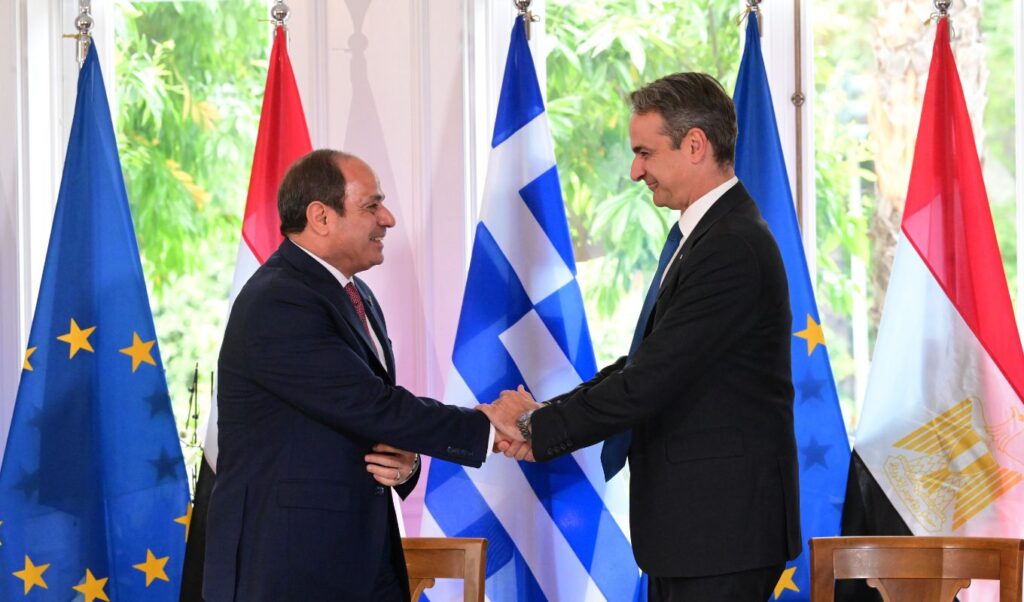
With the question of the ownership status of the Sinai Monastery still unresolved, Prime Minister Kyriakos Mitsotakis travels to Egypt tomorrow for talks with Egyptian President Abdel Fattah el-Sisi. The two leaders are meeting at a critical juncture for the balance of power in the Eastern Mediterranean, with a wide range of geostrategic issues on the table — from the “Mecca Agreement” to the delimitation of maritime zones south of Greece, both with Egypt (through further strengthening of the partial delimitation reached in 2020) and with Libya. Also high on the agenda is the Greece–Egypt electrical interconnection project (GREGY), one of Europe’s most significant energy infrastructure initiatives.
However, the spotlight falls on the issue of the Sinai Monastery. Although the agreement was expected by the end of August — as Archbishop of Sinai Symeon had previously indicated to parapolitika.gr — it has yet to be finalized. Reliable sources speaking to parapolitika.gr attribute the delay to two key factors: first, the health issues suffered by Archbishop Symeon, which prevented him from participating in the necessary consultation process with the Sinaite monastic community; and second, the heightened religious duties surrounding the Dormition of the Virgin Mary celebrations, which — due to the Old Calendar — required two separate feast day observances, drawing large numbers of faithful to the Monastery of Saint Catherine on both August 15 and August 28.
According to the same sources, Cairo’s judicial authorities — following the fourth postponement of the August 23 ruling by Egypt’s Supreme Court of Cassation, the equivalent of Greece’s Areios Pagos (Supreme Court) — have granted the monastic community a new deadline to respond to the outstanding issues. While these are considered secondary details, they still require formal agreement. The same sources confirmed to parapolitika.gr that the agreement reached with the Egyptian state regarding the legal framework governing the monastery’s operation has been substantially completed in its key provisions.
The Sinai Monastery on Mitsotakis’ agenda ahead of his Egypt visit
As sources told parapolitika.gr: “The core points of the agreement — which is genuinely a highly beneficial deal for both the Monastery and Egypt — have been agreed upon between the Monastery and the Egyptians. It is a very good agreement for both sides. It is not one-sided; it is a very good agreement. But even a very good agreement has its details. And right now, we are stuck on details that the Monastery itself needs to handle.” What is certain is that the issue will be raised at tomorrow’s meeting between the Greek Prime Minister and the Egyptian President. The same sources did not rule out the possibility that despite the inability to reach a final agreement in recent months, a breakthrough could happen “in a single day,” with announcements to follow — though they noted this remains a low-probability scenario.
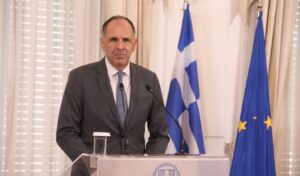
Foreign Minister Giorgos Gerapetritis also addressed the matter from Thessaloniki, emphasizing that Greece and Egypt are working together on this issue. “A preliminary understanding has already been reached,” he stated. “At this point, it is up to the monastic community itself to decide on the future of the agreement. It is important to note that for the first time in the 15 centuries that the Monastery has been in operation, a concerted effort is being made to establish a special regulatory framework for it — one that does not treat it as a mere antiquity. We must never regard Saint Catherine as just another common historical site.”
The Turkey–Libya memorandum
At tomorrow’s meeting between Kyriakos Mitsotakis and President el-Sisi in El Alamein, critical geopolitical issues are expected to take center stage. As Turkey continues to escalate tensions in the Aegean and Eastern Mediterranean, Athens will seek to reaffirm its common position with Cairo on maritime zone delimitation — building on the partial delimitation agreement reached with Egypt in 2020, which effectively nullified the Turkey–Libya memorandum signed a year earlier between Turkey and Libya’s Government of National Accord.
Athens and Cairo are aligned in their opposition to the Turkey–Libya memorandum, which undermines the interests of both countries. Technical talks are underway with both Libyan power centers toward this end. Greece’s goal is to extend the Exclusive Economic Zone (EEZ) agreement with Egypt further eastward, while discouraging Cairo from accepting Turkey’s offers of a Turkey–Egypt EEZ — sweetened by promises of larger maritime zone allocations — a development that, if realized, would deal a severe blow to Greece’s geostrategic interests in the Eastern Mediterranean. Encouragingly, Egypt has so far refused to align itself with the agreement Turkey brokered with Pakistan and Saudi Arabia, known as the “Mecca Agreement,” despite sustained Turkish pressure.
What is clear is that el-Sisi’s Egypt is increasingly oriented toward cooperation with the European Union — a shift to which Athens has made a decisive contribution. As Foreign Minister Gerapetritis stated in Thessaloniki: “Greece was the driving force within the European Union in deepening the relationship between the EU and Egypt, and in unlocking significant financial protocols to support the Egyptian economy, which has been severely affected — first by the global crises that emerged in recent years, and more recently by the war affecting the broader region.”
Egypt is moving in the same direction with regard to the GREGY electricity interconnection project between Greece and Egypt — a scheme of major European strategic interest. Relevant announcements are expected following tomorrow’s meeting, which will also be attended by the President of the Republic of Cyprus, Nikos Christodoulides.