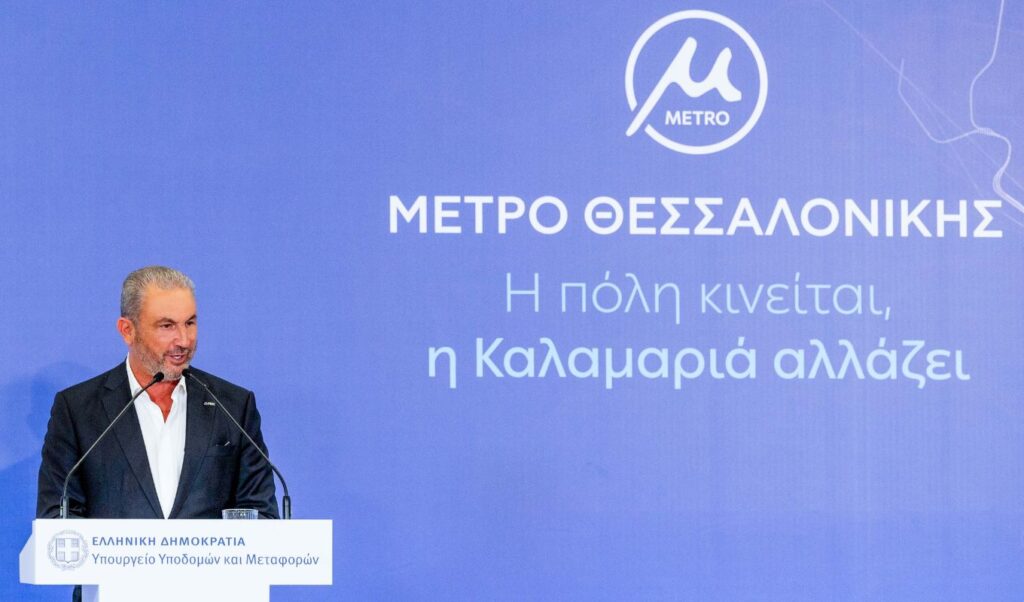
The AKTOR Group officially handed over to the Greek state on Thursday (27/08) the major extension of the Thessaloniki Metro towards Kalamaria, which was inaugurated by Prime Minister Kyriakos Mitsotakis and is now open to the public. The handover ceremony took place at the “Mikra” Metro station, in the presence of cabinet ministers, members of parliament, European Commission Commissioner for Transport and Tourism Apostolos Tzitzikostas, and local authorities. This marks the first branch on an automated metro system in Greek engineering history.
AKTOR Group delivers the Thessaloniki Metro Kalamaria extension
The Chairman and CEO of AKTOR Group thanked Prime Minister Kyriakos Mitsotakis for his pivotal role in bringing the project to completion and stated: “We are proud to deliver to the people of Thessaloniki the most modern metro in Europe. The Thessaloniki Metro is a prime example of how decisive political will can be in completing a major infrastructure project. I want to thank the people of the AKTOR Group who poured their hearts into delivering this project, as well as Hitachi, without whom completing the metro would have been impossible. The Kalamaria Metro extension will transform the lives of thousands of citizens.”
What Alexandros Exarchou said
Mr. Exarchou added: “The story of the Thessaloniki Metro is no different from the recent history of AKTOR. Today we are delivering the most advanced metro in Europe, with a renewed AKTOR that has just completed a €1 billion capital raise to execute €3 billion in investments that have already attracted interest from international investment funds. This confidence from the global investment community in AKTOR also reflects the results of the hard work and effort that has gone into the Greek economy over the past seven years. If we continue on this path, with companies like AKTOR — the largest and most strongly capitalized engineering company in Southeastern Europe — nothing will stand in the way of further growth for the Greek economy.”
Five new stations
The launch of the Metro extension significantly upgrades public transport in the Municipality of Kalamaria, as it is expected to serve more than 60,000 passengers daily, with the journey from Mikra station to the New Railway Station taking just 25 minutes.
The Thessaloniki Metro extension to Kalamaria includes an underground main line of approximately 4.8 km with two tracks, running mostly beneath major road arteries, featuring 5 stations, 5 shafts, 3 railway crossings, and one above-ground station.
The extension begins after the junction located south of and adjacent to the “25th of March” station on the main line, following Solonos Street and then Kritis, Moschonesion, Mitropolitou Kydonion, and Pontou streets, terminating at the junction of Pontou and Ikaron streets (Mikra above-ground station). The five new Metro stations are “Nomarchia,” “Kalamaria,” “Aretsou,” “Nea Krini,” and “Mikra,” respectively.
15 new trains
The extension system has been dimensioned for a minimum capacity of 18,000 passengers per hour per direction at 90-second intervals, taking into account projected passenger volumes per station as well as future system expansions. To meet the operational demands of both the main line and the Kalamaria extension, fifteen new trains were constructed, procured, and put into service as part of the project.
How the extension operates
The operation of the Metro extension to Kalamaria is managed by the Thessaloniki Metro Operations Control Centre, where all metro functions are monitored and controlled in real time, ensuring the safe and smooth running of services and the best possible passenger experience.
No transfers are required for passengers travelling to and from the city centre. Passengers travelling to and from Kalamaria do not need to change trains to reach the heart of the city. At the 25th of March station, the Kalamaria Line (Line 2) meets the Main Line (Line 1). From that point onward, trains from both lines run on the exact same tracks and stop at the same central stations.
The architectural design and operation of the extension follows the standardization of the Thessaloniki Metro’s main line, making the most of passengers’ existing familiarity with how the system works.