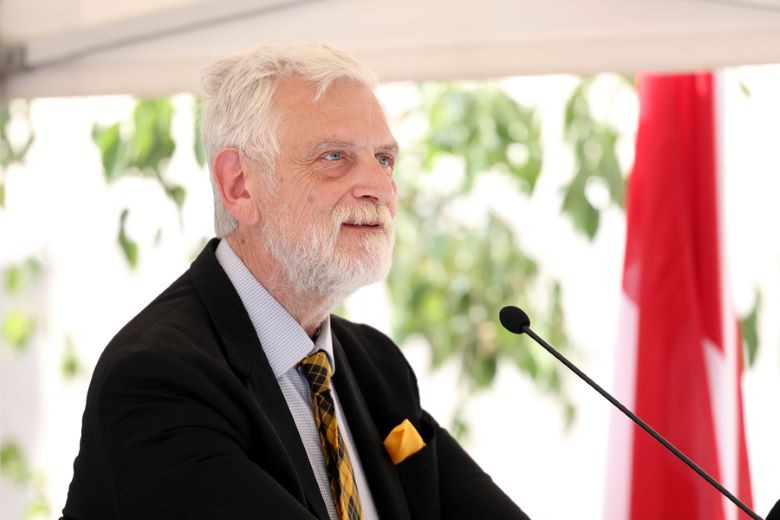
Greece’s Deputy Foreign Minister Yannis Loverodos has left the door open to reducing the Special Consumption Tax on fuel, should conditions in the energy market deteriorate further. Speaking on ERT, Loverodos also addressed the government’s upcoming announcements ahead of the Thessaloniki International Fair, expressed support for the gradual restoration of the 13th and 14th pension payments when fiscal conditions allow, and confirmed that the Greece–Cyprus–Israel electricity interconnection project will be completed.
Loverodos: I won’t rule out a fuel tax cut if things spiral out of control
Commenting on fuel prices, the Deputy Foreign Minister stressed that the government is exploring ways to intervene, while acknowledging the significant impact that a reduction in the Special Consumption Tax would have on public revenues.
“I won’t rule out the possibility that at some point, under certain conditions and circumstances, it could happen — if things completely spiral out of control,” he said.
He clarified, however, that such a measure would result in a substantial loss of revenue and would limit the government’s ability to fund other public interventions.
“Do you know what reducing the Special Consumption Tax on petrol right now would mean for Greek state revenues? A very large reduction — and there would be no money left for other initiatives,” he noted.
On the possibility of a new intervention involving oil refineries, he made clear that he was not aware of any decisions having been made in that regard, and that such matters fall under the jurisdiction of the Prime Minister.
He also argued that the previous intervention had kept petrol prices in check, noting that without it, costs would have been roughly 10 cents per litre higher.
“The risk of a major energy crisis is a global problem”
Loverodos warned that developments in the Persian Gulf and the Middle East are creating heightened uncertainty for the global economy.
“The prospect of a major energy crisis that could trigger global disruption is the biggest challenge facing the world right now,” he said.
He argued that such a scenario could even affect artificial intelligence companies, given their significant energy demands, with potential knock-on consequences for financial markets.
In this context, he called for fiscal caution, rejecting proposals to immediately distribute the entirety of current budget surpluses.
“At this stage, we must be extremely careful and responsible to avoid a new fiscal derailment,” he noted.
Permanent measures, not one-off handouts, at the Thessaloniki International Fair
Regarding Prime Minister Kyriakos Mitsotakis’s upcoming announcements at the Thessaloniki International Fair, the Deputy Foreign Minister emphasised that the Prime Minister will present the government’s overall economic policy for the coming year.
He indicated that the measures to be announced will not take the form of emergency benefits or pre-election giveaways.
“What I know is that these will be permanent measures. They will not be one-off emergency measures,” he said.
He explained that such interventions cannot be based solely on a temporary budget surplus, as they require a stable and sustained fiscal capacity.
“You have to base these kinds of measures on the real, permanent capabilities of the Greek economy,” he stressed.
He also reiterated that elections are scheduled for spring 2027.
“I support restoring the 13th and 14th pension payments”
Loverodos stated that he personally supports the restoration of the 13th and 14th monthly pension payments, as well as equivalent bonuses for civil servants, while making clear that the Greek economy is not yet in a position to sustain such a commitment.
“Personally, I am in favour of not only the 13th, but also the 14th payment — and for civil servants too,” he said.
“They must be gradually restored, of course for both pensioners and public sector employees. I support bringing them back, but it has to come from what the Greek economy can genuinely afford,” he added.
According to him, “we are not yet ready for something like that,” but he maintained that restoration should move forward once the appropriate fiscal conditions are in place.
“The Greece–Cyprus–Israel cable will happen”
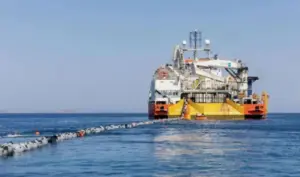
On the subject of the electricity interconnection between Greece, Cyprus and Israel, the Deputy Minister confirmed that the project will go ahead, without specifying a concrete timeline.
“When exactly it will happen, I don’t know, and it won’t be officially announced. It will happen when it happens — and it will happen,” he noted.
Loverodos described the project as one of international and European significance, primarily aimed at connecting Cyprus to the broader European energy grid.
He noted that European countries and international companies are involved in its implementation, and that the project is also receiving funding from the European Union.
He also argued that the interconnection has no bearing on the Greek-Turkish disputes over maritime zone delimitation.
“There is no issue involving Turkey here, and that is why I consider it unthinkable that any problem could arise in relation to this project,” he said.
He added that certain disagreements that had previously emerged between the parties involved have since been resolved, and that “the project will be completed as planned.”
Diplomatic responses to Turkish announcements
Regarding recent Turkish statements on maritime parks and spatial planning for renewable energy sources, Loverodos stressed that Greece’s responses are not issued “in the heat of the moment,” but only after careful analysis of the facts.
He noted that the statements issued by the Foreign Ministry were “very firm,” particularly in cases involving matters that could be linked to challenges against Greek sovereign rights.
He added that Greece will assert its positions at the United Nations, within the European Union, and before every relevant international body.
“All of this needs to be very well prepared and grounded in the principles of international law,” he pointed out.
The Deputy Minister also called on political parties to refrain from exploiting foreign policy and defence issues for partisan gain.
“Above all else comes our country, and we are its servants. On national issues, there must be unanimity,” he said.
“Greece is not participating in any war”
Turning to Greek-owned shipping and developments in the Strait of Hormuz, Loverodos argued that the protection of maritime trade routes directly affects the Greek economy and consumers.
He noted that Houthi attacks have caused disruptions to maritime transport and forced vessels onto longer, more costly routes, resulting in higher prices for goods.
“When the shipping route gets longer, the product gets more expensive,” he said.
He also defended the deployment of a Greek frigate to protect shipping lanes and the stationing of a Patriot missile battery in Saudi Arabia, arguing that these moves serve to safeguard transport security and ensure the smooth flow of oil.
“We are not participating in any war. We are supporting Greek-owned shipping, and of course we must do so, because it is critically important for the interests of both Greece and the Greek people,” he concluded.