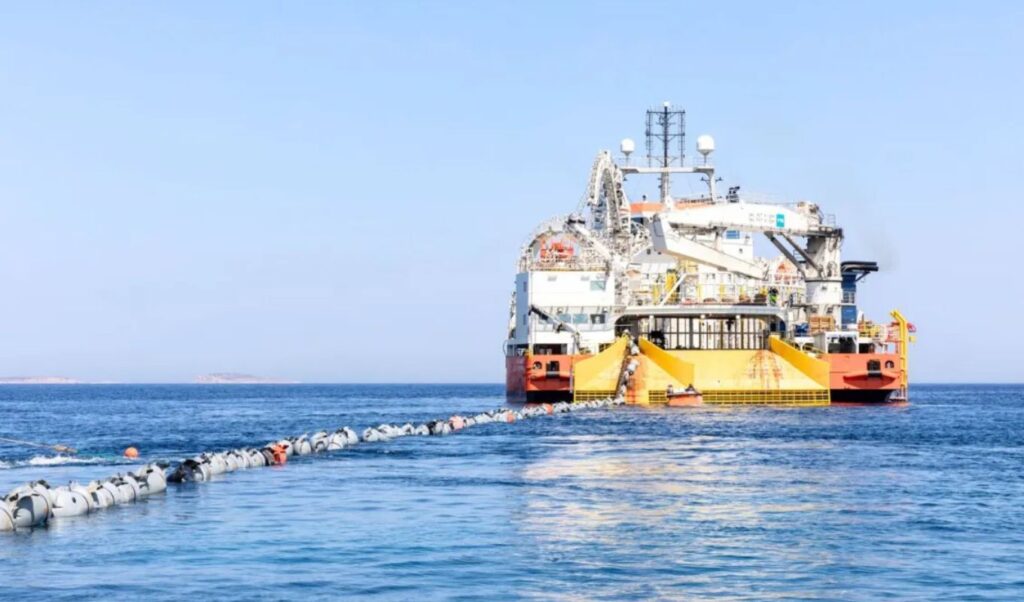
The submission of an investment request to the regulatory authorities of both countries by ADMIE, as the implementing body of the Great Sea Interconnector (GSI) project, signals a major acceleration in the electrical interconnection between Cyprus and Israel, in accordance with the provisions of the European regulatory framework. The Cyprus-Israel segment of the interconnection is considered a particularly challenging undertaking, as it requires resolving not only bilateral issues between the two countries but also significant technical hurdles — with an offshore cable length of approximately 324 kilometers and a laying depth ranging between 2,200 and 2,400 meters. Nevertheless, the Greek side remains optimistic, stressing that project completion is viable under all scenarios.
Before moving forward, however, a precise agreement must be reached between the regulatory authorities of Greece, Cyprus, and Israel on how costs and benefits will be distributed among consumers in each country — a determination expected to be made in the near future. The submission of the investment request is a prerequisite for launching the evaluation process by the competent regulatory authorities of Cyprus and Israel, with the aim of reaching a cost-sharing agreement between the two countries, to be recovered through the project’s revenues. In any case, the interconnection is advancing at a rapid pace, with the goal of enabling bidirectional electricity transmission and allowing for the reversal of power flow direction. This development is consistent with the Greek government’s firm commitment to promoting the GSI as a project of exceptional geopolitical and energy significance for Greece, Cyprus, Israel, and Europe as a whole. It comes just days after the signing, at the Maximos Mansion, of the ADMIE-Meridiam agreement — marking the entry of the French investment group into the Great Sea Interconnector company — and following a phone call between Greece’s Minister of Environment and Energy, Stavros Papastavrou, and his Israeli counterpart, Eli Cohen, to advance the Cyprus-Israel electrical interconnection.
These successive developments are building powerful momentum toward the realization of the overall project, at a time when international support appears stronger than ever. The European Union regards the GSI as a Project of Common Interest (PCI) and backs it with the largest grant ever awarded to a Cypriot infrastructure project, while simultaneously rejecting Turkish objections. The United States, for its part, views the project as a pillar of geopolitical stability and a natural extension of the IMEC economic corridor. Bipartisan support in the U.S. Congress, combined with interest from the state investment fund DFC in participating in the project, provides a significant diplomatic umbrella for the entire endeavor. ADMIE is in continuous cooperation with the competent authorities of Cyprus and Israel, transmission system operators, and all relevant stakeholders from both countries, with the aim of advancing the necessary technical, regulatory, and financing actions. The Greek side’s goal is to attract additional investors for the Cyprus-Israel segment as well, following the model established in the first leg of the project — the Greece-Cyprus interconnection — with the entry of Meridiam into the investment scheme.