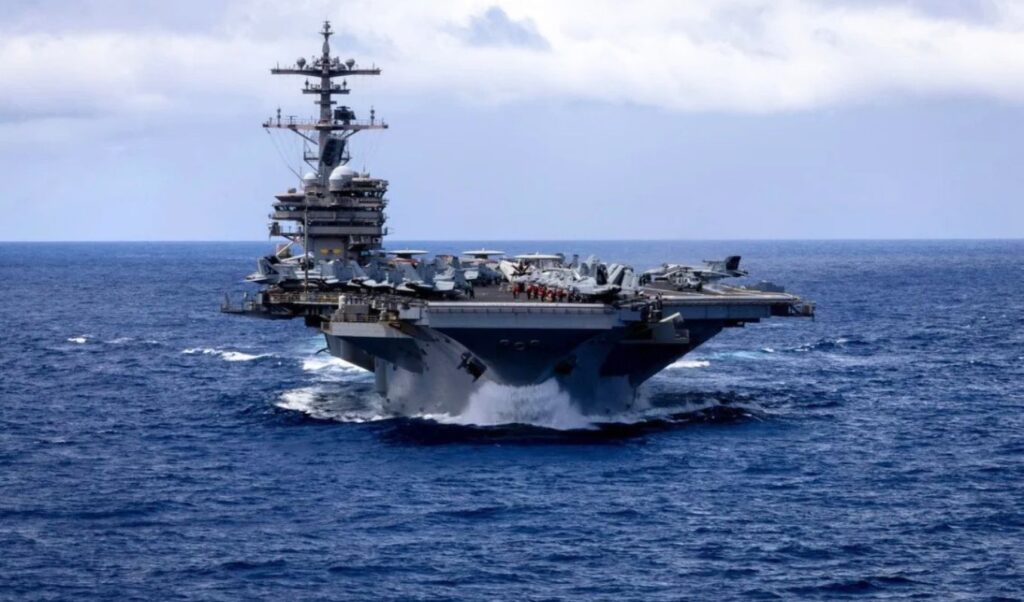
The United States is moving forward with a planned redeployment of its naval forces in the Middle East, with the aircraft carrier USS Abraham Lincoln heading home and another American carrier preparing to take its place.
Trump confirms USS Abraham Lincoln is departing the Middle East
US President Donald Trump confirmed the departure of the USS Abraham Lincoln while speaking to reporters at Andrews Air Force Base, near Washington, shortly before departing for New York. He stated that the carrier is already on its way and will soon be replaced by “a very similar ship,” emphasizing that this is a routine rotation of forces and not a US withdrawal from the region. Donald Trump also dismissed assessments that the USS Abraham Lincoln’s deployment had been extended for too long. When asked about it, he responded characteristically that its deployment had not lasted “nearly long enough.” According to a previous Wall Street Journal report, the US is preparing to send the USS George Washington to the Middle East, where it is expected to replace the USS Abraham Lincoln as part of the scheduled operational rotation.
Reporter: Family members of service members are concerned about conditions on the USS Lincoln.
Trump: No, they’re not.
Reporter: Has the deployment gone on too long?
Trump: No. No. No. Not nearly long enough. pic.twitter.com/24Z58NYFVf
— Clash Report (@clashreport) August 14, 2026
The USS Abraham Lincoln, carrying approximately 5,000 sailors and crew members, began its deployment in the second half of November, with its primary mission being to support US military operations in the Middle East. The deployment was initially expected to conclude in May, but its presence in the region was extended for several additional months. Meanwhile, Military Times had reported that during the extended deployment, particularly serious mental health incidents were recorded among crew members. The replacement of the USS Abraham Lincoln by the USS George Washington signals that, despite the return of one of America’s most significant warships, Washington is not scaling back its naval presence in the Middle East. On the contrary, it is maintaining its capacity for immediate military intervention and a strong naval air presence in the region through the continuous rotation of aircraft carriers.