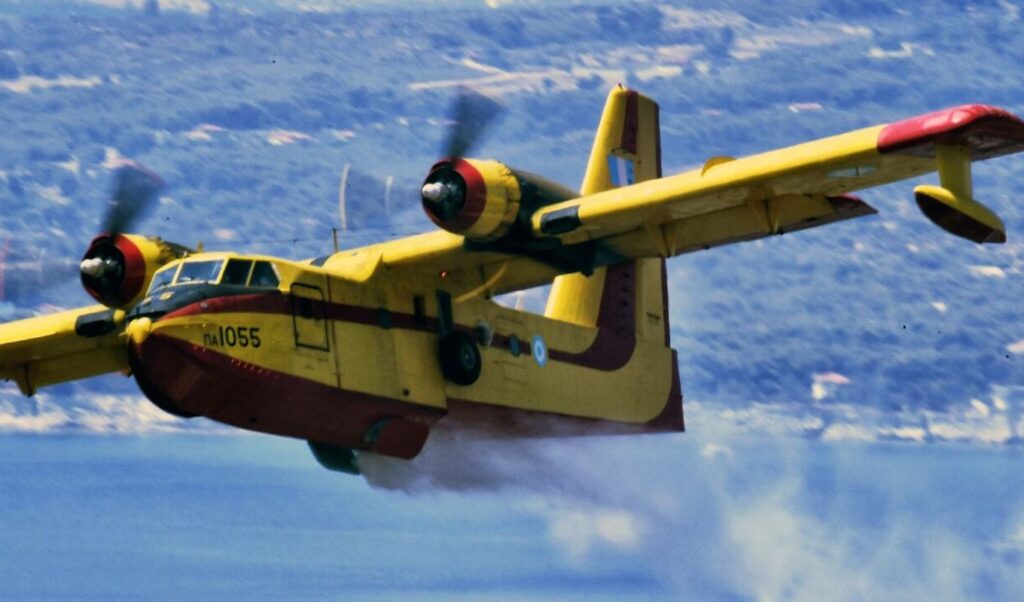
The upgrade of European aerial firefighting fleets is firmly back on the European Union‘s agenda, as this year’s wildfire season is shaping up to be one of the most devastating in the past two decades. Since early 2026, wildfires have scorched nearly 1.1 million acres, intensifying the urgent need for more powerful aerial firefighting capabilities. Greece has emerged as a leading force in this European initiative, championing the strengthening of the continent’s shared fleet.
At the heart of this initiative is an ongoing order for the next-generation Canadair CL-515 amphibious aircraft — a game-changing firefighting platform capable of carrying 6 tonnes of water, scooping a full load from seas, lakes, or rivers in just 12 seconds, operating in severely adverse weather conditions, and even conducting water drops at night, significantly enhancing aerial firefighting effectiveness.
Seven of the first CL-515s to fly in Greek colors
In its first phase, the EU has ordered more than 20 CL-515 aircraft to meet the needs of its member states. Greece is set to receive the lion’s share of the new Canadairs — seven aircraft in total — and will contribute two of them to the European Civil Protection Pool, which deploys reserves wherever they are needed most.
Greece was, in fact, one of the few countries that led the push for a collective European order of the next-generation Canadairs. The original production line run by Canadian manufacturer Bombardier had shut down in 2015 due to a lack of orders. A critical mass of interested EU member states was needed to convince fellow Canadian company De Havilland — which had since acquired the relevant rights — to restart production.
As far back as 2020–21, Greece was among the first countries to pursue initial orders, and gradually enough nations came on board to finalize the overall agreement between De Havilland and the EU in 2024. Since then, additional orders from individual member states have brought the total number of aircraft on order to approximately 40.
“I want to remind everyone — because a major debate is currently taking place across Europe regarding the firefighting resources available to the European Union as a whole — that it was Greece that led the effort, several years ago, to secure a pan-European agreement to restart the Canadair production line. All of this happened on Greece’s initiative, and Greece will be the first country to take delivery,” Greek Prime Minister Kyriakos Mitsotakis stated at today’s Cabinet meeting.
The fact that Greece will be the first country to receive the initial CL-515 was recently confirmed to Agence France-Presse by De Havilland’s head of strategy, Jean-Philippe Côté. The first delivery is expected in 2028. At present, European countries operate capable but aging CL-215 and CL-415 models.
Why the new Canadairs matter in the age of megafires
The new Canadairs could prove to be an invaluable weapon in the battle against megafires — infernos supercharged by climate change. Megafires, which Greece has faced repeatedly in recent years, share defining characteristics: they spread with alarming speed through parched vegetation, reach temperatures that overwhelm conventional firefighting methods, can jump firebreaks that were once considered more than adequate, and often remain ferociously active through dry summer nights — conditions under which nighttime humidity used to offer some relief to firefighters.
While there is no silver bullet against megafires, the Canadair’s rapid water-scooping capability offers a critical advantage for Mediterranean countries like Greece, where most fire fronts are relatively close to the sea, allowing the aircraft to make extremely frequent drops. Aerial assets rarely extinguish a forest fire outright, but they can strike quickly, slow its spread, and buy vital time for ground crews to deliver the final blow.