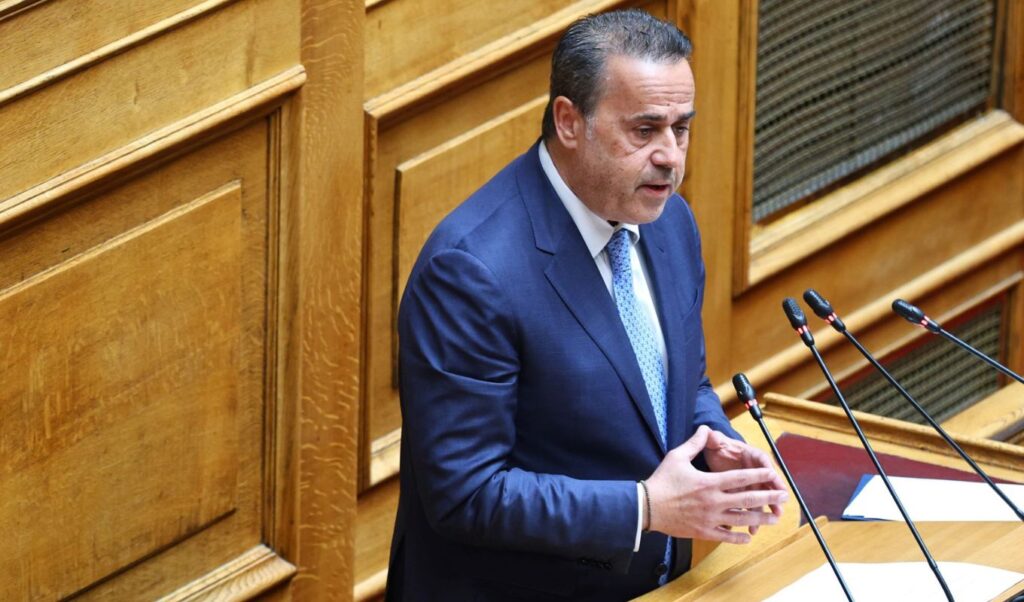
The Greek government has the necessary fiscal room to support households and businesses that may be affected by rising energy and fuel prices, said Environment and Energy Minister Stavros Papastaurou. Speaking on OPEN TV, the minister addressed the difficult international environment created by geopolitical developments — particularly the war in Iran — highlighting the mounting pressure on energy markets. Papastaurou made a pointed remark about fuel pricing on OPEN TV, noting that “in the international oil market, when prices go up, they rise like a rocket — as the saying goes — but when prices come down, they fall like a feather.”
Read also: Parliament: Committee approves in principle the bill on expanding the powers of EYDAP and EYATH
When asked about the geopolitical turmoil in the Middle East and its impact on fuel and energy prices, the minister argued that the government’s prudent fiscal policy has generated the necessary budget surplus that can be deployed to support citizens and businesses, should the need arise.
Papastaurou: Exploiting hydrocarbons is the only way to stop depending on others
According to Stavros Papastaurou, the ongoing international turmoil validates the government’s strategy of boosting the country’s energy independence through the development of its hydrocarbons sector, which he described as “the only solution so that we are not dependent on others and are not affected, to the extent possible, by international disruptions.”
The minister also drew attention to the water management bill currently under parliamentary debate, stressing that the more than 735 separate water management bodies currently operating across Greece are synonymous with fragmentation and inefficiency.
As the minister explained, “no municipality can manage on its own the finances needed to invest in aging infrastructure. The current situation leads to widespread leaks, waste, and if we did not take steps to protect water for future generations, we would not be fulfilling our institutional obligations,” he emphasized.
Among other points, he noted that a core principle of the bill is the consolidation of resources around the publicly controlled utilities EYDAP and EYATH, which he said will create tangible operational benefits for citizens.