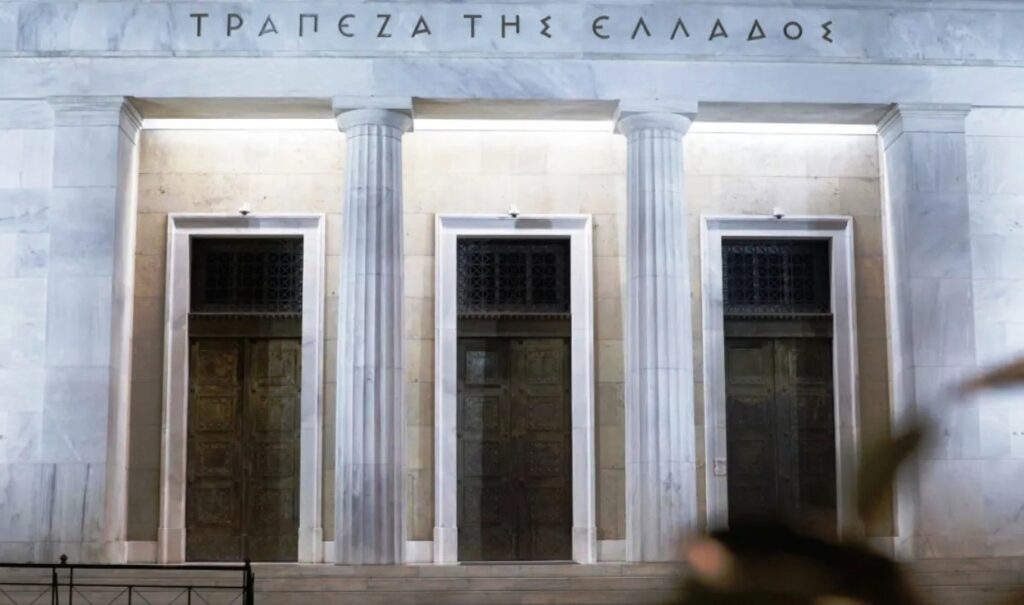
The Bank of Greece has imposed administrative fines totaling €2,273,325 in 2025 on banks, loan and credit management companies (servicers), insurance companies, as well as individuals and legal entities under its supervision, following violations identified during its inspections. According to the Annual Report on Prudential Supervision and Resolution Activities 2025, the majority of penalties were imposed on credit institutions, with significant weight given to cases involving the prevention of money laundering and terrorist financing. Of the total fines, €1.908 million relates to banks, while €233,400 was imposed on credit servicers. In several cases, in addition to financial penalties, institutions were required to implement specific corrective measures to prevent the recurrence of similar violations.
Read also: Stournaras: “The international community is talking about an economic miracle” — “We are right to pay off our debt with our surpluses” (Video)
Bank of Greece: Nearly €1.9 million fine for money laundering violations
According to the report, during 2025 13 violations of the regulatory framework for Anti-Money Laundering and Counter-Terrorist Financing (AML/CTF) were identified at a single credit institution. A total fine of €1,891,050 was imposed for these violations, and the institution was simultaneously required to implement corrective actions to strengthen its compliance procedures.
In total, during 2025 the competent Credit and Insurance Affairs Committee of the Bank of Greece identified 38 violations of the supervisory framework, involving credit institutions, insurance companies, credit servicers, as well as individuals and legal entities under the Bank of Greece’s supervision. Administrative sanctions were imposed in all cases, while in certain instances additional corrective measures or compliance with the supervisory authority’s recommendations were also required.
Inspections and priorities for 2026
During 2025, four on-site inspections were carried out to assess compliance with anti-money laundering legislation, covering two credit institutions — one significant and one less significant — as well as two payment institutions. Two additional inspections that had commenced in 2024 were also completed.
The inspections focused on anti-money laundering policies and procedures, the information systems used to monitor transactions and detect suspicious activity, as well as the procedures for assessing and reporting suspicious transactions to the relevant authority. Additionally, risks related to Information and Communication Technologies (ICT) were examined, particularly with regard to the specialized information systems used for money laundering prevention.
The report notes that the inspections revealed weaknesses in both internal policies and procedures, as well as in customer due diligence measures and transaction monitoring systems — findings that led to the imposition of sanctions and demands for immediate compliance.
Outlining the key priorities for 2026, Bank of Greece Governor Yannis Stournaras emphasizes that the supervisory objective is to further strengthen banks’ resilience against geopolitical risks, international economic uncertainty, and cybersecurity threats. Particular emphasis is also placed on the application of prudent lending standards, monitoring of loan restructuring solutions, and improving the corporate governance of servicers, with the aim of achieving more effective receivables management and enhancing transparency in their relationships with borrowers.