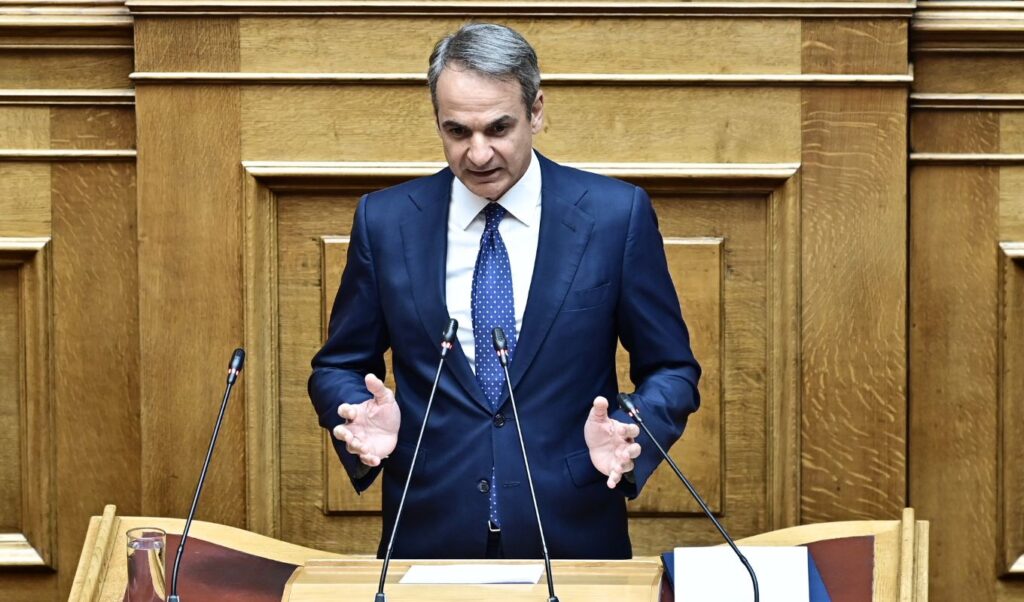
New Democracy is looking to capitalize on the constitutional revision process to present a political platform of institutional reforms, frame pre-election dilemmas for voters, and simultaneously highlight its differences from opposition parties.
Yesterday’s first parliamentary vote saw none of the 33 proposed revision articles reach the required threshold of 180 MPs, with only New Democracy lawmakers and a handful of independents voting in favor. As a result, it will be the parliament formed after the 2027 general elections that will decide — in its opening session and by a majority of at least 180 MPs — on which articles are to be revised.
Mitsotakis to seek voter mandate for constitutional reforms at the elections
This outcome gives New Democracy the opportunity to incorporate its proposed institutional changes into its pre-election campaign messaging, since it will ultimately be the voters who decide — through the ballot box — whether those changes move forward. “The elections will be held in 2027, and our electoral campaign will also be built around our constitutional revision proposals, as we believe popular legitimacy is required — in the sense of putting these issues before the electorate ahead of the next elections,” Prime Minister Kyriakos Mitsotakis said recently.
At the same time, it gives New Democracy a fresh opening to go on the offensive against PASOK, which the ruling party accuses of political deception after the opposition voted “present” on 15 articles it had previously said it agreed with in principle. Responding to PASOK’s “present” and “no” votes, government spokesman Pavlos Marinakis argued that this stance “on the part of Mr. Androulakis, following a long series of prior decisions, represents the culmination of his deliberate choice to turn his party into a protest party of sterile refusal and regression. The citizens will be the final judges.”
In his closing remarks during the plenary debate on the constitutional revision last Friday, the Prime Minister concluded as follows: “So if the Greek people, Mr. Androulakis, trust us and we have a majority, they will know very well what constitutional changes will follow. We have hidden nothing from anyone. We will seek popular legitimacy for these changes too — and, you know, citizens know why they vote for New Democracy. The big problem is that no one understands why they should vote for PASOK.”
During yesterday’s debate, which preceded the vote, government officials who took the floor directed sharp criticism at PASOK — and also at SYRIZA — for its stance, with an eye firmly on the so-called battle for the political center, from which New Democracy is seeking to draw PASOK voters. “SYRIZA, for example, tells us on the one hand that it will not repeal the new framework for non-state universities, but on the other that it will not vote for the revision of Article 16. PASOK, however, says the opposite — that it will vote for the revision of Article 16, while at the same time continuing to reject the law that paved the way for that change, even though this constitutional framework was supported by prominent constitutional scholars from within their own political camp. The contradiction is now deafening. The opposition is not clashing here with the government — it is clashing with its own positions and with the distance that separates those positions from the reality of 2026,” said Minister of National Economy and Finance Kyriakos Pierrakakis.
Deputy Prime Minister Kostis Hatzidakis placed particular emphasis on the ruling majority’s proposals to constitutionally enshrine the Greek language and flag. “There is no consensus even there. I wonder what logic lies behind this approach — whether there is any logic at all, or whether partisan passion has blinded them. I hope and wish that, even at the last moment, there will be at least one exception made for the flag and the language,” he said in his address.
The key changes
The government camp is expected to place particular emphasis on the following changes that would take effect should the required 180 votes be secured in the next parliament:
- Artificial intelligence is introduced into the country’s constitutional text for the first time, as follows: “Artificial intelligence must serve individual freedom and the well-being of society, so that its risks are mitigated and its benefits are harnessed.”
- The state’s monopoly on higher education is broken, opening the door to “the possibility of providing higher education by university-level legal entities, which may be of a public or private nature, with full self-governance, under state supervision and subject to ensuring a high standard of studies provided.”
- The ability to dissolve parliament over a national issue of exceptional importance is abolished. Dissolution will instead take place on the government’s proposal and by a parliamentary decision to renew the popular mandate (self-dissolution of parliament).
- With 2015 in mind, rules for the proper conduct of referendums are introduced: the question must be formulated in a clear and comprehensible manner for citizens, and a sufficient period of at least 20 days must elapse between the calling and the holding of the referendum.
- Greeks living abroad will gain the ability to exercise their right to vote by postal ballot.
- With an eye on the pre-memorandum era, a constitutional provision is introduced stating that “the budget must ensure sustainable fiscal operation.”
- Under the contentious Article 86 on the criminal prosecution of ministers, the procedure is revised as follows: investigation, preliminary inquiry, or preliminary examination to be conducted by a Court of Appeals prosecutor, with a proposal to prosecute to be made by a supreme judicial body. The requirement for immediate transmission of evidence to parliament is abolished, as is parliament’s authority to conduct preliminary examinations. The prosecution of government members or deputy ministers for criminal offenses committed in the exercise of their duties will require a parliamentary decision by an absolute majority of the total number of MPs, by roll-call vote.
- For the first time, the country’s constitutional text enshrines “an obligation to evaluate public servants, based on the principles of impartiality, neutrality, professional competence and efficiency, with the possibility of participation by the Supreme Council for Civil Personnel Selection.”