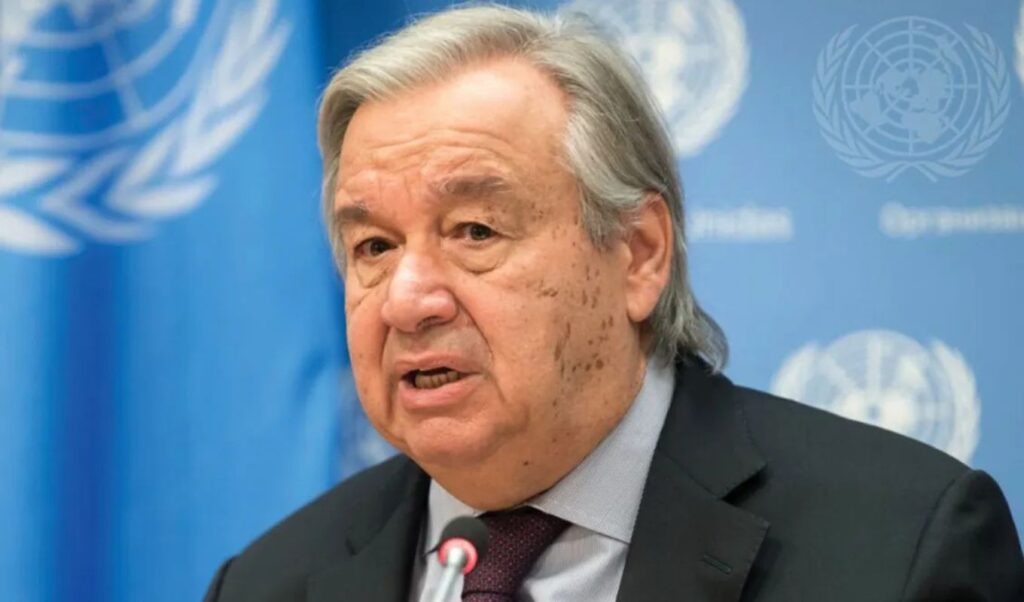
With strong indications that UN Secretary-General António Guterres is set to announce the convening of an Expanded Meeting on the Cyprus Problem, the Republic of Cyprus is welcoming the UN chief this evening. According to credible diplomatic sources speaking to parapolitika.gr, the primary objective of Guterres’ visit to the island — his first in 16 years — is to lay the groundwork for the “next step” and the resumption of “substantive” talks that will once again put the Cyprus issue on a path toward a lasting solution.
Toward an expanded meeting on Cyprus: the significance of Guterres’ visit to Nicosia after 16 years
The European Union appears to be taking on a leading role in efforts to restart negotiations. Its latest moves signal a strategic push to elevate its presence and break the longstanding deadlock. Senior analysts note that the recent appointment of EU Special Envoy for Cyprus, Raffaele Fitto, has helped prepare the ground for the resumption of talks. Additionally, European Commission President Ursula von der Leyen has maintained an open line of communication with the UN Secretary-General in an effort to capitalize on the current momentum. EU High Representative Kaja Kallas, in her meeting last week with the Secretary-General’s Personal Envoy, María Ángela Holguín, in Brussels, reaffirmed the EU’s continued and resolute support for the UN’s efforts.
A key driver behind Brussels’ engagement is the prospect of thawing EU–Turkey relations across critical areas. As Cypriot diplomatic sources put it: “They are pushing — I’m not sure we can use exactly the word ‘pushing’ — but they certainly have a particular interest, because they want good cooperation with Turkey. We want exactly the same, and so does Greece. We believe this is a framework that can be beneficial for everyone.”
The European programs Turkey is seeking to join serve as potential incentives for Ankara, most notably its participation in the SAFE defense program — which Greece currently vetoes — the lifting of visa restrictions (a longstanding Turkish demand that faces reservations from countries such as France), and the upgrading of the Customs Union, which is currently blocked by the Republic of Cyprus.
The EU’s mission is not without obstacles. There is deep mistrust on the Turkish Cypriot side, and Turkey’s approach is being interpreted as a classic “bargaining” tactic, where hardline rhetoric is deployed to maximize gains ahead of any final decisions. As well-informed sources within the Republic of Cyprus assess, despite the tough stance, the other side is ultimately seeking to project an image of constructive engagement. “Turkey’s tactic of hardening their rhetoric and their approach ahead of decisions they’ll be called upon to make is nothing new. It’s just different now. Whether they’ll stick to this approach or make some adjustment that allows things to move forward remains to be seen. They’re trying to extract as much as possible right up until the end,” the same sources told parapolitika.gr.
Meanwhile, the Turkish side is maintaining a wait-and-see attitude regarding the intentions behind the UN Secretary-General’s visit to Cyprus. Turkish media outlets are expressing cautious skepticism as to whether any new proposal will take Turkish demands into account or revert to past frameworks. As Hürriyet notes, the coming days are critical for the Cyprus issue, linking Guterres’ visit to broader geopolitical developments and the exploitation of energy reserves in the Eastern Mediterranean. In a meeting held the day before yesterday in Turkey, Foreign Minister Hakan Fidan reiterated to Holguín that Turkey, as a guarantor power, considers the most realistic solution to the Cyprus Problem to be the coexistence of two separate states on the island. At the same time, within the Turkish Grand National Assembly, the Cyprus issue was sparking tensions, with proposals even emerging to rename the breakaway state the “Cyprus Turkish Republic,” on the grounds that Turkish Cypriots have rights over the entire island and its resources. Notably, the Turkish opposition has argued that under the Erdoğan government’s current approach, Turkey is losing significant ground on the Cyprus issue.
The issue nonetheless appears to be entering a new phase of consultations. António Guterres arrives in Cyprus this evening, traveling from Syria, and on Tuesday will hold a crucial meeting with President of the Republic of Cyprus Nikos Christodoulides, followed immediately by a meeting with Turkish Cypriot leader Tufan Erhürman. On Wednesday at noon, following a joint meeting of all three parties, a press conference is expected to be held at which the outcomes of the talks will be announced.