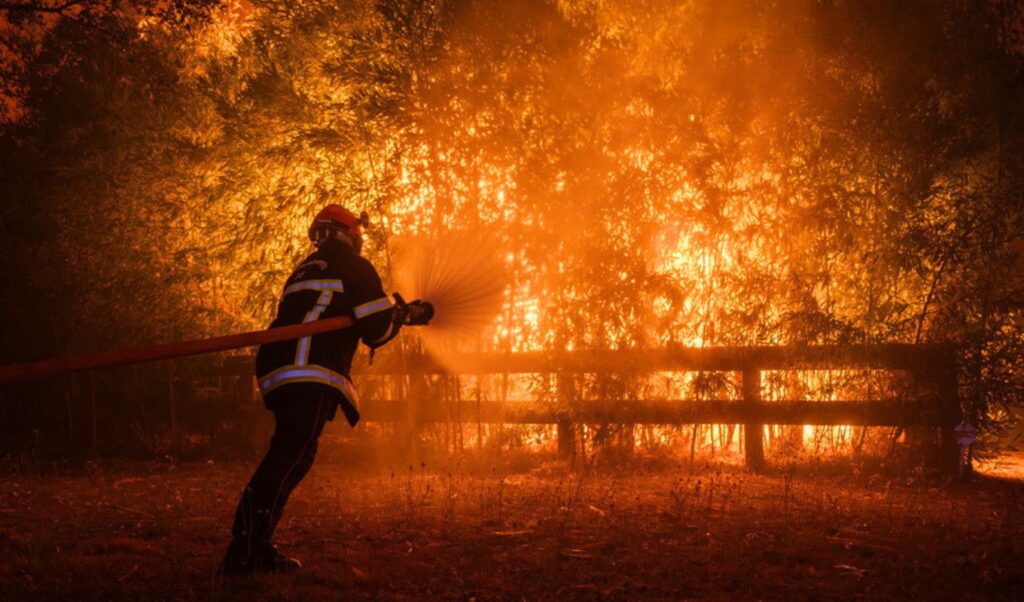
The devastating wildfire crisis in France continues to rage out of control, with firefighters battling to contain the wildfires threatening the Bordeaux region. Evacuations are ongoing as authorities remove increasing numbers of residents from surrounding suburbs. Southwestern France has been ravaged by the fires during an intense summer heatwave that has swept across much of Europe. Meanwhile, in Spain — where the government declared a national state of emergency — the situation appears to be improving. Large sections of the Madrid wildfire have now been brought under control, according to a senior officer from Spain’s Military Emergency Unit (UME). However, a separate fire in Valencia claimed the life of one elderly person.
France: Fire spreads near Bordeaux — mass evacuations underway
A massive wildfire in southwestern France continues to burn uncontrolled, threatening the area around Bordeaux, with authorities announcing that more than 220,000 people have now been evacuated from danger zones.
“During the night, the fire was observed spreading at a rapid rate,” local authorities responsible for the Bordeaux region said in a statement today.
The Bordeaux region is world-renowned for its vineyards, and the city serves as a major transit hub for tourists visiting nearby Atlantic coast resorts.
🔥🇫🇷 URGENT l Les flammes sont à 20 kilomètres de Bordeaux. (Bordeaux Métropole / LCI) pic.twitter.com/vKvpOHSnx5
— – Le Direct Info 🔴 (@LeDirectInfo) July 25, 2026
An additional 55,000 people were ordered to evacuate villages in the area overnight, as the fire intensified under strong wind conditions. A further 30,000 residents were displaced by a second major front in the Landes department to the south.
The French government reinforced firefighting operations by deploying an additional 500 soldiers, bringing the total number of military personnel on the ground to 1,500. According to the Defense Ministry, troops are assisting with evacuation operations and protecting homes abandoned due to the emergency.
Local farmers also volunteered to help firefighters on the ground. “We came to help because if it were our area, we would want others to do the same. And given the scale of the disaster, we believe our efforts are very much welcome,” said 65-year-old farmer Pascal Roudier. So far this July, temperatures in the Aquitaine region have averaged 32.2°C — some 7.3°C above the monthly maximum average recorded between 1961 and 1990, according to the Reuters Climate Monitor.
Le Cornu: The coming hours could be difficult
French Prime Minister Sébastien Le Cornu warned that “the coming hours could be difficult,” as weather forecasts worsened and conditions made containment efforts increasingly challenging. Interior Minister Laurent Nuñez stated that the firefighting operation would be a “long battle,” making clear that residents who have evacuated will not be allowed to return until the fire is brought under control.
Strong winds have also caused significant disruption to transportation. A roughly 60-kilometre stretch of the A63 motorway connecting Bordeaux to the Spanish border has been closed, while French rail operator SNCF suspended train services across approximately 100 kilometres south of Bordeaux.
Wildfire fronts across France
Authorities also announced the arrest of three men in the Gironde department on charges of endangering human lives. Two of them are allegedly connected to incidents involving the use of fireworks, while more than 32,000 hectares of land have already burned in the area.
In the Var department of southeastern France, around 2,000 people remain unable to return to their homes, as the fire in the Pontevès area remains “very active,” having burned through 4,000 hectares in five days. In Corsica, firefighters continue working to contain a blaze near the town of Corte, where more than 800 hectares have been destroyed.
The scale of the disaster in France even affected the country’s premier cycling event. Tour de France organizers announced they had shortened the final stage route from Thoiry to Paris, in a gesture of solidarity with the regions and communities devastated by the wildfires.
Madrid: Gaining the upper hand against the flames
Large sections of the Madrid wildfire have now been brought under control, according to a senior officer from Spain’s Military Emergency Unit (UME). Speaking on public broadcaster RTVE in the morning, Lieutenant Colonel Alfonso Arribas said significant progress had been made in containing the blaze.
“Significant progress has been achieved across the entire fire perimeter,” he said. “At this moment we can say that the main front has essentially been brought under control. There are only a few active hotspots where operations are ongoing, and we hope that today’s conditions will allow us to work on the areas still out of control. Under no circumstances, however, are we talking about the entire perimeter.”
New evacuations — situation remains critical in Valencia
The wildfire crisis has also intensified across Spain, where at least 60,000 people have been forced to flee areas around Madrid due to exceptionally dry conditions, heatwaves, and powerful winds accelerating the spread of the fires.
In eastern Spain, firefighting forces are battling a major new front near the coastal city of Valencia, where approximately 15,000 people have already been evacuated from their homes, according to AFP.
The president of the Valencia region, Juanfran Pérez Llorca, said the situation remains extremely difficult, as the fire has exceeded immediate containment capacity. “The fire is beyond our ability to extinguish it. It has a perimeter of approximately 21 kilometres and it remains difficult to determine the number of hectares burned,” he stated.
Spanish authorities also ordered new evacuations on Saturday around Toledo, southwest of Madrid, describing the situation as complex, as wind gusts are driving the flames southward, according to the same source.
Residents of the municipalities of Buenaventura, Navamorcuende, Real de San Vicente, Hinojosa de San Vicente, Castillo de Bayuela, Garciotum, Nuño Gómez, and Pelahustán were ordered to leave their homes.
International forces are also participating in firefighting efforts, with aerial tankers from Portugal, Italy, and other countries reinforcing Spanish ground teams.
Spanish Prime Minister Pedro Sánchez stated that firefighters are working with the primary objective of saving human lives. In eastern Spain, one person lost their life in a separate fire in the Valencia region before firefighting forces managed to bring that particular front under control.