Eight years have passed since the afternoon of July 23, 2018, when Eastern Attica was engulfed in flames and Greece was plunged into mourning, living through one of the greatest tragedies in its modern history. For hundreds of families, however, time never truly moved forward. It stopped inside the homes that were swallowed by fire, in the cars that came to a standstill on the narrow roads of Mati, in the courtyards, on the shores and in the sea, where people fought for hours to hold on to life.
Some never had a chance to leave their homes — or simply couldn’t. Others were trapped inside their vehicles, desperately searching for an exit that never came. People unfamiliar with the area were funneled toward Mati after traffic was cut off on Marathon Avenue, finding themselves ensnared in narrow streets alongside residents and vacationers who were running with no information and no guidance.
Families were separated in the thick smoke. Residents knocked on doors to warn elderly neighbors. People made their way toward the sea not knowing whether they would ever reach it. Some were forced to jump from rocks, driven by the advancing flames. Others fell into the water and remained there for hours — exhausted and injured — waiting for help in the darkness.
Not everyone made it. Some drowned in their desperate attempt to escape the wall of fire. Others lost their lives just meters from the water’s edge. On a plot of land on Dimokratias Street, dozens of people were found embracing one another, having tried until their very last moment to reach the shore.
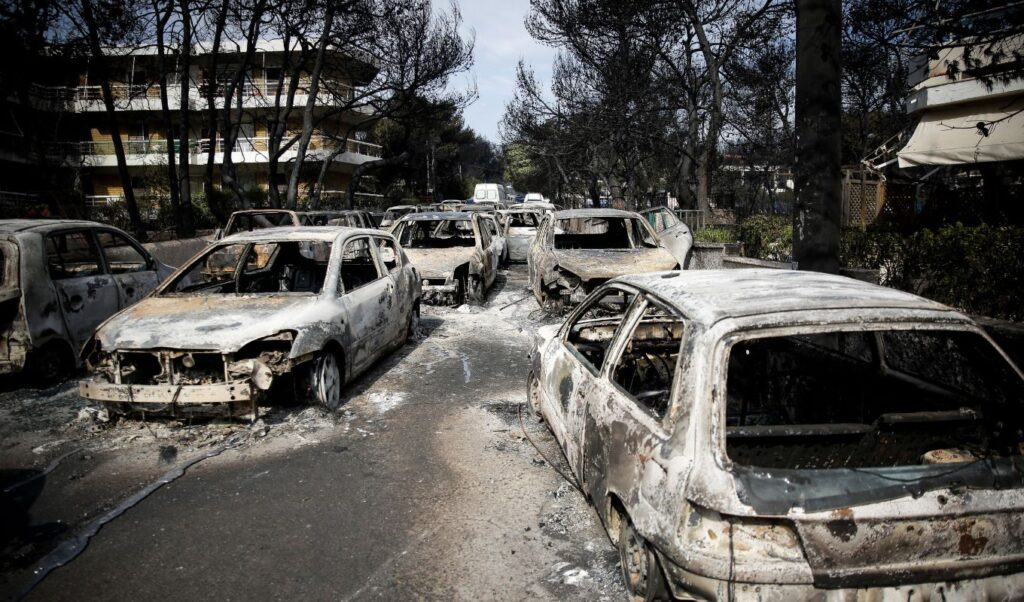
The following morning, rescue crews, relatives, residents and journalists were confronted with scenes of almost surreal devastation that the human mind struggled to comprehend: burned-out homes, melted cars, streets blanketed in ash and personal belongings scattered where people had fought their final battle for survival.
It was then that the true scale of the catastrophe began to emerge. In the days and months that followed, countless heartbreaking stories came to light — stories of people who were asleep and, with no early warning issued, never made it out of their homes; of drivers who had no connection to Mati but found themselves trapped within the fire’s path; of survivors who swam for hours; of burn victims who were saved, but who to this day remain in an ongoing process of physical and psychological recovery.
The fire left behind at least 104 dead, 57 burn survivors, and countless shattered lives. The question of “why” — formed on the lips of relatives and survivors — regarding the failures, the omissions, the absence of timely warnings, and the breakdown of state coordination has never been silenced. Eight years on, the wounds remain open. The families of the victims and the burn survivors continue to search for the truth, to demand justice, and to fight for what they consider the bare minimum: the protection of the memory and dignity of the dead, proper care for the living victims, and a full and honest investigation into everything that happened before, during and after the disaster.
Mati: Appeal to Greece’s Supreme Court over mass grave at Nea Makri cemetery
Just days before the eighth anniversary of the tragedy, the Association of Relatives of the Deceased and Burn Survivors of July 23, 2018 filed a complaint with the Prosecutor’s Office of the Supreme Court (Areios Pagos), requesting a criminal investigation into the mass burial site at the Nea Makri cemetery, as well as into the procedures followed for recording, identifying, handing over and burying the victims.
The complaint was submitted on Monday, July 20, accompanied by a file of official documents and supporting evidence. It calls for an investigation into whether all required procedures were properly followed and whether any criminal or other liability can be established.
Speaking to parapolitika.gr, the president of the Association of Relatives of the Deceased and Burn Survivors of July 23, 2018 in Eastern Attica, Kalli Anagnostou, explained that the aim is to shed light on everything that, based on the evidence gathered, remains unexplained. “We are waiting for everything that has not yet been clarified to be clarified — at least on the basis of the information that is currently available,” she said.
At the center of the complaint is the mass burial site at Nea Makri cemetery. The Association is seeking to establish exactly what has been interred there and whether the remains belong to unidentified individuals — or possibly even to victims who were already considered identified.
“It is an extremely sensitive matter and we are trying to handle it with the greatest possible care. Based on the evidence we have submitted to the Prosecutor’s Office, it appears that there are remains of unidentified persons,” she noted.
When asked whether the figure of 16 unidentified persons could be confirmed, she responded cautiously, stressing that the investigation must first be completed. “If what we have in our evidence is verified to be as we have seen it, then yes, the number is 16. What we do not know is who is included among them,” she said. One of the outstanding questions concerns a woman whose body was recovered from the sea after the fire, taken to the Schisto mortuary, and buried after a considerable period of time. “We do not know whether her remains are among those at the site, or whether this is yet another victim,” she explained.
At the same time, it cannot be ruled out that some of the remains may be connected to individuals whose bodies were previously considered identified. “Unfortunately, that possibility also exists. We want to identify these people, find out who they are, and examine whether there is any connection to victims who were already identified,” she stressed.
“A burn wound never fully heals”
Ms. Anagnostou speaks not only as the president of the Association, but also as one of the people who survived the fire with serious burns. “There are very significant challenges that we continue to face today, eight years on. A burn does not heal — especially when we are talking about severe burns. It does not fully recover,” she clarified. As she explained, the fight for burn survivors is no longer about achieving full recovery, but about maintaining their current condition and preventing further deterioration. “We are trying to maintain the state we are in so that it does not worsen. There is pain, there is a burning sensation, there is itching, and there are neurological and dermatological problems.”
When asked whether meaningful support is being provided, her answer was unequivocal. “No. And it is tragic that eight years on, we are still fighting for things that should be self-evident.” According to Ms. Anagnostou, this fight concerns both the dead and the living victims. “For eight years, relatives of the deceased and burn survivors have been fighting for everything that should be taken for granted — whether it involves establishing the truth about the victims who died, or the truth about the victims who lived, or protecting the honor and lives of both.”
“Justice has not been served”
Ms. Anagnostou’s position is unequivocal. “Under no circumstances can we speak of justice.” Those who were at the epicenter of the fire, she says, know exactly what happened and continue to live with the consequences of the actions and failures of that day.
“The consequences did not only determine how we came to be burned — they also determine how we must live afterward. They define the responsibilities of the state,” she noted.
In her view, there can be no vindication for as long as the state does not fully acknowledge what occurred. “When the state has not acknowledged what happened and continues to speak — even now — with falsehoods about the circumstances, then no, we have not been given justice.” She is clear, however, that this fight is not driven by a desire for revenge. “I don’t say this out of anger or vengeance. It is simple logic. When you don’t acknowledge your mistakes, you don’t correct them. Nothing gets fixed when you sweep it under the rug.”
“It was not an extreme natural phenomenon”
Ms. Anagnostou firmly rejects the narrative that the tragedy was the result of an extreme and unmanageable natural event. “It was not unregulated construction, it was not extreme winds, it was not some other extreme factor that led to this outcome. It was inaction, wrong decisions and the absence of actions that should have been taken,” she argued, stressing that the fire broke out at approximately 4:20 p.m. and that there was critical time available for warnings and intervention. As a telling example, she cited the evacuation of the summer camps at Agios Andreas, from which more than 600 people — the majority of them children — were safely evacuated in time. “They saw the fire, they requested an evacuation, and within about an hour the camps had been cleared. Yet during that same period, nobody thought to warn us,” she said.
In her view, residents believed the fire appeared out of nowhere precisely because they had no information about its progression. “If we had known that the fire had started at 4:20 p.m. and was moving toward the area, we would have acted in an entirely different way.”
How drivers were funneled into Mati
She also drew particular attention to the management of traffic on Marathon Avenue. According to her account, the police had not received the information they should have had about the direction of the fire and, in an attempt to clear the avenue, directed large numbers of drivers toward Mati and Kokkino Limanaki. “They sent everyone through Mati and Kokkino Limanaki, and everyone converged at the same points. People were not trapped because of the area’s layout. They were trapped because a massive number of people were suddenly funneled into the same location.” Many of those drivers, she notes, were unfamiliar with the narrow streets or the access routes to the sea.
The case remains open
Despite any impression to the contrary, the case has not been closed in the courts. According to Ms. Anagnostou, on September 16 the Athens Court of Appeal is expected to hear requests from convicted individuals seeking recognition of mitigating circumstances based on prior law-abiding conduct. Additionally, a new court hearing concerning burn survivors has been scheduled for November 11, while the complaint filed with the Supreme Court now also awaits investigation. “The case has not been closed — neither in the courts nor on a real level for us, because our dead do not return and none of us goes back to the life we had before,” she said.
“The case has not been closed morally either. Eight years on, we are forced to keep returning to the same issues — things that should have been addressed by the justice system and by state institutions. We are compelled to do what they should have done. And that concerns all of society,” Ms. Anagnostou concluded, emphasizing that any one of us could, at any moment, find ourselves in the position of the people of Mati, of Mandra, of Tempi.