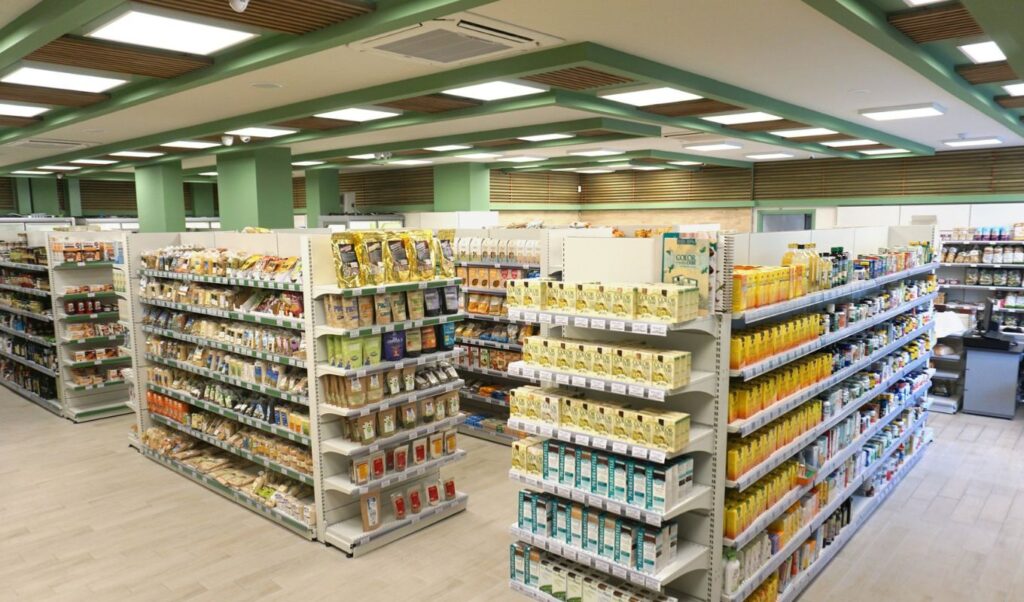
The debate over supermarket prices has become a high-stakes issue with multiple dimensions — both political and otherwise — especially with upcoming elections on the horizon. The government is attempting to establish a framework for containing or even reducing prices on essential consumer goods, at a time when the cost of living remains the top item on the public agenda. Indeed, yesterday’s meeting between Development Minister Takis Theodorikakos and representatives of supermarkets and suppliers had precisely this as its central objective: to secure price reductions exceeding 5%, as part of the development of a national strategy on the issue.
Yet once again, the issue that appears to have been left off the table among the parties involved is that of the financial benefits suppliers provide to supermarkets in order to secure “a place in the sun” on the shelf — and how this affects market dynamics and ultimately shapes the final prices paid by consumers.
A complex problem
The exercise is, in any case, far more complex than a simple agreement to cut shelf prices. Behind the final price the consumer sees lies a multi-layered system of commercial agreements between suppliers and retail chains. These include invoice discounts, credit arrangements, promotional allowances, secondary display placements, leaflet participation fees, logistics costs, centralized delivery charges, and additional fees for new product codes. Industry insiders explain that the total value of benefits a supplier provides to a major retail chain can exceed 40% of the list price — though this does not mean that the same percentage is passed on in full to the consumer. A portion of that 40% is reflected by supermarkets as a discount, another portion as a credit note, and yet another as a commercial allowance for promotion or distribution.
Centralized delivery to retail chain warehouses alone can burden a supplier with an additional 2 to 3 percentage points, while in some cases the actual logistics cost can climb even higher. This typically hits smaller suppliers the hardest — those who lack the distribution network and resources to deliver products store by store, and who therefore opt to deliver to the supermarket chain’s central warehouses, incurring the associated charges before their goods are distributed to individual outlets. In detail, the benefits involved include invoice discounts, credit notes, service fees, and a range of other mechanisms that are routinely applied.
For example, an invoice discount alone can amount to 23%. Among the more creative commercial arrangements in use are dedicated promotional periods for specific products — typically running ten to fifteen days — which serve to justify the additional benefits suppliers are expected to provide to supermarkets.
Shelf placement plays a critical role. Where a product ends up on the shelf is determined not only by the discount a supplier offers, but also by how fast that product sells. A high-turnover item can hold a strong position even if its supplier’s contribution is lower than that of a competing product. Conversely, for new product codes or additional promotional placements, the charges can be substantial. For premium display positions within large stores, the cost can range from €5,000 to €10,000 — before the cost of the promotional offer itself is even factored in.
Key pressure point
This is precisely what makes things difficult for the government. List prices are what show up most clearly in official data and in comparisons with other European markets. But actual purchase prices are often shaped by promotional offers, multipacks, and temporary discounts. When promotions are scaled back — as happened following the government’s implementation of the Code of Conduct — consumers can feel they are paying more, even if the nominal unit price has technically decreased.
What is now on the table is a commitment from both retailers and suppliers to deliver price cuts exceeding 5%, with the goal of producing visible results on the shelf by autumn. Supermarkets argue that their net profit margins remain slim — around 1.5% before tax — citing high operating costs including energy, payroll, logistics, advertising, and e-commerce. The government, on the other hand, believes that the growth in transaction volumes and the scale of commercial benefits being extracted leave meaningful room for more substantial price relief.
Hard bargaining behind the scenes
Behind the image of a product sitting on a supermarket shelf lies a complex web of negotiations that consumers rarely see. Shelf positioning, the number of product codes listed, promotional offers, secondary display placements, commercial allowances, credit arrangements, and logistics costs all form an equation that determines not only the relationship between supplier and chain, but ultimately the price that reaches the consumer. The first critical battleground is the planogram — the way shelf space is allocated across product categories. In many cases, according to senior industry executives, it is not the supermarket that exclusively controls this layout, but rather the category leader. In practice, this means a large, well-recognized brand with strong sales velocity holds a significant competitive advantage.
Shelf space does not open up simply because a supplier offers a higher contribution. It opens primarily when a product sells quickly, drives volume, and delivers a satisfactory margin. That is where the delicate balance lies. According to the same sources, if a supplier offers a larger contribution than a competitor, it may secure better treatment. But if the product does not move, the chain will favor the competitor that sells more — even if that competitor’s contribution to the chain is lower. For supermarkets, what matters is not just the percentage discount off the list price, but the final return per shelf square meter.
The “housewarming gift” effect
Commercial allowances represent one of the most complex chapters in the relationship between retail chains and their suppliers. It is not simply a matter of an invoice discount. There are rebates, credit notes, promotional activities, ten- or fifteen-day display campaigns in specific stores or locations within a store, leaflet participation, charges for new store openings, and centralization costs.
All of these eventually add up to form the total commercial contribution a supplier makes to a supermarket chain. A telling example is the practice of offering the first order free — meaning the supplier stocks the shelves at no charge when a new store opens. In this way, suppliers are routinely called upon to effectively “fund” a supermarket chain’s investment in new outlets. In industry circles, this practice is sometimes referred to as the “flowerpot” — a nod to the tradition of bringing a potted plant as a gift when attending a shop’s opening.
Alternatively, some chains set a fixed fee that they collect from their suppliers, for which a service invoice is issued, on the grounds that the supplier is receiving a service from the chain.
Entry fees
Particularly significant is what is known as the entry fee — the cost of getting a new product code listed on the shelf. When a supplier launches a new product, it may be required to pay for placement across a specified number of stores. From there, a fresh round of negotiations begins between the two parties, depending on store classification, network size, and the commercial appeal of the product. Presence in large, high-footfall stores carries a different value than placement in smaller outlets.
Secondary display placements represent an additional cost layer. High-visibility spots within the store — such as end caps, special promotional displays, or central freestanding units — each come with their own price list. A supplier pays extra to occupy such a space for a defined period and typically accompanies the display with a promotional offer on its products to drive consumer interest. As a result, the real cost is not only the fee paid for the space, but also the discount the supplier funds for the consumer.
Market distortions
At the same time, government interventions in the market, restrictions on promotional offers, and changes to how prices are displayed under the recently enacted Code of Conduct have introduced new distortions. The Code was designed to limit bundle promotions such as “buy 5, get 1 free” or “buy 2, get 1 free” deals — but the unintended consequence is that consumers are now pushed toward purchasing individual packs, which inherently carry a higher unit price than the same product sold as part of a multi-unit promotional bundle.
Originally published in Apogevmatini