The now-famous blue folders of the Greek government made their first appearance at the inaugural Cabinet meeting of the newly elected New Democracy government in July 2019: compiled under the supervision of Akis Skrekas, they contained detailed, ministry-by-ministry policy targets for the second half of 2019.
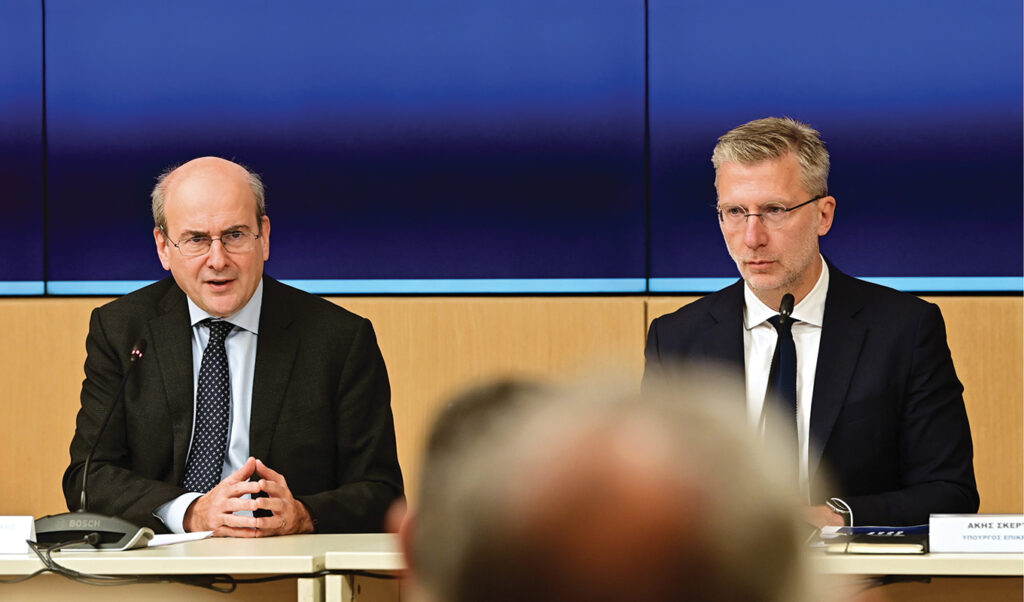
Seven years after that first Cabinet meeting, at last Tuesday’s final session, Deputy Prime Minister Kostis Hatzidakis and Minister of State Akis Skrekas presented what are effectively the last blue folders before the next national elections. In a far more concise format, they outline the thirty reforms the government must complete before the end of the year — closing out the scorecard of this four-year term and giving its record a reform-driven character ahead of the upcoming national elections.
Tax cuts, the Thessaloniki International Fair and the Recovery Fund in the government’s plan
Over the summer, a new package of tax cuts for citizens and businesses will be finalized and announced at the Thessaloniki International Fair (TIF). Meanwhile, the revision of the National Recovery and Resilience Plan is underway, along with the assessment of the 8th payment request, while the submission of the 9th (grants) and 8th (loans) requests is scheduled for the end of September.
Major infrastructure projects: The E65 motorway, Thessaloniki Metro and railway network
On the infrastructure front, the government is racing to complete a number of flagship projects on time: the full delivery of the E65 motorway by the end of July, the launch of the Thessaloniki Metro extension to Kalamaria in August, and — also within August — three key railway segments: “Domokos–Krannona,” “Palaiofarsalos–Kalambaka,” and “Larissa–Kileler.”
OPEKEPE, agricultural subsidies and the new Common Agricultural Policy
In the agricultural sector, urgent priorities include the rollout of a new, permanent digital system for farm subsidies and the strategic planning of a new Common Agricultural Policy (CAP). Regarding the integration of OPEKEPE (the Greek Payment and Control Agency for Guidance and Guarantee Community Aid) into AADE (the Independent Authority for Public Revenue), the process of dispatching 2025 Pillar I support payments has been completed — totalling €617.5 million distributed to 529,494 unique beneficiaries — while an online consultation platform for the 2028–2034 CAP is already live.
Affordable housing and social land-for-apartment schemes: The next steps
Among the 30 reforms is the establishment of Special Spatial Planning Frameworks (SSPFs) for renewable energy, industry and tourism: the public consultation on the Industry SSPF closes on July 10, and three SSPFs (Tourism, Renewables, and Industry) are due to be issued by the end of August. Also included is the launch of an affordable housing programme on four inactive military camps (Social Housing) and the first ten public properties (Social Land-for-Apartment Exchange). The Social Land-for-Apartment scheme will initially launch with eight properties managed by DYPA (in Paiania, Larissa, Pyrgos and Kalamata), delivering 400 apartments, while the Social Housing initiative is awaiting the signing of a joint ministerial agreement between the Ministries of National Defence and Social Cohesion, expected within July.
On the infrastructure front, the priority is the timely completion of flagship projects, including the E65 motorway, the Thessaloniki Metro extension and the new railway lines.
Regarding the upgrade of civil aviation security systems, the VCRS is currently being implemented, with the signing of a PBN contract and an air navigation systems contract for Kastelli both expected in July. For S-mode, a contract covering the procurement and operation of eight radars is scheduled to be signed in August, while the TOPSKY ATC1 contract is expected to be finalised by year-end. Additionally, the tender for upgrading and expanding the National VTMIS (Vessel Traffic Management and Information System) for safer and more controlled maritime navigation is expected to be published in September.
Healthcare: Electronic health records and hospital upgrades
In the healthcare sector, plans call for the expansion of interoperability across the National Electronic Health Record system: all interoperability links and the integration of patient data from 120 hospitals across the country are scheduled for completion within July. The government’s agenda for the coming months also includes completing the upgrade of 156 health centres and 80 hospitals, with 145 health centres and 80 hospitals to be finished by the end of August and the full programme wrapped up by year-end.
Regarding accessible beaches, 114 inclusion decisions have already been issued, with works expected to be completed within July. A further key reform involves the review and simplification of 400 procedures on the MITOS administrative platform. Still pending are the introduction of a Bureaucracy Measurement Index, the publication of 20 administrative burden assessments using the Standard Cost Model, and the digitalisation of financial sector procedures (a joint ministerial agreement between the Ministries of National Economy and Digital Governance is currently awaiting signature).
Education: School renovations through the “Marietta Giannakou” programme
In education, the Hatzidakis–Skrekas presentation — which has taken the place of the traditional blue folders — references the expansion of the “Marietta Giannakou” programme to at least 214 schools, with 238 renovated school buildings set to be handed over in September.
The presentation also mentions the transformation of Enterprise Greece, with a new organisational structure and an upgrade of the AGORA information system to be completed by December, as well as the modernisation of Export Credit Greece, with the Bank of Greece expected to approve a licensing file for the establishment of a subsidiary insurance company by year-end.
Defence: The new FDI frigates and the Armed Forces housing programme
Among the 30 reforms is the submission and approval by the European Union — and subsequent implementation — of the Greek Social Climate Plan, covering projects worth €5.3 billion, as well as a defence procurement programme involving the delivery of three new FDI frigates (“Kimon,” “Nearhos,” “Formion”). The “Kimon” has already been delivered, while “Nearhos” and “Formion” are expected by the end of 2026. As for the Armed Forces housing programme, 327 apartments have been built across 17 locations, with an additional 117 apartments in 9 locations to be completed by end-2026. Regarding the implementation of the Digital Work Card in the public sector, the agreement between the Ministry of Interior and the Information Society S.A. is pending signature, with the tender competition scheduled for December.
Additionally, all studies for the National Archaeological Museum must be completed before year-end. For the electronic border surveillance system (e-surveillance), the publication of the relevant tender is also expected by year-end. Running concurrently is the preparation for the Greek Presidency of the EU Council.
Finally, the government’s plan includes deliveries under the “Aegis 2025–2027” programme across its main categories, with a total budget of €2.16 billion. These include emergency communications stations and meteorological data systems for areas of interest, fire detection and suppression systems at 21 archaeological sites, equipment for volunteer organisations, the upgrade and integration of Next Generation 112 technologies, and equipment for the temporary accommodation of populations affected by natural disasters.
Published in Parapolitika