In a bold “checkmate move” in the circular economy market — with a focus on waste and water management — the AKTOR Group is making its play, following the announcement of a proposal submitted to Motor Oil for the acquisition of a 75% stake in ELEKTОР (ΗΛΕΚΤΩΡ) and THALIS. This move comes at a time when the circular economy sector is undergoing rapid and far-reaching transformation. Acquisitions, portfolio restructurings, and new business alliances are reshaping the competitive landscape, while investor interest in these sectors is experiencing a strong revival. Together, ILECTOR and THALIS form the largest environmental services group in Greece, with a backlog of projects approaching €600 million, according to Motor Oil’s 2025 financial results.
The two companies are therefore set to occupy a pivotal position in the sector’s next chapter, as their combined expertise and operational base cover virtually the entire value chain — from the design and construction of complex environmental infrastructure to the long-term operation of modern waste and water treatment facilities across the country. The AKTOR Group is making a strategic push into a market with significant growth potential, as investments in the waste management sector are estimated to approach €5 billion in the coming years — a figure that explains the group’s drive to strengthen its presence.
The developments surrounding this strategic partnership are not an isolated business move, but part of a broader framework of engagement between AKTOR and Motor Oil. It is worth noting that AKTOR is already in advanced talks with Motor Oil regarding joint participation in the Dioryx Gas floating storage and regasification unit (FSRU) project in Agioi Theodoroi, with a total capacity of up to 210,000 cubic metres. This investment remains pending its Final Investment Decision (FID), as rising construction costs — combined with the gradual withdrawal of European financing support for new natural gas infrastructure — have slowed the project’s progress. A partnership agreement with AKTOR, which has already secured significant contracts for the transportation of American liquefied natural gas (LNG), would further strengthen Motor Oil’s strategic planning.
ILECTOR serves as the operational arm of the group in the management and operation of waste treatment facilities, as well as in concession projects and public-private partnerships (PPPs). The company brings substantial experience in municipal solid waste management and energy recovery from waste, with operations in Greece, Cyprus, and abroad. It currently operates seven municipal solid waste treatment facilities in Greece and Cyprus, two hazardous clinical waste management units, and four energy production facilities that harness biogas from sanitary landfill sites. The combined installed capacity of these units exceeds 33 MW.
Its portfolio also includes new projects such as waste treatment plants in Agrinio, a waste management project on the island of Andros, environmental projects in Crete and Germany, as well as a high-efficiency combined heat and power (CHP) unit for PPC at the Kardia power plant. A key component of its portfolio is its participation in the waste management PPP for Western Macedonia — the first project of its kind to be tendered in Greece. At group level, ILECTOR recorded a marginal decline in turnover in 2024, to €99.3 million from €101.8 million in 2023, but reported a significant improvement in operating profitability. EBITDA rose to €21.9 million from €15.4 million, while net profit more than doubled, reaching €15.45 million compared to €6.95 million the previous year. The total headcount of the ILECTOR Group in 2025 stood at 725 employees.
THALIS, meanwhile, strengthens the group primarily in the field of environmental infrastructure design and construction, with activities spanning solid and liquid waste management, contaminated land remediation, and waste-to-energy conversion. The company has a strong footprint in the water circular economy, undertaking construction and upgrade projects for wastewater treatment plants. In Crete in particular, it is implementing projects related to the reuse of treated water for irrigation purposes, contributing to more effective management of the island’s water resources.
THALIS also has a significant presence in Crete and Northern Greece, and has expanded into the digitisation of environmental infrastructure and smart city applications. In this way, it brings to the group technical expertise in the construction of complex projects, as well as capabilities in sectors that are expected to be at the forefront of new circular economy investments. THALIS recorded strong growth in 2024, with turnover reaching €88.1 million, up from €63.9 million in 2023 — a rise of 37.8%. Net profit after tax came in at €5.16 million, compared to €4.13 million in the previous year, while earnings before interest and taxes reached €8.66 million. These results reflect a substantial expansion in the company’s business volume while maintaining solid profitability. Total headcount in 2025 stood at 169 employees.
The waste management market
The waste management market is on a trajectory of intense transformation, even as two critical pending issues remain unresolved: the update of the Regional Waste Management Plan (RWMP) for Attica, and the government’s final decisions on energy recovery from waste. These are two interconnected fronts that will determine both the map of new infrastructure and the financing potential for major projects in the period ahead.
Inevitably, Attica sits at the centre of these developments, bearing the greatest weight of pressure. Waste generation remains high, existing infrastructure is operating at or near capacity, and delays in the development of new projects are intensifying concerns about the system’s adequacy in the years ahead.
Against this backdrop, investor appetite for new infrastructure remains strong. The aim is to “unfreeze” the tender for the waste management facility at Schisto — which had stalled at the expression of interest stage — and to simultaneously launch a PPP tender for the upgrade of the Mechanical Recycling Plant (MRP) at Liossia.
At the same time, the Ministry of Environment and Energy has approved a “holistic plan” for separate waste collection in Attica. However, the critical challenge is no longer the drafting of new plans, but rather their translation into effective, measurable implementation on the ground.
New infrastructure and waste management facilities are expected to mobilise total investment estimated at around €3.5 billion. Of this amount, approximately €1.5 billion is expected to be directed towards energy recovery units, while around €1 billion will be required for the necessary waste treatment facilities in Attica. The remaining funds will be allocated to the development of other related facilities.
The market map is being redrawn
At the same time, the Greek waste management market is once again attracting interest from major international groups. The deal between Veolia and Mesogeios appears to be in its final stages, with the French giant advancing its agreement to acquire a majority stake. Barring any unforeseen complications, the transaction is expected to be completed in the near term, paving the way for Veolia’s dynamic re-entry into the Greek waste management sector. It should be noted that Veolia ranks among the world’s most powerful multi-sector environmental services groups, with a presence in 56 countries.
Several strong market players have already positioned themselves to compete for upcoming projects, with significant interest also being expressed by cement manufacturers Heracles and TITAN, both of which are vying for their own role in the unfolding landscape. Following the acquisition of TERNA Energy by Masdar, the GEK TERNA Group is taking on the waste management arm, continuing to operate — through PPP arrangements — processing units in Epirus and the Peloponnese. The group recently also prevailed in both tenders issued by the Waste Management Authority of Central Macedonia. In the recycling space, Heracles Group, a member of Holcim, strengthened its position through the acquisition of W.A.T.T. Recycling, gaining access to two Materials Recovery Facilities in Fyli and Koropi, with a combined annual capacity of 150,000 tonnes.
The past two years have been marked by significant shareholder changes at Mesogeios S.A., with Dionysis Georgopoulos and Angeliki Katsiou acquiring the 50% stake previously held by the Laskaridis family, completing their divestment in November 2023. This development restructured the company’s shareholder base and set the stage for the current acquisition process — at a time when Mesogeios has been expanding its footprint in waste and water resource management projects, with active facilities in Alexandroupolis and Ilia and a growing presence at the core of the circular economy.
New prospects in the water sector
Despite recent rainfall, water scarcity is becoming a structural challenge for Greece. Climate pressure, significant network losses — reaching up to 50% of drinking water in some areas — increased consumption driven by agriculture and tourism development, particularly on the islands, are all compounding the problem. Water storage projects, dams, network modernisation, water conservation and reuse are now moving to the forefront as measures to reduce losses and capture larger volumes of freshwater that currently flow unused into the sea.
Water is emerging as yet another field of major investment opportunity for the AKTOR Group. The recent signing of a cooperation memorandum with Suez International — following nearly four months of contacts and negotiations — fits precisely within this strategic direction. The agreement provides for an exclusive partnership with one of the world’s largest water management groups, and marks AKTOR’s positioning in the market for water infrastructure and water cycle services.
This move comes at a moment when interventions to address water scarcity and enhance climate resilience are expected to form a key pillar of the new investment cycle. It is also being interpreted by market sources as a sign of the group’s strengthening international connections, particularly given the participation of Global Infrastructure Partners — BlackRock’s infrastructure investment arm — in Suez’s shareholder structure.
As the government prepares new projects in water supply, irrigation, storage, and water reuse, the AKTOR–Suez partnership creates the conditions for participation in a broad portfolio of interventions, rather than individual standalone projects. The group’s position in the water infrastructure sector is further reinforced, especially if the partnership with Motor Oil is finalised — particularly through THALIS, which brings significant expertise in liquid waste management, wastewater treatment, and water reuse projects.
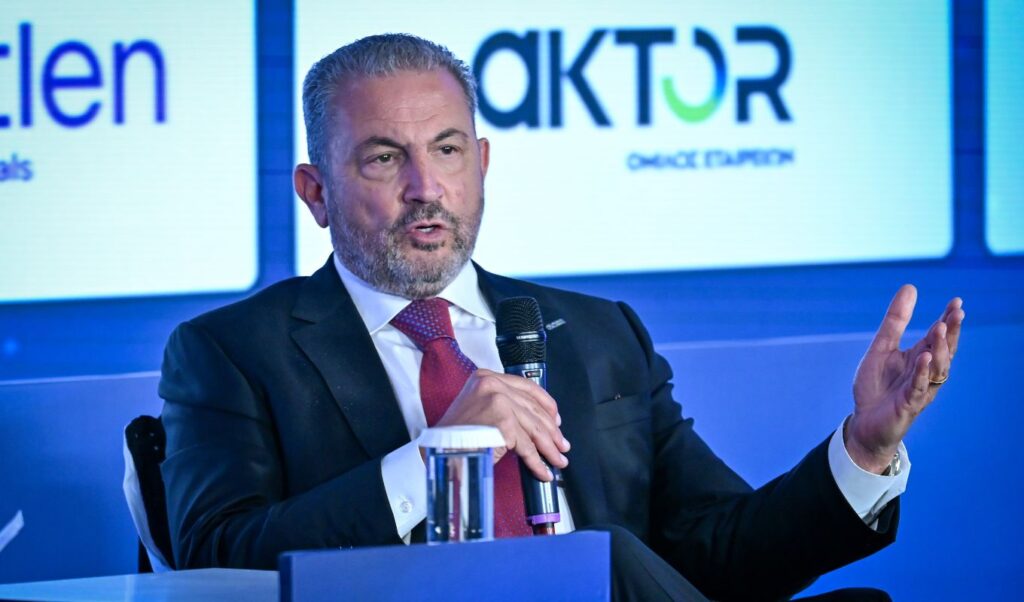
Taken together, the AKTOR Group is accelerating its transformation from a leading construction group into a vertically integrated regional player in energy and infrastructure, with a strong presence across renewables, LNG, concessions, construction, PPPs, and now the circular economy and water management. A €650 million share capital increase and the issuance of a €300 million bond — announced by Group CEO Alexandros Exarchou — are boosting the group’s financial firepower to deliver a €3 billion investment plan. The goal is to further expand into business activities with more predictable and recurring revenue streams, such as concessions, environmental infrastructure, and waste and water management.
The group is also raising the bar, targeting EBITDA of €600–700 million and revenues of €4.5–5 billion in the coming years, up from approximately €207 million and €1.4 billion respectively in 2025. The upcoming share capital increase is also expected to broaden the group’s shareholder base through the entry of institutional investors from Greece and abroad, while the commitment of core shareholders Winex Investments and Castellano to participate with a combined €300 million serves as a strong vote of confidence in the new strategic plan.
In this context, the bid for ILECTOR and THALIS is not an isolated transaction, but a link in a broader chain of moves that aims to transform AKTOR into a fully integrated energy, infrastructure, and environmental services group with a footprint across Southeast Europe.