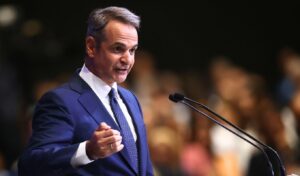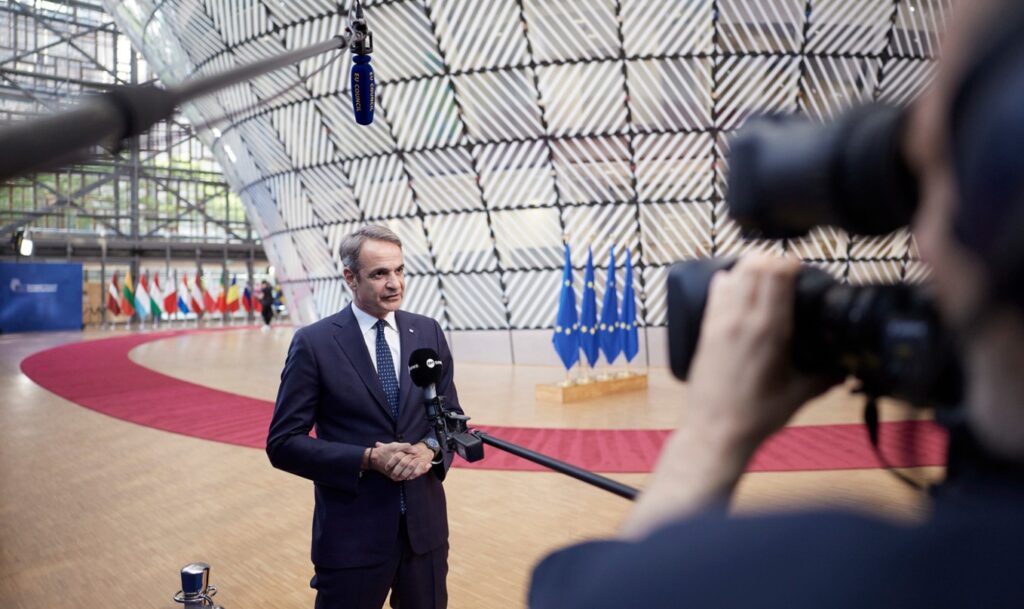
Prime Minister Kyriakos Mitsotakis weighed in on the latest developments in the Middle East during a statement following the conclusion of the Summit held in Brussels. The Greek Prime Minister stressed that ensuring freedom of navigation in the region is the central objective and the most significant achievement of the initial agreement that has been made possible.
Kyriakos Mitsotakis expressed his hope and wish that no turbulence would arise that could jeopardize this critical component of the agreement reached. “I hope and wish that there will be no disruptions that put this part of the agreement at risk,” he said, noting that a significant de-escalation in oil prices is a priority for all members of the European Council.
The Prime Minister left open the possibility of Greek participation in a security mission in the region, provided that there is international legitimacy at the United Nations level. “Greece would be willing to participate in some kind of mission, which should have international legitimacy at the level of the UN Security Council,” he said, clarifying that this is not currently on the table and that the goal is a return to the previous status quo.
Mr. Mitsotakis recalled that before the war began, passage through the Strait was completely free and there was no discussion of either imposing fees or a peacekeeping mission. “Greece has proven that it can be present in the field when required,” he stressed, adding that “should any additional contribution be required of us, we will not hesitate to make it.”
Kyriakos Mitsotakis on the European budget
On the European budget, Mr. Mitsotakis noted that the gaps between member states remain significant and that, while the goal is to complete negotiations by the end of the year, the task is far from easy. “It will be an extremely difficult negotiation. There are significant divergences,” he said, adding that “the aim is to conclude the negotiation by the end of this year,” but “right now there are very large gaps.” For Greece, he emphasized, safeguarding resources for cohesion and the Common Agricultural Policy (CAP) is a “non-negotiable priority,” while Athens expressed satisfaction with the provision for increased resources on migration.
Asked who can speak with Vladimir Putin on behalf of Europe, the Prime Minister made clear that the European Union is not seeking a mediating role. He stressed, however, that should a communication channel be needed, it must represent the European Council, as the decisions taken on the conflict concern all European leaders. As he put it, “in that case, it must be put forward by the President of the European Council.”
On migration, the Prime Minister described the new returns regulation as “yet another tool” in the arsenal available to Greece and Europe. He said Greece is particularly active in this area, and experience with returns to Egypt showed that once they began, the number of Egyptians arriving illegally in Crete dropped significantly.
Referring to the prospect of establishing asylum processing centers outside the European Union, he noted that this is a topic that has been under discussion for some time and can now be considered as an option. For Greece, however, he said, the immediate priority is curbing migration flows from eastern Libya to Crete. The Prime Minister spoke of a significant reduction along the land and eastern borders, as well as meaningful contacts with the political and military leadership of eastern Libya. “We have developed a solid channel so as to ensure, in the first instance, that flows from the Tobruk area to Crete will be significantly reduced in the coming months,” he said.
On the cost of living and fuel prices
On the cost of living and fuel prices, Mr. Mitsotakis noted that a “notable reduction” in petrol and diesel prices is already being recorded, explaining that it typically takes about a week from the time raw material prices fall for the decrease to be passed on at the pump. He assured, however, that supervisory mechanisms are “on standby” to ensure the reduction reaches consumers, whether for petrol or diesel — the latter of which also carries an additional subsidy of €0.15 for the current month.
The Prime Minister linked the decline in energy prices to the trajectory of inflation, estimating that as global inflationary pressure on energy eases, a corresponding drop in inflation will follow. He noted that the increases seen in recent months are solely the result of international developments.
In closing, Mr. Mitsotakis referred to discussions with Ukraine on the possibility of cooperation in the field of unmanned vehicles. “We are in advanced discussions with Ukraine on the possibility of an agreement that would allow our country to leverage the expertise the Ukrainians have developed in unmanned vehicles — whether aerial, ground-based, or underwater,” he said. The Prime Minister declined to provide further details but expressed optimism that the discussions “could mature very quickly.”