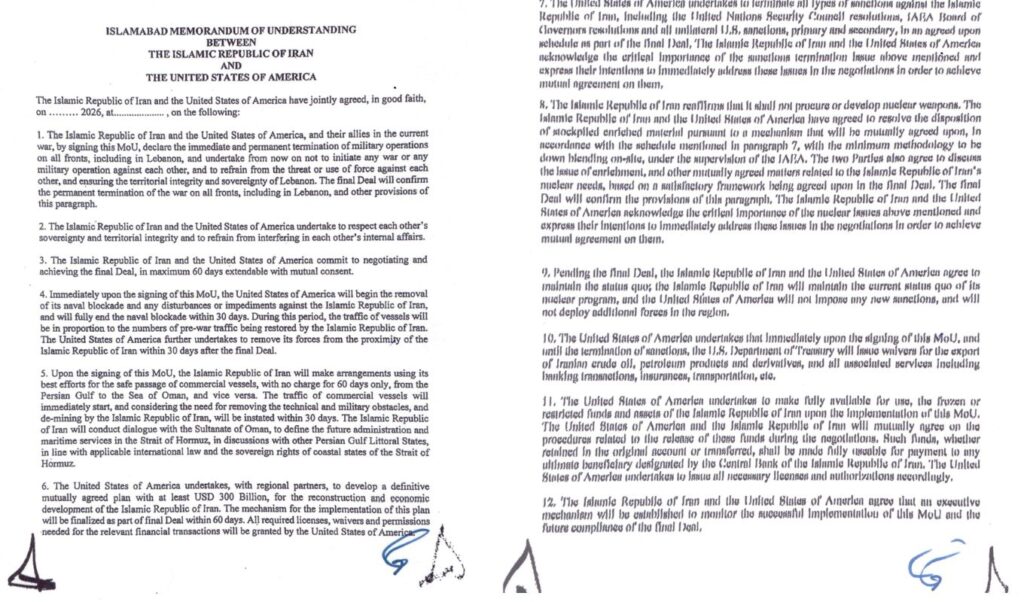
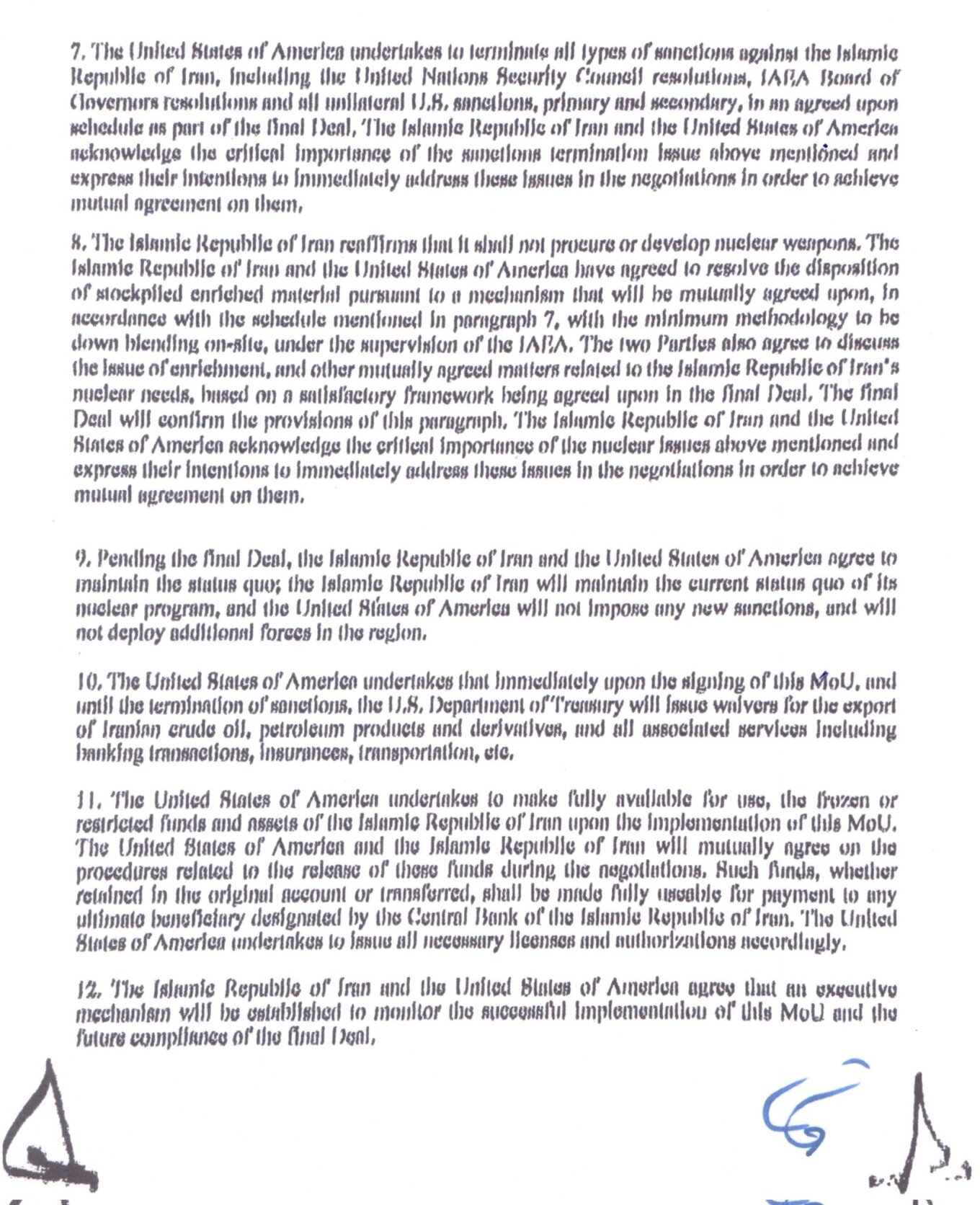
Iranian President Masoud Pezeshkian has publicly released the three-page “Islamabad Memorandum of Understanding” via his account on X. The document consists of 14 paragraphs and bears the signatures of Pezeshkian himself, US President Donald Trump, and Pakistani Prime Minister Shehbaz Sharif. “This is a historic document and a message from a strong Iran: peace will be achieved through mutual respect,” the head of the Islamic Republic stated, adding that “the Islamic Republic of Iran is always committed and faithful to world peace, while preserving dignity and independence, progress and regional cooperation.”
این یک سند تاریخی و پیامی از ایران مقتدر است: صلح در سایه احترام متقابل تحقق خواهد یافت.
جمهوری اسلامی ایران به صلح جهانی با حفظ عزت و استقلال، پیشرفت و همکاری منطقهای همواره متعهد و پایبند است. pic.twitter.com/FgbeHSioKX
— Masoud Pezeshkian (@drpezeshkian) June 18, 2026
The moment Pakistan’s Prime Minister signs the document:
Islamabad :18 June 2026.
Prime Minister of Pakistan Muhammad Shehbaz Sharif signed the Islamabad Memorandum of Understanding (Islamabad MoU)، as mediator.
The Islamabad MOU has been signed by President of USA Donald J. Trump and Iranian President Masoud Pezeshkian. pic.twitter.com/M0LKK9XoK8
— Prime Minister’s Office (@PakPMO) June 18, 2026
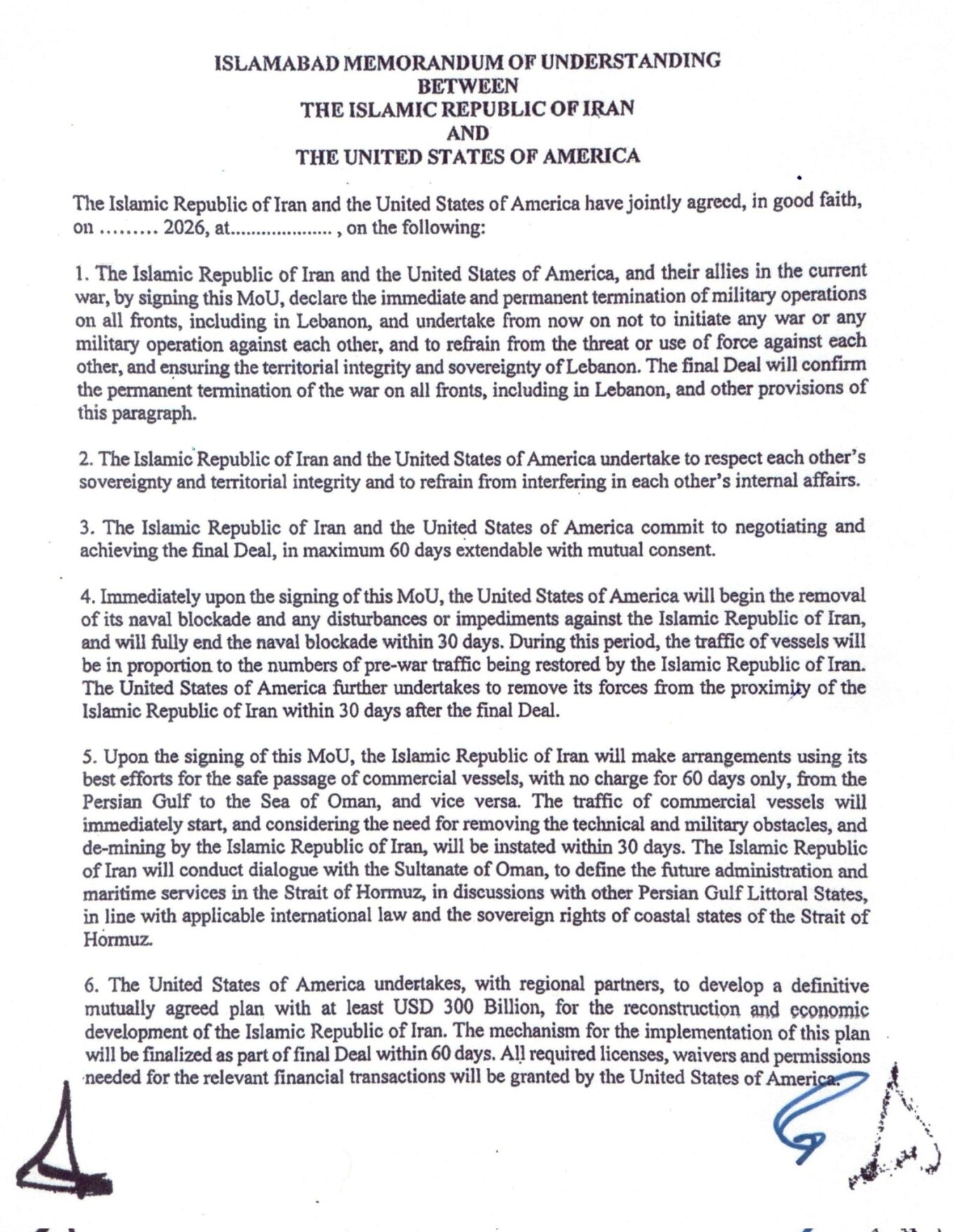
Full text of the agreement
The United States of America and the Islamic Republic of Iran have agreed, according to the draft memorandum of understanding (MOU), on a 14-point framework aimed at ending the conflict, restoring economic relations, and establishing a new security architecture in the region.
The first paragraph declares an immediate and permanent cessation of military operations on all fronts, including Lebanon, by both countries and their respective wartime allies. Both parties also commit to not initiating future wars or military operations against one another, to refraining from the threat or use of force, and to safeguarding the territorial integrity and sovereignty of Lebanon. The final agreement will permanently codify these provisions.
The second article establishes mutual respect for the sovereignty and territorial integrity of both states, along with a commitment to non-interference in each other’s internal affairs.
In the third article, both sides undertake the obligation to negotiate and conclude a final agreement within 60 days, with any extension permitted only by mutual consent.
The fourth article stipulates that immediately following the signing of the memorandum, the United States will begin a phased lifting of the naval blockade and all other restrictions against Iran, with full removal to be completed within 30 days. During this period, maritime traffic will gradually return to pre-war levels. Furthermore, the US commits to withdrawing its forces from the proximity of the Islamic Republic of Iran within 30 days of the conclusion of the final agreement.
According to the fifth article, Iran will make every possible effort to ensure the safe and toll-free passage of commercial vessels between the Persian Gulf and the Sea of Oman for a period of 60 days. Commercial shipping will resume immediately, with full restoration to be completed within 30 days, taking into account demining requirements and the removal of technical and military obstacles. Additionally, Tehran will initiate dialogue with Oman and the other Gulf coastal states to establish a future governance and maritime services regime for the Strait of Hormuz, in accordance with international law.
The sixth article provides that the United States, in cooperation with regional partners, will develop a financing plan of at least $300 billion for the reconstruction and economic development of Iran. The implementation mechanism for this plan will be finalized within the framework of the final agreement within 60 days, while the American side commits to issuing all necessary licenses and approvals for the relevant financial transactions.
In the seventh article, the United States undertakes the obligation to lift all forms of sanctions against the Islamic Republic of Iran. This commitment covers UN Security Council resolutions, decisions of the Board of Governors of the International Atomic Energy Agency, as well as all unilateral primary and secondary US sanctions. The implementation timeline will be determined within the framework of the final agreement.
The eighth article concerns Iran’s nuclear program. Tehran reaffirms that it will not acquire or develop nuclear weapons. The two countries also agree to jointly determine how to manage stockpiles of enriched nuclear material. The minimum method prescribed is the dilution of the material in situ under IAEA supervision. Both sides will also discuss the issue of uranium enrichment and other matters related to Iran’s nuclear needs, within an acceptable framework to be defined in the final agreement.
The ninth article provides that until the conclusion of the final agreement, both countries will maintain the existing status quo. Iran will preserve its current level of nuclear program activity, while the United States will impose no new sanctions and will not deploy additional military forces in the region.
According to the tenth article, immediately following the signing of the memorandum and until the sanctions-lifting process is completed, the US Treasury Department will issue exemptions permitting the export of Iranian crude oil, petroleum products and their derivatives, as well as all related services, including banking transactions, insurance, and shipping.
The eleventh article provides that the United States will make available for use Iran’s frozen or restricted funds and assets immediately upon the memorandum entering into effect. The procedures for releasing the funds will be agreed upon during negotiations. These amounts will be fully accessible to the final beneficiaries designated by the Central Bank of Iran, and the American side commits to issuing all necessary licenses and approvals.
The twelfth article provides for the creation of an executive monitoring mechanism to oversee the implementation of the memorandum and both parties’ compliance with the final agreement.
According to the thirteenth article, negotiations on the final agreement will commence after the signing of the memorandum, provided that implementation has begun of the articles relating to the cessation of hostilities, the lifting of the naval blockade, the operation of the Strait of Hormuz, oil exports, and the release of Iranian funds. Finally, the fourteenth article provides that the final agreement will be ratified through a binding resolution of the United Nations Security Council, conferring upon it international legal force.