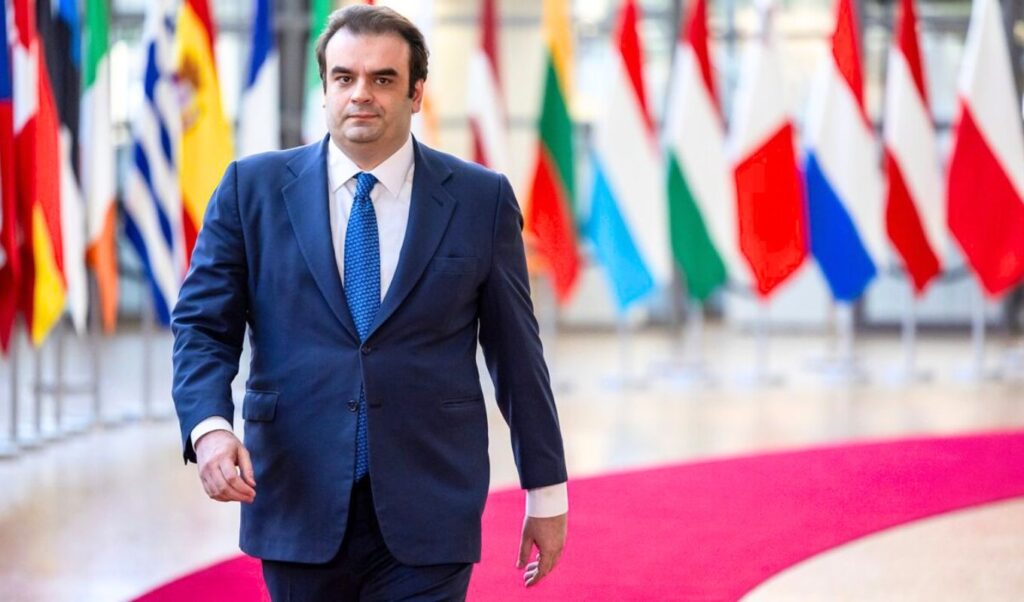
“A Capital Markets Union without adequate European supervision is like a Monetary Union without the European Central Bank,” emphasized, among other things, the Minister of National Economy and Finance and President of the Eurogroup Kyriakos Pierrakakis, in his intervention at the public session of the EU Council of Ministers (ECOFIN) in Luxembourg.
The need for unified supervision & European ambition
Mr. Pierrakakis emphasized that strengthening ESMA’s role is a necessary prerequisite for creating a more integrated and competitive European financial market. As he said, entities with cross-border activities must be supervised at the European level, while national authorities should maintain their role in domestic markets. Referring to Crypto-Asset Service Providers (CASPs), he noted that Greece supports the European Commission’s proposal for direct supervision by ESMA of the largest providers, with ambitious criteria that will take future developments into account. The minister recalled Jean-Claude Juncker’s statement that the Capital Markets Union is the most important achievement that the current generation of European policymakers can deliver. “I believe he is right,” he stated, emphasizing the need to complete the project under the Irish presidency. In closing, Mr. Pierrakakis compared the need for unified supervision in capital markets to the creation of the European Central Bank for the Monetary Union, noting that institutions must match the scale of the market and European ambitions. “If we want a Europe that finances its future with its own forces, we must build the institutions that will make this feasible,” he concluded.
Full intervention by Kyriakos Pierrakakis at ECOFIN
“Allow me to start by congratulating the Cypriot Presidency and the European Commission, as well as you personally (referring to the Minister of Finance of the Republic of Cyprus Makis Keravnos and EU Commissioner Maria-Luis Albuquerque), for advancing this legislative package. I would like to start by pointing out something that is obvious to many of us in our countries: when we try to describe the Savings and Investment Union broadly, it is a highly technical issue. And when we discuss such technical matters, I am strongly reminded of a television series that many of us have watched, “Yes Minister”. Sir Humphrey, an iconic figure in the series, had the unique ability to turn the most important political issues into extremely complex technical discussions, serving his own purposes. And the MISP (Market Integration and Supervision Package) faces, I would say, the risk of ending up like one of these discussions. Because, a citizen who follows this discussion, which is being broadcast on television right now, could reasonably wonder: “What exactly are all these people discussing in Luxembourg? What are they trying to achieve?”.
I would say that the easiest way to understand MISP is to start from the final goal and work backwards. We want deeper and stronger capital markets, more investments and more innovation. We want European savings to finance European development, and a Europe that can finance its future more effectively. Every basic chapter of MISP serves exactly one of these goals. The provisions concerning trading platforms and market infrastructures aim to create larger European capital markets with enhanced liquidity. The provisions concerning asset managers and investment funds aim to enable European savings to be directed more effectively toward European investment opportunities. Similarly, the provisions concerning crypto-asset elements aim to ensure that the future architecture of digital finance will develop on the basis of consistent European rules. Finally, the supervision provisions aim to establish the trust and consistency that integrated markets require.
Last night, we all participated in the Eurogroup dinner with Jean-Claude Juncker. And I believe I’m not violating any confidentiality if I say that when we asked him what is the most important achievement that the current generation of European policymakers can deliver, he immediately replied: the Capital Markets Union. I believe he is right. This is perhaps the most important European economic undertaking that still remains incomplete. That’s why it should be completed before the end of the year, during the Irish presidency, under my good friend Simon Harris. We must support the Irish presidency to bring this work to completion. In this context, I would like to reiterate that Greece continues to support the European Commission’s proposal, as we consider it to be the most consistent and ambitious approach for implementing the goals of the Savings and Investment Union. We believe that deeper market integration presupposes a corresponding degree of central European supervision. Market entities with systemic or broad cross-border presence should be supervised through a common European approach. We cannot expect to create a truly integrated capital market when cross-border activities are supervised through 27 different supervisory perspectives and practices. Strengthening ESMA’s role and capabilities is not, therefore, a matter of institutional preference. It is a necessary prerequisite for creating a more integrated, effective and competitive European financial market.
Specifically, regarding Crypto-Asset Service Providers (CASPs), Greece has consistently supported the European Commission’s original proposal. However, if member states converge on a model of direct supervision by ESMA only for the largest crypto-asset service providers, then the relevant criteria should be ambitious and take future developments into account. These criteria should cover not only the largest providers operating in the market today, but also companies that are developing at rapid rates and show a high degree of interconnection with the market, as their activities may over time acquire systemic importance. At the same time, we fully recognize the important role played by competent national supervisory authorities. The future framework should be based on a substantial cooperative relationship between ESMA and national competent authorities, fully utilizing the expertise and capabilities that each side possesses. The rule is simple: Europe must regulate what is European and national authorities must supervise what is national.
Allow me to conclude with a final thought. Europe did not create Airbus by coordinating 27 national aerospace champions. It created Airbus by building from scratch a truly European undertaking, capable of competing on a global scale. Nor did it create a Monetary Union by leaving monetary policy entirely at the national level. We created the European Central Bank because institutions must correspond both to the size of the market they serve and to the height of our ambitions. The same principle applies today. A Capital Markets Union without adequate European supervision is like a Monetary Union without the European Central Bank. If we are truly serious about creating deeper and stronger capital markets, more investments, greater innovation and a Europe that can finance its future with its own forces, then we must have the confidence and ambition to build the institutions that will make these goals feasible“.