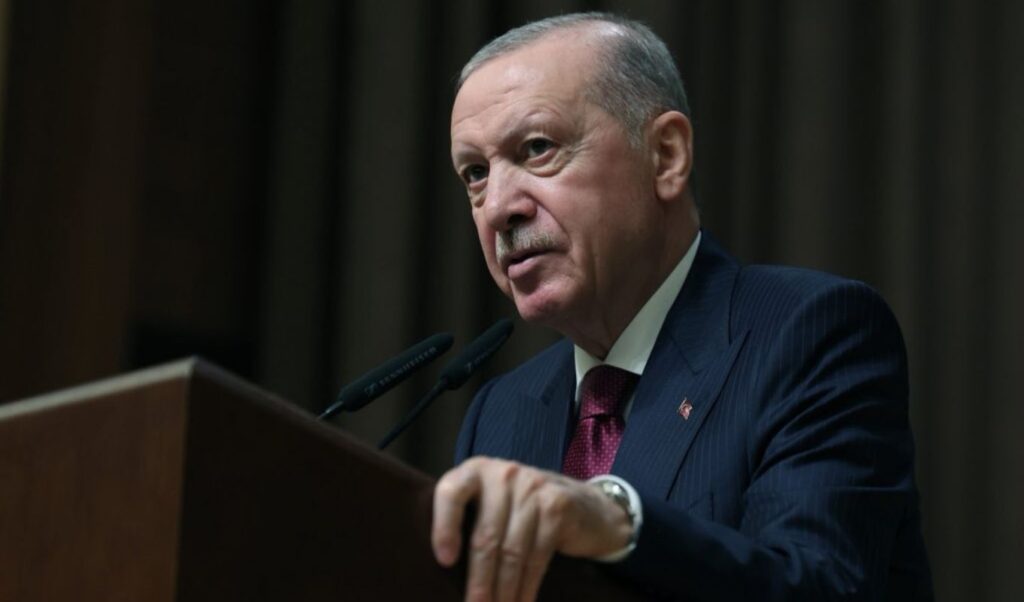
In yet another attempt to impose Ankara’s geostrategic dominance in the Eastern Mediterranean, Turkish President Recep Tayyip Erdoğan issued warnings on Wednesday to Greece and Cyprus of a “harsh response” to any move threatening the interests of Turkey and the self-proclaimed “Turkish Republic of Northern Cyprus.”
Turkey targets Cyprus-Israel defense cooperation
Speaking to the AKP Parliamentary Group, Erdoğan called on the international community not to be drawn into “adventures” and accused the Republic of Cyprus of dangerous military cooperation with Israel. Erdoğan claimed that Israel seeks to provoke instability on the divided island, while linking Turkey’s security to developments in Lebanon and Syria. He even compared the current situation to World War II, warning that if Israeli aggression is not contained, the entire world will suffer the consequences.
Sotiris Roussos: “Turkey wants Cyprus under diminished sovereignty”
Erdoğan’s attack, which returns tension rhetoric to pre-2023 levels, reveals Ankara’s intense concern about the presence of French forces in Cyprus and other defense partnerships of the Republic of Cyprus, which it is trying to prevent. According to International Relations Professor Sotiris Roussos, one of Ankara’s longstanding goals is transforming the Republic of Cyprus into a “quasi-protectorate.” As he tells parapolitika.gr, Turkey seeks to strip Cyprus of its autonomy in foreign policy decisions, demanding that Nicosia’s decisions take Turkish interests into account. As Professor Roussos argues: “According to Turkey, the Republic of Cyprus should take its position into account in whatever it does. If a move doesn’t align with Turkey’s perception, then it starts shouting and threatening. It’s a standard practice where every time the Republic of Cyprus makes autonomous decisions, like any independent sovereign state, Turkey starts roaring. It’s obvious that Turkey wants to have the Republic of Cyprus under quasi-diminished sovereignty.”
Erdoğan’s eyes on NATO Summit and Donald Trump
While the Turkish President attempts to impose himself through threats on the new balances in his country’s southern region, he once again turns to the US President and prepares the agenda of issues he will raise during Donald Trump’s anticipated arrival at the NATO Summit. In this context, the “Blue Homeland” rhetoric remains a central pillar of Turkey’s aspirations, despite American pressure to reduce tensions in the Aegean. Ankara exploits the fact that it is a “very useful” ally for NATO and the US, using this position of strength to push Washington to take a stance.
Why Washington seeks de-escalation in the Aegean
However, as Professor Roussos explains to parapolitika.gr, “a key factor in Turkey’s moves is the behavior of the United States. The US doesn’t want problems in the region because they have many and don’t want to add another one. So they follow an appeasement stance toward Turkey, while simultaneously exerting pressure on Athens in this direction, so we don’t have problems in the Aegean. It’s a situation where the Americans don’t want this part of the Eastern Mediterranean dispute to become involved, which they also need to resolve. And this is because we’re talking about two US allies, two NATO members. As is known, Turkey is very useful to them on many fronts, especially now that the Middle East conflict still continues.”
Gerapetritis – Fidan: Open communication channels despite tensions
Contrary to all this, the Greek and Turkish Foreign Ministers, in their meeting on the sidelines of the SEECP Summit in Sofia, agreed to maintain open communication channels. Nevertheless, Giorgos Gerapetritis made clear on Wednesday to Hakan Fidan that unilateral actions, such as legislating the “Blue Homeland” doctrine, produce no legal effects, insisting on Greece’s established position that the only difference to be resolved remains the delimitation of EEZ and continental shelf. For its part, however, Turkey persists in its expansionist ambitions in the Aegean, not backing down from any of its claims.