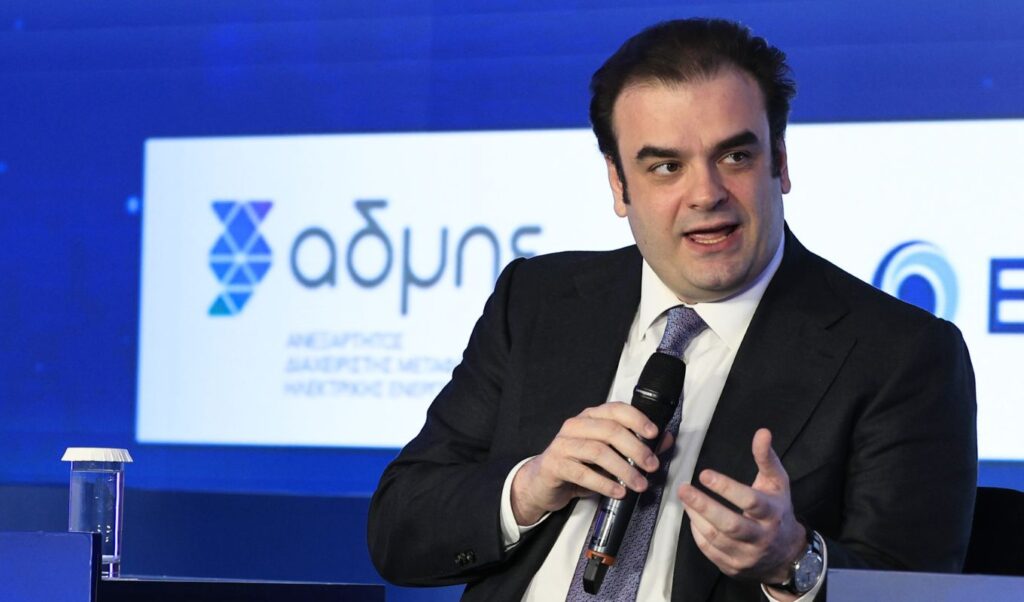
At the 24th CFO Forum of KPMG in Greece, themed “Economic Policy in an Environment of Geopolitical and Political Disruptions” with the central message “The CFO Shift: Tech. Talent. Transformation,” Kyriakos Pierrakakis participated in a discussion with journalist Nikos Filippidis. During the discussion, the Minister of National Economy and Finance highlighted, among other things: “We have reduced 83 taxes and contributions so far, we need to reduce more and more, as regarding the middle class, over-taxation continues to be a reality. And as fiscal space is created, this is the priority of this government and this Prime Minister, to remove burdens from the economy. So, we will continue in this direction because we, first and foremost, recognize that this is the most beneficial direction for the economy to move forward.”
Pierrakakis on Recovery Fund and private debt
Regarding what will happen after the expiration of the Recovery Fund, the minister said that on one hand the country has all the state funds, increased public investments, the new NSRF and new Funds that will come from Brussels. This is part of the answer, he emphasized. Regarding private debt, he mentioned that “we implement policies that reward the compliant.”
Key highlights from the discussion
On the different image of the country abroad and domestically
This is the dualism I experience as a Greek Finance Minister and as President of the Eurogroup, with my Greek identity. The dualism of vocabulary. When we cross borders and find ourselves outside Greece, Greece is treated with tremendously positive vocabulary, because we are the country that overcame the existential crisis of the past decade, whether we talk about tax evasion, development, surpluses, or the debt curve. Whatever parameter you take, investments, exports… Greece has made stunning progress. Progress that is highlighted even more intensely by the challenges other countries are experiencing. So there is great weight when one speaks as a Greek Finance Minister at this moment, precisely because of what Greek society and the Greek state were called to manage in the past decade. This is half of the equation.
The other half is the raw conviction that macroeconomic indicators don’t interest you when you’re at the supermarket checkout. So, one must simultaneously balance between the two and establish the connection of how economic progress reaches every Greek household. It reaches more and more, I would say. That is, you ask me, “is it tangible?” (figuratively). When 600,000 jobs have been created, when we have double the growth rate, when we are ready to reach the historic low in unemployment and when a series of actions have been taken, both short-term: fertilizers, diesel, family support with children or tax reform, permanent measures, ENFIA abolition in 12,000 settlements…all these, cumulatively, act positively. It doesn’t solve the problem.
It’s part of a journey that solves the problem. And every day, every week, every month, the goal is to constantly improve this picture. There is no other way. The only reliable way to support those who have the greatest possible need is to build on stable achievements. So, this is what we will continue to do…considering that we bring the credibility of our accomplishments. But beyond that, I’ll tell you there’s also a connection between national and European. Greece makes many reforms, many changes, tries to run faster, to bring investments. As parts of the equation are solved both European-wide and all these things we discuss in Europe for decades are implemented, the more you will see Greece’s growth rate improve and a larger part of the equation I’m asked about will be solved.
On the escape clause
You all know what the escape clause is. It’s the deviation from European fiscal rules, it’s our money again. It’s the deviation from a new rule introduced at European level, which says that we agree with the Commission on expenditures. Regardless of whether you have a surplus or deficit, you can deviate from this based on your own policies, e.g. combating tax evasion. So the European Union allows you to do what? To have a deviation, initially regarding defense, after Russia’s invasion of Ukraine.
It was therefore judged that this specific escape clause could be linked with additional investments for energy. And I think the crisis in the Middle East makes this absolutely clear. Both regarding the impact on energy prices and regarding the inflationary impact, the secondary impact on a series of products.
On the resilience of the Greek economy and predictions for the Middle East war
We know the European economy has shown resilience. We also know the Greek economy has shown multiple times more resilience compared to the European average, this is reflected in the growth rate. Growth in the first quarter was 2% compared to last year and came from more investments, more exports relative to imports and from the tax reform we implemented recently.
Beyond that, if we look at where oil is today, where the barrel is, it’s at $92. This means markets are not incorporating a worst-case scenario prediction into the price. Markets currently have alertness, but not extreme pessimism. It remains to be seen how quickly the Straits will open.
I’ll tell you we’re watching three parameters: When they will open, how they will open, what regime will prevail in the Straits. And how much damage has been done to the region’s energy infrastructure. So these three together compose the status quo that will exist afterward.
We’ll see all this reflected in prices. Regarding supply conditions, it’s established that Asia has been hit harder than Europe and Europe has been hit harder than America. But beyond that, prices are global in character. Therefore, we face the problem on a global basis. 20% of natural gas and oil passes through the Straits and many other cases. The problem is significant.
But beyond that, we know as Europe that we must do a lot to better organize “our house.” Part of it has to do with our own European-type reforms we discuss in European Councils. Part of it has to do with energy investments. They are absolutely necessary to reach where Europe can and obviously every national economy including our own.
On private debt and the multi-bill under consultation
I’ll go one step back because the bill is still under consultation and we’ll discuss the final parameters when it’s submitted. I want to focus a bit on private debt because for me it’s very important. I don’t believe politics is exercised from above.
What do I mean? There are people who want to honor their commitments, their obligations to the state, and cannot. And this is something that remained from the crisis years. So as long as this exists… is private debt a problem in Greece? If one sees it as a systemic issue, it’s not. Because you have 121% of GDP private debt in the European Union, 94.5% in Greece. Red loans in banks are 3.3%. Last year we had 6.8 billion euros in arrangements. So if one looks at these, systemically we’re in a much better position than the rest of Europe.
However, as long as there’s one person, one family and one business that has a problem, their problem is our problem. This is our job. So in this sense we must build arrangements that reward the compliant. And arrangements that are functional. And I see the responsiveness they have among people. The increase in the limit for the unseizable account from 1,250 euros to 1,600 – I saw the messages on my phone – mattered a lot to many people, as it affects thousands of our fellow citizens.
On the arrangement for payment in 72 installments
Similarly, the 72 installments for old debts until ’23 – after that the normal tax arrangement from AADE applies – is something people were asking for.
*On the Out-of-Court Mechanism, the Katseli Law and the Real Estate Acquisition and Re-leasing Entity*
For me, the most important tool we have for managing private debt is the Out-of-Court Mechanism, which we see being embraced by people. We reduced the inclusion threshold from 10,000 to 5,000 euros.
But for me, you know, Mr. Filippidis, what’s more interesting? We talk about the Katseli Law all these years. Did the Katseli Law work? The Katseli Law, in my opinion, hasn’t worked. First, because it entangled those who needed to find a solution from the Katseli Law in judicial paths of many years and hid many people who shouldn’t have been subject to this Law, wrongly, behind its provisions.
The out-of-court mechanism now becomes a tool for protecting primary residence. That is, we allow the citizen to define a protection perimeter for primary residence in the out-of-court mechanism and say “this interests me.” Greater “haircut,” smaller installment, if you do it. It’s much more effective for a person who really wants to protect their primary residence, to be subject to this.
Add to this the Entity for real estate acquisition and re-leasing, the Entity that will operate in autumn – we’ve been waiting for it for years, this is true. But it’s a complex project, where there had to be a tender, there had to be a contractor in the tender. In autumn all this will be able to operate.
All these together are a much more effective tool than any other we had in the past. And if one puts them together, it’s the largest package of measures for private debt after the crisis.
This, in a country that is developing, reducing its unemployment and has logic to emphasize that it must help those who are compliant, I think is the most beneficial thing we can do cumulatively. The provision will be voted within the month. We’ll move very quickly.
On tax measures
Basically, we reformed how the tax system works. We said we’ll make the largest tax relief that has been done, but it will have a philosophy: we change how we tax you according to how many children you have, your age and where you live (regarding ENFIA). This had a very specific structure and philosophy: it recognizes that the demographic problem is Greece’s existential problem – I’ll tell you it’s Europe’s existential problem not just Greece’s.
At the same time, it recognizes that regarding the middle class, over-taxation continues to be a reality. Because we’ve reduced 83 taxes and contributions now, we need to reduce more and more and more. And as fiscal space is created, this is the priority of this government and this Prime Minister, to remove burdens from the economy. So, we’ll continue in this direction because, first and foremost, we recognize this is the most beneficial direction for the economy to move forward.
And, since you asked before about the crisis, there’s a revision regarding the Middle East crisis, inflation, generally, is revised upward, growth generally is revised downward. You saw that regarding us there was a revision from 2.4% to 2%. Yes. But for next year the revision is upward, it’s toward 2% while it was lower.
This has to do with the development trajectory the Greek economy has taken and with the increase in public investments being carried out and additional European packages, but mainly in the conviction that -I flirt with the idea of saying it figuratively- money doesn’t exist, it’s born. The economy must generate money and this is how we want to move forward. Mergers and acquisitions.
We are, therefore, on a path of qualitative change of what Greece is economically. And I think that building on all the good that has preceded and constantly improving ourselves, we’ll be able to achieve what the country can really achieve.
On SMEs and advance tax payment
I could talk a lot about all those measures that were introduced during the memorandum years or crisis years, which must be removed, one after the other. I won’t hide from you, I also have a big list of things I’d like to see removed quickly. But what’s removed is a function of what you can remove. What is the fiscal space? Fiscal space is a function of the fiscal rules we have ahead of us. It’s not the surplus anymore, it’s that part of the surplus I can spend within the fiscal rules framework.
So, the amount we’ll have for permanent measures, based on a prioritization that includes the obvious, let’s see what space we have. Therefore, many of the things you’ll ask me about are on the table, I won’t confirm any of them. The conception is to really be able to achieve it. Because, see what the problem is. You say “take all the advance tax payment” (about 8 billion euros we collect). That is, you must see for the one year of transition, what fiscal impact you’ll have from implementation. You can’t do everything. Whatever you do, you must do with care and measurement. Many things are feasible. On the strong foundations built, even more will be done.
On the future after the Recovery Fund
I’ll say that I’m glad the entire loan component was exhausted, because we’re talking about 27.5 billion total investments. It doesn’t reach recipients yet though, 27.5 billion is the total investments and there are 798 total contracts and 60% concerns small and medium enterprises.
So, if one looks at it overall, the investments that will be made are very significant. Obviously, there was a picture where we struggled to get investment plans out of drawers and as soon as the deadline was announced, more came out. This is something we’ve gotten used to and seen many times in Greece.
I’ll say I’m glad these plans exist and I’m glad the banking system in cooperation with the Recovery Fund finances them. I hope many of these will be financed without Recovery Fund assistance going forward, because many of these plans are also extremely high quality. Overall, though, I’ll say all this mobilizes investments.
Many say after the Recovery Fund, what? I’ll tell you that, on one hand you have all the state funds, the increase in public investments I mentioned before, the new NSRF, the new Funds that will come from Brussels. This is part of the answer.
The fundamental answer is the change in thinking. The one that gives you the ability to create European champions. To grow Greek businesses. To generate growth and money and economic substance. And we’re there. We’ve now reached the gates of claiming to be there. Especially, compared to other European countries that currently have lower development current. They see some things more fearfully. Greece is opening up. And the more it continues to be in this direction, not only will jobs be created, because the historic lowest in unemployment. We’re ready to catch it. Soon we’ll be there. The issue now is not to reduce unemployment further only. The issue is better-paid jobs. And I think we’re close.
On the strategy for enlarging Greek businesses and their position on the global competition map
The strategy must be primarily European. That