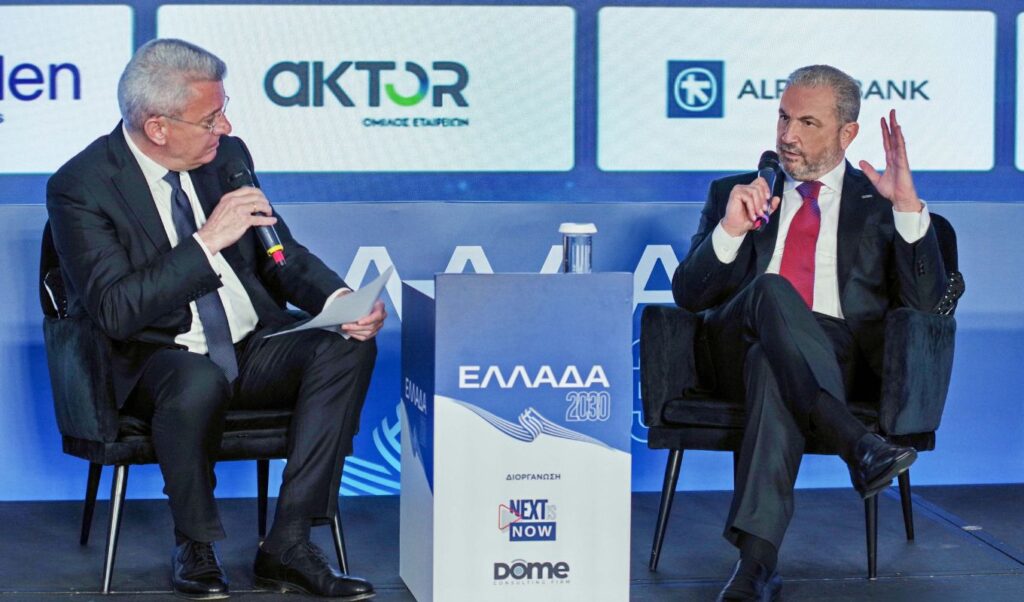
If the positive trajectory that the Greek economy has followed so far is reversed and it loses its ability to refinance public debt in the next decade, it is not unlikely that Greece could return to the situation of 2010, emphasized the President and CEO of AKTOR Group, Mr. Alexandros Exarchou, speaking to journalist Nikos Chatzinikolaou during a discussion at the “Greece 2030” conference held in Athens.
Read: Alexandros Exarchou: “The Vertical Corridor is an answer to geopolitical realignments” (Video)
As the head of AKTOR Group noted, if the positive image of the Greek economy is reversed, the achievements of recent years are lost, deficits return and unemployment rises again, it would not be difficult at all for Greece to return to the situation it was in 2010, given that from 2032, when the debt grace period expires, it will be called upon again to refinance its borrowing – and for this to happen, its creditors must feel confident about the economy’s positive trajectory.
Ensuring favorable economic conditions
Mr. Exarchou noted that we must not forget the reasons why we reached 2010, as well as the fact that the structures of the Greek economy have not changed drastically compared to that time, despite the fact that the country, through tremendous effort, managed to upgrade its prospects by creating the appropriate conditions for this purpose.
He clarified, however, that concern can only arise if the impression is created that there will be no stable governance, expressing his hope that this will be avoided, as, he added, it is the first time he sees foreign capital taking business risks in Greece, and for what has been achieved to continue, there must be basic conditions of predictability in the economy.
Significant foreign investments
As he emphasized, the country is now becoming a field for receiving major investments, such as with the bond issues and capital increase of Credia Bank, where significant foreign capital was placed. He added that the early debt repayment sends a strong message abroad that Greece has regained its strength, noting that if the good effort continues, the country will continue to develop.
Greece has achieved much
For this reason, Mr. Exarchou continued, it is very important to maintain the momentum that has been created, namely the combination of fiscal discipline, high growth rates, and the continuation of conditions that made foreign capital flows to Greece possible.
He noted that we should focus on what our country has achieved so far and not forget what had preceded in the previous decade, when the economy suffered destruction and was led to internal devaluation.
Predictions for high inflation and eurobonds
Mr. Exarchou estimated that the coming winter will be difficult for Europe due to rising inflation, which results from geopolitical developments and the lack of natural gas availability in international markets in light of the ban on Russian gas and due to the damage suffered by Qatar’s energy infrastructure.
Additionally, he commented that Europe must find a balance in energy sources so as not to depend on any supplier and not find itself dependent again, as happened with Russian natural gas and the war in Ukraine.
He also emphasized that the EU should accelerate its responses to address the issue and, in view of the inevitable interest rate increases by the European Central Bank, expressed his hope that the EU will proceed with issuing eurobonds to address the situation following the model of the Recovery Fund a few years ago.