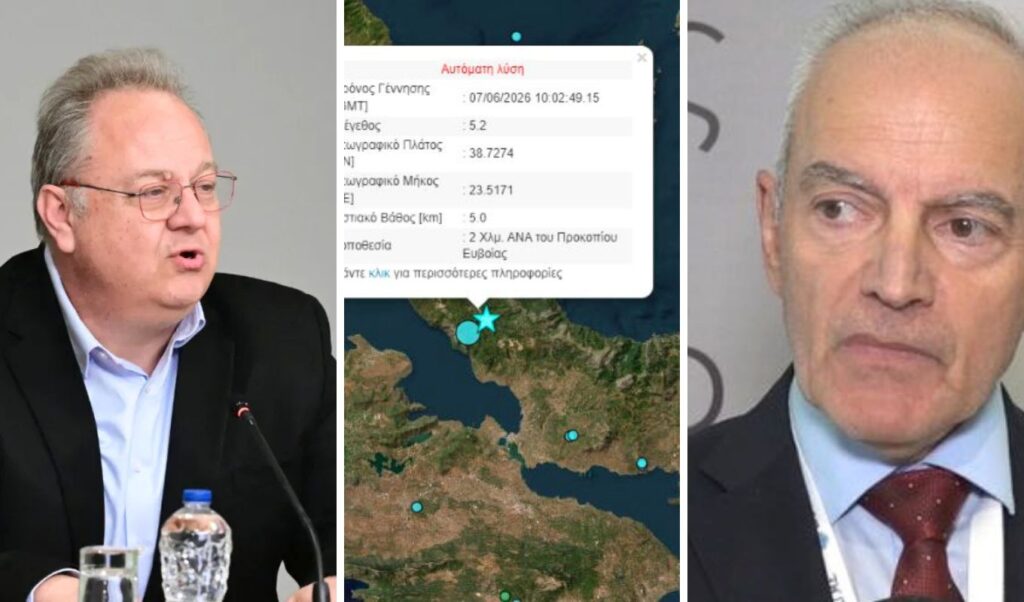
Citizens should not be concerned about the intense seismic sequence being recorded in Evia, according to initial assessments made by Professor Kostas Papazachos and Research Director of the Geodynamics Institute of the National Observatory, Athanasios Gkanas. The region became the center of attention after a series of successive seismic tremors, with the first recorded at 12:58 with a magnitude of 4.8 on the Richter scale, while the phenomenon was particularly felt across a large part of Attica.
Kostas Papazachos reassuring about the earthquake swarm in Evia
This specific area frequently produces seismic tremors of such intensity and they are of the type that do not cause great concern, emphasized seismology professor Kostas Papazachos. Speaking on ERT television minutes after the intense phenomenon, the professor was reassuring, characteristically stating: “We must wait a bit because it’s not yet clear where the epicenters are. The duration of the earthquakes is short, lasting just a few seconds”.
According to him, this seismic sequence should not cause concern among citizens. The barrage of seismic tremors began in Evia with a first strong tremor of 4.8 magnitude on the Richter scale, which occurred at 12:58 with an epicenter 5 kilometers south of Prokopi, and was particularly felt as far as Attica.
Athanasios Gkanas: Known fault with no history of major earthquakes
Research Director of the Geodynamics Institute, Athanasios Gkanas, provided reassuring assessment that the Northern Evia region has no history of major earthquakes. Speaking on ERT News channel, Mr. Gkanas explained that after the first and weaker tremor of 4.8 on the Richter scale, the second and stronger earthquake of 5.2 followed, clarifying that this is a focal area that frequently produces such magnitudes. As he noted, the phenomenon is developing on a known fault behind Mount Kandili, where historically no strong tremor above 6 on the Richter scale has been recorded, with the current seismic sequence moving exactly within this expected range.
Meanwhile, Mr. Gkanas noted that it’s still early to map the situation with absolute accuracy, adding that no warning seismic activity had preceded during the previous period.
Professor Kostas Papazachos moved along the same lines earlier, emphasizing that this specific area is characterized by tremors of such intensity that do not inspire great concern. Mr. Papazachos pointed out that the duration of the earthquakes was short, lasting only a few seconds, and recommended patience until the exact epicenters of the activity are fully clarified.