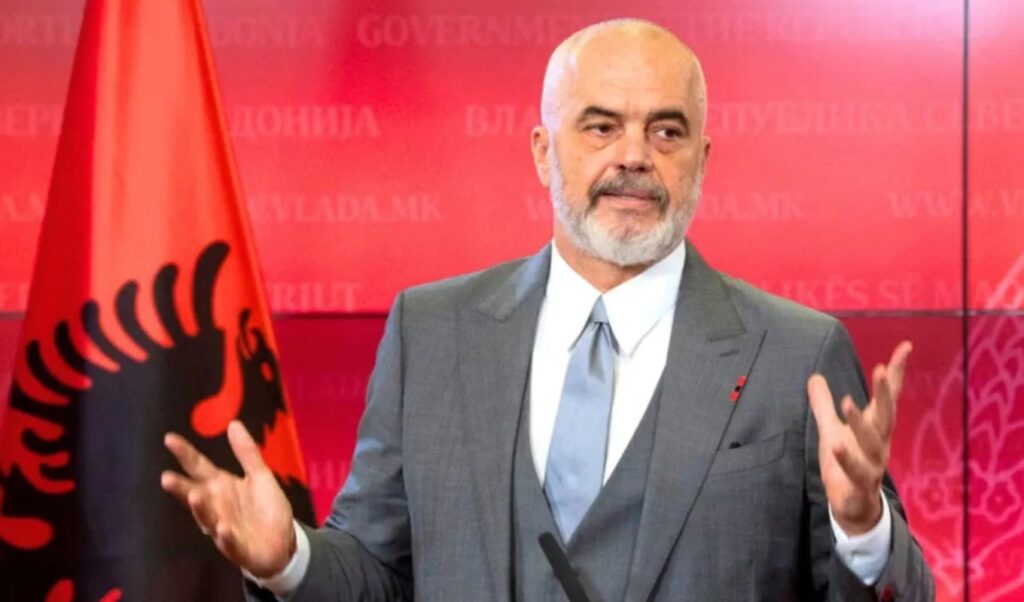
In a post on X, Edi Rama addresses the protest demonstrations against Kushner’s investments in Albania, which are making headlines worldwide and have caused an uproar. The Albanian Prime Minister speaks of “deepfake, manipulated images” – that show protesters as much more numerous than they actually are – and “fabricated claims” regarding the tourism investment case of Ivanka Trump and her husband, Jared Kushner in a wetland area in the Vlora region. “How could a local protest involving a few thousand people turn into an international spectacle?” wonders Edi Rama.
Read: Rama on Trump’s son-in-law’s resort in Albania: “If it weren’t Jared, they wouldn’t care”
Subsequently, the Albanian Prime Minister – referring to the Kushner investment that has sparked a wave of reactions – emphasizes that in reality “no project exists yet, there isn’t even a final design yet”.
“And yet, from this simple reality emerged a hurricane of digital hysteria, sensational headlines, manufactured outrage and sweeping conclusions presented as proven facts,” emphasizes Edi Rama, specifically referring to American CNN, all international media that report daily on the demonstrations, and social media.
Full post by Edi Rama
“To @CNNInternational and to all the endless media outlets, big and small, together with all the well-meaning content producers of Facebook, X, Instagram, TikTok and every other platform that now shapes the global conversation, I would very much wish to pass the following post:
As we speak, today’s protest has attracted approximately 2,000 participants. This is the lowest turnout so far, but even at its peak, participation never exceeded 8,000 people.
How then has it been transmitted to the world these past days as so massive, so dramatic, so overwhelming?
How could a local protest involving a few thousand people turn into an international spectacle?
How could assumptions become facts, narratives become verdicts and speculation become accepted truth, before even the basic facts were established?
And perhaps most importantly, what does it say about our information ecosystem when perception can travel around the world faster than reality itself?
Because the reality is that no project exists yet.
No building permit exists yet.
No construction exists yet.
There isn’t even a final design yet.
There is only a vision and a plan: to transform Albania into the most attractive high-quality tourism destination in this part of the world, while creating purely positive environmental development that, according to the current vision, will ultimately result in approximately 25% more trees and green spaces than exist today, along with measurable improvements in multiple biodiversity indicators.
The ambition is not simply building.
The ambition is to demonstrate that development and environmental improvement can go hand in hand.
This is precisely why some of the world’s top experts in ecology, biodiversity, landscape architecture, environmental engineering and sustainable tourism are working on these concepts and parameters.
Whether they will succeed or fail is a matter of future assessment, science, public scrutiny and transparent discussion.
But presenting as environmental disaster something that doesn’t exist yet, hasn’t been designed yet, hasn’t been permitted yet and whose stated goal is actually to produce positive environmental outcomes, does not constitute a serious contribution to public debate.
And yet, from this simple reality emerged a hurricane of digital hysteria, sensational headlines, manufactured outrage and sweeping conclusions presented as proven facts.
Along the way came deepfakes, manipulated images, fabricated claims, coordinated amplification, anonymous networks and online behavior that bears many characteristics of the hybrid information warfare that increasingly shapes public discourse in democratic societies.
Even more remarkable is that social media platforms recorded an explosion of activity around this topic, with engagement in Albanian language increasing manifold within just a few days.
A significant part of this sudden increase appears to be due not to an organic expansion of public participation, but to the rapid multiplication of newly created profiles, anonymous accounts and pages with minimal or no recognizable history, raising legitimate questions about artificial amplification and the manufacture of digital momentum.”
To @CNN International and to all the endless media outlets, big and small, together with all the well-meaning content producers of Facebook, X, Instagram, TikTok and every other platform that now shapes the global conversation, I would very much wish to pass the following post:… pic.twitter.com/yFEQepcoH0
— Edi Rama (@ediramaal) June 6, 2026