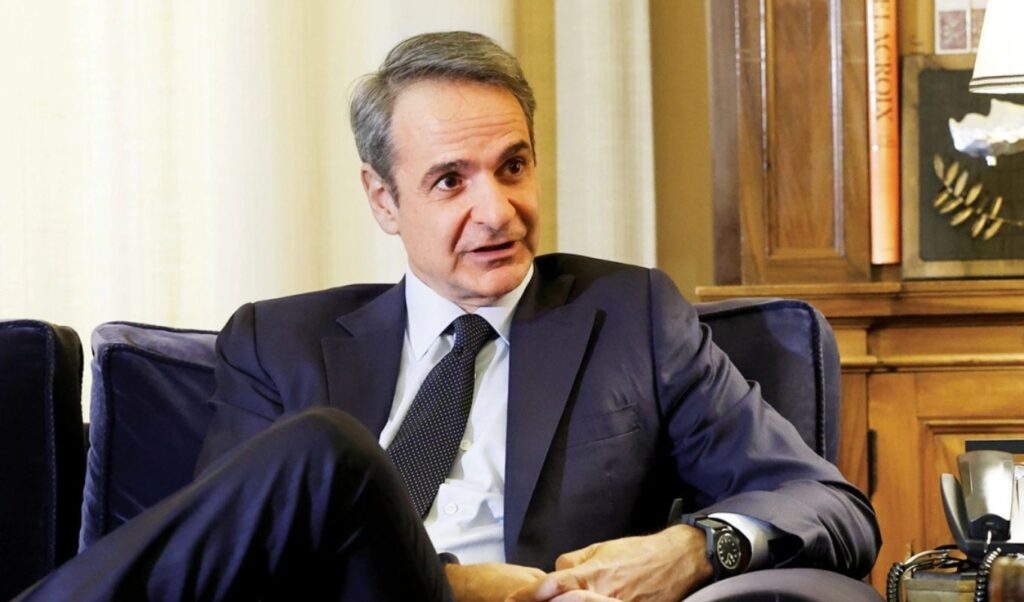
In his Sunday message, Kyriakos Mitsotakis addressed the Constitutional Reform and the changes the government plans to bring with its proposals. The Prime Minister emphasized that the changes proposed by New Democracy “may seem bold to some. However, I believe they are necessary for a country that wants to look to the future with confidence.”
The full post by Kyriakos Mitsotakis
Good morning and happy Sunday. If I had to find a phrase that connects many of today’s review topics, it would be “Greece 2030.” A more modern, more functional and more mature country that definitively leaves behind problems and pending issues of the past. You will understand why I say this as we continue.
Let me start with our proposal for Constitutional Reform, another commitment of ours that becomes reality. The changes we propose may seem bold to some. However, I believe they are necessary for a country that wants to look to the future with confidence. We propose establishing non-state universities, changing the article on ministerial responsibility and further strengthening judicial independence, linking public sector permanency with evaluation, constitutional protection of the country from any bankruptcy threat, recognizing affordable housing as a state obligation, stronger provisions for addressing the climate crisis, and a framework of principles for utilizing Artificial Intelligence for the benefit of people and society. Different interventions with a common goal: a country more ready for future challenges. We are not proposing these changes with the next electoral contest in mind, but the next decade. In 2030, it will be 200 years since the official formation of the Greek state. I would like us to be able to say then that we took certain steps that the country owed to itself for decades. And I hope all political forces will present their positions, because this undertaking transcends us all and needs us all.
If there is one development that shows the country is truly leaving behind some of its heaviest past burdens, it is the European Commission’s decision to remove Greece from the list of states with “macroeconomic imbalances,” officially closing a cycle that opened 16 years ago at the beginning of the debt crisis. For the first time in many years, Greece is not discussed in Europe as part of the problem, but as an example of progress and stability. That’s why I find it difficult to understand those who rush to downplay the significance of this development. Because precisely these macroeconomic imbalances in which we had been trapped for years are what keep citizens’ incomes divergent from those of other European countries. And this is a development that is neither accidental nor self-evident. It is the result of citizens’ efforts and political stability that allowed the country to move forward during a period of successive international crises. Today the Greek economy is developing at faster rates than the European average, reducing public debt at the fastest rate in Europe and has created almost 600,000 new jobs.
And as the economy becomes stronger, we have more opportunities to return the dividend of this progress to society. Obviously, exiting this list does not mean all problems are solved. It does not mean that inflation has disappeared or that incomes are where we want them. However, it means that the country now has much more solid foundations to address these challenges and continue converging with the most developed European economies.
Another decades-old pending issue being closed is the codification of spatial planning and urban planning legislation. With the new Spatial Planning-Urban Development Code passed in Parliament, provisions that until today were scattered across 119 legislative acts and 53 presidential decrees, some dating back to 1923, are brought together for the first time in a unified framework! An important reform that brings order to a field that for years tormented citizens, professionals, investors and public administration. In achieving this emblematic undertaking, the role of Nikos Tagaras, whom we recently lost, was catalytic. A rare person and a moderate, capable politician, respected even by political opponents. For me, a friend. He was inspired by the ethics of responsibility, with service to the homeland in whatever position he found himself. That’s why we gave his name to the Spatial Organization project, as minimal honor to a true public servant.
Changing topics to the National Health System, whose upgrade continues with visible results from this major reform. We have concrete results: just in recent days, three more fully renovated Emergency Departments were delivered in Kilkis, Kavala and Alexandroupoli, while renovation of the Thermi Health Center was completed. Simultaneously, two new clinics were inaugurated, the Ophthalmology clinic at “AHEPA” University General Hospital, and the Pulmonology clinic at “Hippokration” General Hospital of Thessaloniki, as well as the “IASIS Generations | Kilkis” Day Care Center for Comprehensive Care, one of seven modern facilities providing integrated services to people with dementia, Alzheimer’s disease and related neurodegenerative disorders. Particularly in dementia and autism, we see these facilities meeting real needs of families and local communities. That’s why we are proceeding with creating 40 new units across the country, 20 for dementia and 20 for autism.
Other important government actions: we are increasing the protection limit for non-seizure accounts from 1,250 to 1,600 euros, adapting it for the first time in many years to current data. Our goal is for those with debts to maintain a larger amount available for basic daily needs, without this nullifying the obligation to pay off their debts.
The Digital Work Card now extends to health sectors, telecommunications, cleaning services, repairs and other activities, covering an additional 476,000 workers. It will be implemented gradually in two phases, aiming to protect more workers by combating undeclared and under-declared work and accurately recording actual working hours. The Digital Work Card now covers approximately 2.5 million workers, and it’s worth noting that in 2025, over 2.7 million additional overtime hours were declared and paid compared to 2024.
Another important change moves from theory to practice. The politis.gov.gr platform was launched, through which citizens can digitally track the progress of their applications to the Public Sector. For the first time, they will know exactly what stage their case is at, which service handles it, and the estimated completion time.
The “Neighborhood Nannies” program platform also opened for parents at ntantades.gov.gr, so families can choose a caregiver for children from 2 months to 2.5 years old. Initial data shows the program meets a real need, as interest is already particularly high. I remind you that the program provides financial support up to 500 euros per month for parents working full-time or who are freelancers, and up to 300 euros for parents working part-time or seeking employment. Moreover, a caregiver can be someone from the family environment, like a grandmother, provided they meet the required conditions. Additionally, we are proceeding with a necessary modification to the important Personal Assistant program. On small islands, where there is often insufficient availability of personal assistants, family members will now be able to take on this role. Thus, our fellow citizens with disabilities will not be deprived of such an important service due to their place of residence, while daily care often provided by the family itself can now be officially included in the program and practically supported.
Speaking of new possibilities and choices, let me highlight an initiative with special symbolism. The Greek Armed Forces, for the first time, welcomed female volunteers who chose to serve their military duty. A total of 72 Greek women reported to the Recruit Training Center in Lamia and will be sworn in at the end of June. The voluntary military service program operates on a pilot basis and provides for 12-month service for women aged 20 to 26 years. Incentives for those who want to serve include recognition of their service period as prior service and scoring in ASEP competitions for recruitment as professional soldiers or hiring graduates as civilian personnel. Good beginning to our female soldiers!
In the cultural sector, I want to mention an important move by our country, which returned to Cyprus 48 antiquities from Ambassador Christos Zacharakis’ collection, whose heirs asked the Greek state to return them where they belong. This is a move that confirms, if nothing else, that Greece applies the same principles it invokes when claiming repatriation of its own antiquities.
We have now entered June and with it the most demanding zone of the fire prevention period. Citizens’ legitimate question is whether the country is better prepared today against fire risk compared to previous years. The answer cannot be given with words, but through continuous strengthening of Civil Protection means and capabilities. In this context, the Fire Service received 10 new tractors that will cover critical needs for transporting fire vehicles and special equipment throughout the country. They will be allocated to Regional Administrations of mainland Greece and Crete, contributing to faster mobilization of forces where needed. This is another addition to equipment the country acquires through the “AEGIS” program, aiming to be as prepared as possible against increasingly difficult conditions created by the climate crisis.
Before closing, I want to congratulate Amorgos fishermen for the “Amorgorama” award with the first Annual Sustainable Fishing Prize established by the Ministry of Rural Development. Those who regularly read my reviews may remember I have mentioned this initiative in the past, which has evolved into a reference point for sustainable fishing in the Mediterranean. I am particularly pleased when such efforts are recognized and rewarded.
I close by returning to the thought with which I began. The topics you read about today may be very different from each other. From the Constitution and economy to the National Health System, Public Sector or Civil Protection. However, they have something in common: they show a country that does not remain stagnant, but tries to solve problems that accompanied it for years. That’s why I spoke initially about Greece 2030. Because this Greece will not suddenly appear one day. It is built step by step, through changes being made today. Have a good day.