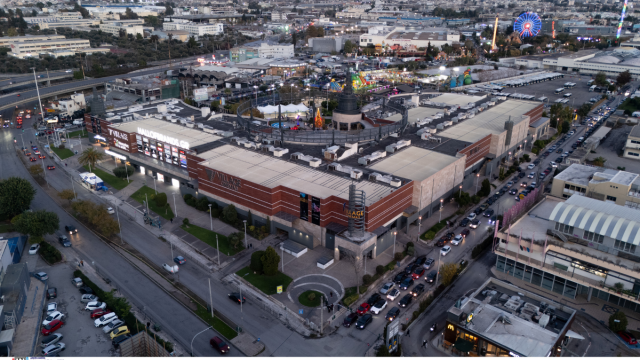
The Renti area is undergoing a complete repositioning, with two major investments reshaping the commercial and entertainment landscape of Attica. On one side, Premia Properties, in partnership with the Antetokounmpo family, is proceeding with the reconstruction and reestablishment of the Village Park Renti shopping center, which is being renamed to Renti to Go. On the other, Sklavenitis is developing the neighboring property of the former Pitsos factory into one of the largest urban redevelopment projects in Attica’s retail building sector.
The convergence of these two investments is not coincidental in terms of their significance. This is an area with a strong commercial footprint that for years hosted entertainment, retail, and industrial activities, but without a unified development identity. Today, this image is changing, as Renti is gaining renewed interest as a destination for shopping, recreation, dining, and family entertainment.
Renti: Village Park becomes “Renti to Go” with Antetokounmpo family signature
In Premia’s case, the former Village Park Renti has already entered a transformation phase, with a two to three-year investment plan worth approximately 15 million euros. According to available information, interventions have already begun with tenants and the usage mix, aiming for the property to acquire a dual character – both as a commercial destination and as an entertainment and sports activity venue. A central element of the new identity is the participation of the Antetokounmpo family, which with a 30% stake in this project connects it to basketball, social action, and the concept of experience beyond simple commercial visits. Within this framework, Renti to Go will feature basketball courts, while the Antetokounmpo Foundation offices are expected to relocate to the property. The goal is for the shopping center to become a destination where visits are not limited to consumption but are connected to sports, family, children, and entertainment. This is a strategy that follows the international trend of converting traditional commercial spaces into mixed-use destinations, with more reasons for visits and longer stays.
Sklavenitis’s mammoth investment in the former Pitsos factory
The proximity to Sklavenitis’s investment in the former Pitsos factory is also of pivotal importance. The project, with a budget exceeding 150 million euros, is being developed on a property with a total area of over 51,800 square meters and includes the creation of a supermarket, dining areas, multipurpose halls, children’s areas, and supporting infrastructure. For the country’s largest supermarket chain, this specific development represents a key point in the Athens basin, as it transforms an inactive industrial property into a modern commercial complex. According to the recent environmental impact study, the original plan for outdoor parking is being replaced by the construction of a two-story parking building with 334 spaces. The building will be developed on a plot within building block 240 and will include a ground floor with 159 spaces, first floor with 133 spaces, and rooftop with 42 spaces. The basement will house tanks and electromechanical equipment, while photovoltaic shelters will be installed on the roof, enhancing the facility’s energy efficiency.
20,000 daily visitors are estimated to be received by the Sklavenitis complex at the former Pitsos factory
Over 20,000 daily visitors and 1,200 new jobs
Based on the group’s estimates, Sklavenitis’s new complex is expected to attract more than 20,000 visitors daily, while it is calculated that over 1,200 new jobs will be created. Between Renti to Go and the Sklavenitis investment lies another significant property. This is the plot owned by the local municipality and used as a bus depot. The existence of this intermediate space has its own significance, as it may in the future become a factor affecting the overall urban planning and functional connection of the two major poles, since the proximity of the projects creates conditions for different types of commercial synergies.
These synergies become even more interesting given that the Sklavenitis family has acquired a minority stake in Premia, the listed real estate company headed by Greek-Swedish businessman Ilias Georgiadis. This relationship creates a background of understanding and common interests in an area developing into a new commercial hub. Premia gains added value from upgrading its property, while Sklavenitis invests in a high-traffic complex that can enhance overall commercial activity in the area.
Allou Fun Park development also on the table
The broader framework also includes the potential development of the Allou Fun Park space, which has remained inactive in recent years. If there is progress on this specific property, then Renti could be transformed into a unified hub of commerce, recreation, and entertainment for all of Attica. The reopening or redevelopment of such a space would complete the puzzle, enhancing the area’s overall attractiveness.
Published in Moneypro of Parapolitika newspaper