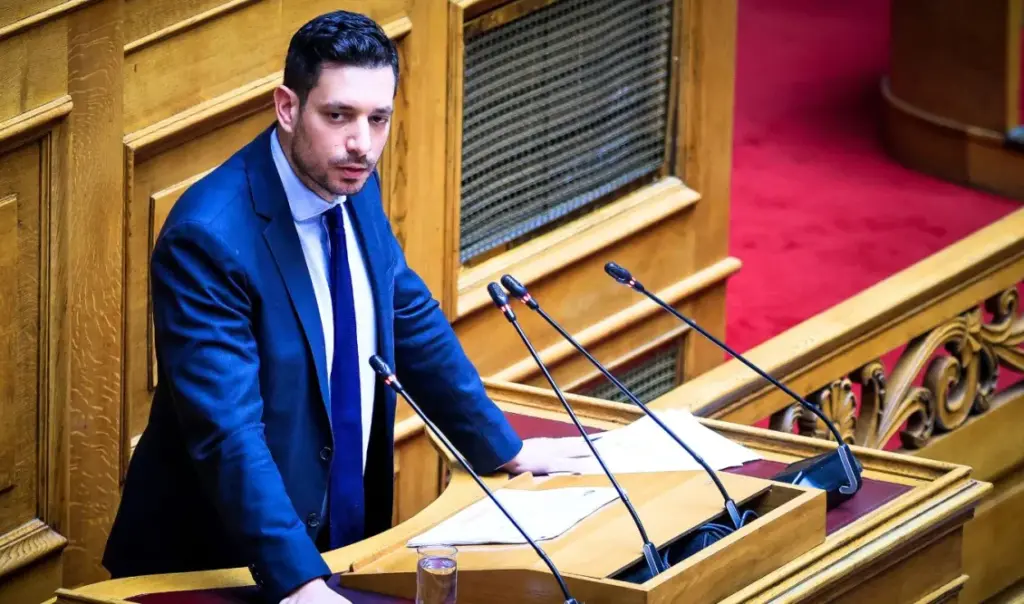
The die has been cast for Konstantinos Kyranakis, who, as “Apogevmatini” reported on Friday, is the prime minister’s proposal for the position of secretary of the Political Committee, with his election expected next Wednesday, when the members of the body that emerged from the 16th Congress of New Democracy in mid-May will convene. A proposal that the deputy minister of Transport accepted, proceeding with the official announcement of his candidacy, thanking Kyriakos Mitsotakis for the trust he showed in his person.
Konstantinos Kyranakis: The unity message and political stance of the new secretary
In his announcement, he refers to his long journey within the party, emphasizes the sense of responsibility that accompanies this new challenge, and sends a message of unity, giving his political stance and the major challenge he has to carry out. “Let’s win the battle of elections but mainly the battle of ideas. Let’s make Greece truly strong and proud,” said the outgoing deputy minister of Transport.
Electoral readiness and early election scenarios behind the scenes
Meanwhile, while the prime minister and government officials have rejected scenarios of early recourse to the polls, the possibility of electoral surprise in the autumn after the Thessaloniki International Fair remains on the table. Under this perspective, Konstantinos Kyranakis, who has proven to function effectively under high-pressure conditions, is expected to run New Democracy’s electoral preparation at rapid pace, with emphasis on ballot preparation, so that the party is organizationally ready whenever Mr. Mitsotakis decides to press the button. Regarding his replacement, according to sources from Maximos Mansion, after Wednesday and the election of the new secretary of the Political Committee, his succession in the critical Transport portfolio will be initiated. Correspondingly, the replacement of the late Nikos Tagara’s position is also expected, for which Ioannina MP Giorgos Amyras is mentioned, as well as ND MPs who have the professional qualification of engineer.
Hatzivasileiou’s return and broader cabinet reshuffle scenarios
Meanwhile, it is considered almost certain that Tasos Hatzivasileiou will return to government. It will be interesting to see if the upcoming changes are implemented on a broader scale and affect the government scheme. For example, if an active government official is chosen for the position of Transport minister, which would consequently cause a change in another ministry as well. At the same time, there are scenarios on the table for changes in the structure of Maximos Mansion. Kyriakos Mitsotakis’ proposal for the elevation of Konstantinos Kyranakis to the position of secretary of New Democracy’s Political Committee, in this political juncture, is not treated by Maximos Mansion as a typical intra-party change of guard but as a choice with a clear political and ideological footprint and a clear message for the party mechanism’s challenge in the coming period.
Why Maximos Mansion politically invested in Kyranakis
The prime minister’s associates spoke of a targeted choice for political, organizational and communication strengthening on the road to national elections. In this framework, people with knowledge of the balances within ND, reading between the lines of the Kyranakis choice, find that the challenge is not simply managing the party mechanism -that is self-evident- but revitalizing the party base and reactivating citizens who remain emotionally close to ND but have distanced themselves from active participation. This is an audience that either remains silent or watches from a distance, and under this perspective Mr. Kyranakis has a crucial advantage: he can speak to a party audience but also address audiences that traditional parties struggle to approach, as the 39-year-old politician speaks the language of New Democracy supporters and simultaneously of young people.
Of course, the Kyranakis choice takes into account that this is an official who comes from the depths of the party and knows like few others the authentic DNA of the party’s voters. From DAP-NDFK and ONNED to the Youth of the European People’s Party, of which he was elected president twice, Konstantinos Kyranakis is a person with trajectory and intra-party legitimacy, who has climbed the party hierarchy step by step, but also has strong international networking and respect within European center-right circles.
At Maximos Mansion they estimate that Mr. Kyranakis has been tested in difficult times and does not avoid political risk. On the contrary, he has proven that he can handle high-pressure missions. “He is among those who don’t avoid difficulties, always trying to deliver results,” say those well-acquainted with the “blue” backstage. More specifically, at the Digital Governance ministry he was associated with the completion of the Land Registry after 30 years of delays. Acceleration of digitization processes, reduction of bureaucracy and addressing entrenched phenomena of corruption and dysfunction compose the picture of a significant reform. Subsequently, as deputy minister of Transport, he takes on one of the most difficult and politically “hot” files: amid mass demonstrations over Tempi, with pressing demands for railway safety upgrades. His tenure there is completed successfully, as the railway has five additional safety valves, infrastructure projects are delivered on time, while the agreement for the procurement of brand new trains is also implemented.
According to information, the fact that Konstantinos Kyranakis is a person very close to Kyriakos Mitsotakis himself is also significant. Few know that he was in the current prime minister’s team during the campaign for ND’s presidency in 2015-2016. This is therefore a personal relationship that goes back many years, and as secretary, Konstantinos Kyranakis is expected to give his all and personal zeal to the battle for self-sufficiency and the prime minister’s re-election, with the central requirement that all officials “sweat the jersey.” The crucial question, therefore, for Mr. Kyranakis is not only organizational readiness ahead of elections. It is whether New Democracy can appear more extroverted, more modern, more attractive to citizens who today either remain politically inactive or look toward other directions.