A total of 17 changes are included in New Democracy’s final proposal for Constitutional Revision, as submitted to Parliament on Tuesday – compared to the version first presented at the ruling party’s Parliamentary Group meeting on May 7th. During this period, extensive discussions took place within New Democracy, resulting in the removal of provisions such as lowering the age limit to 21 years for parliamentary candidates, along with suspension of military service obligations. The possibility of establishing incompatibility between MP and ministerial positions remains in the final proposal, however it now requires that the implementing law must be passed by an enhanced parliamentary majority.
Mitsotakis’ message and the Constitutional Revision objective
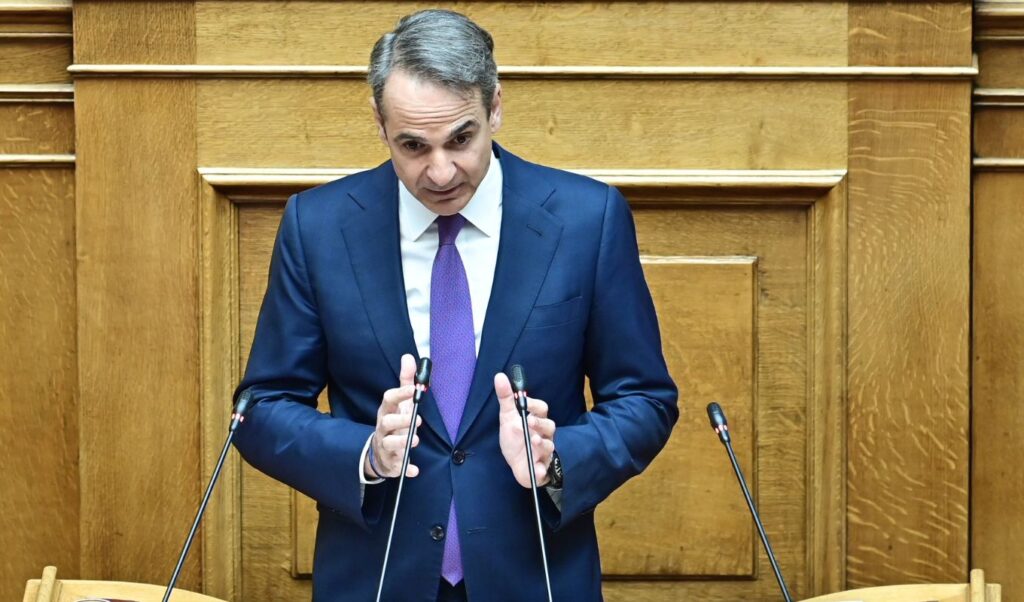
“Consistent with its commitments, New Democracy submits today to Parliament its proposal for Constitutional Revision. A roadmap that modernizes public life and the political system, addressing decades-old pathologies. Simultaneously, however, opening the path for major reforms our country needs as we advance into the 21st century,” noted Kyriakos Mitsotakis in his announcement of New Democracy’s proposal submission, formally initiating Parliamentary procedures for Constitutional Revision. “Our goal is that in 2030 -the year marking 200 years since our state’s official establishment- we meet the future, guided by a modern Constitutional Charter,” the Prime Minister stated, while calling on “all political forces to present their positions, instead of abstaining as they do today.”
Changes made by New Democracy to the Constitutional Revision proposal
Specifically, the changes compared to the original text, resulting from internal consultation and more careful analytical processing of each provision, are as follows:
-“Clarification and rationalization of press, television, radio and internet” became “expanding protection of freedom of expression in modern media and removing detailed formulations unsuitable for the Constitution”
-In the provision for “State care for protection, cultivation and dissemination of the Greek language” the final formulation is “state care for protection and promotion of the Greek language.”
-In the proposed provision for “protection of the Greek flag as a symbol of the Greek nation and Greek culture” the phrase “and Greek culture” was removed.
-The provision that mandatory schooling years cannot be fewer than 11 (instead of 9 currently) was removed.
-The final formulation for the much-discussed article 16 is as follows: “Possibility of providing higher education through legal entities of university education, public or private character, with full autonomy, under state supervision and ensuring high-level studies.”
-The formulation regarding party operations initially stated “Parties must organize and operate democratically,” while now it reads “Parties take into account principles of democratic operation.”
-Added the proposal for abolishing the possibility of granting amnesty for political crimes.
-The “right to be elected at 21,” combined with “suspension of military service obligation for the duration of parliamentary tenure,” which had caused internal party reactions, was removed from the final proposal.
-A provision not in the original proposal is introduced: “obligation of government members to respond to parliamentary oversight.”
-Article 77 paragraph 3 revision is introduced for the first time, as follows: Possibility of referring constitutionality issues of laws, after voting but before publication, by the President of the Republic, Prime Minister or Parliament to the Supreme Special Court. The President may refer up to one voted bill per parliamentary session. Referral by Parliament requires a request from the absolute majority of all MPs.
-Voted bills under articles 51 and 54 are mandatorily referred to the Supreme Special Court before publication. Until the Court’s decision, law publication is prohibited.
-“The budget must ensure fiscal balance between revenues and expenditures and sustainable fiscal operation” was New Democracy’s original proposal, now made more concise with broader interpretation: “The budget must ensure sustainable fiscal operation.”
-The change to article 81, paragraph 2, which caused much discussion within New Democracy, established “possibility of providing by law functional incompatibility between MP/minister and temporary replacement.” With the new formulation, the law establishing incompatibility between MP and minister requires enhanced parliamentary majority: “Possibility of redefining, by enhanced majority law, incompatibilities of ministerial and deputy ministerial office with other functions or capacities.”
-The introduction of provisions for “Good governance rules” was specified much more, as follows: “Annual approval of Unified Government Policy Plan for the following year, which is published and discussed in special plenary Parliamentary session.”
-The notorious article 86 is presented in full in its final form (as proposed for revision) because the overall formulation is particularly significant:
Conducting investigation, preliminary investigation or preliminary examination by Appeals Prosecutor and proposal for prosecution by supreme judicial body.
Abolishing immediate transmission of any evidence to Parliament, as well as Parliament’s competence for conducting preliminary examination.
Prosecution for criminal offenses committed by government members or deputy ministers during duty performance will be decided by Parliament, with absolute majority of all MPs and roll-call vote.
For another controversial issue, selecting Supreme Court leaderships, New Democracy’s original proposal included revising article 90 as follows: “Promotions to supreme judge positions by special parliamentary committee from among senior judges, without government intervention, from a list of three judges per position proposed by relevant plenary sessions.” In the new formulation, the restriction to senior judges was removed: “Promotions to supreme judge positions by special parliamentary committee, without government intervention, from a list of three judges per position, proposed by relevant plenary sessions.”
Article 100 regarding the Supreme Special Court and constitutionality control changed significantly compared to New Democracy’s first proposal and now reads as follows:
Supreme Special Court competence for preventive constitutionality control of voted bills, under article 77 paragraph 3.
Decision on voted bill constitutionality will bind all courts during constitutionality control.
Supreme Special Court composition includes Presidents of the Council of State, Supreme Court and Court of Audit, two State Counselors and two Supreme Court judges, appointed as members by lottery every three years, plus two regular law professors from country’s university law schools, also by lottery every three years. The senior among Council of State and Supreme Court Presidents presides.
In constitutionally establishing civil servant evaluation, from the phrase “Evaluation is bidirectional, both from subordinates to supervisors and from citizens to all,” the final part “and from citizens to all” was removed.