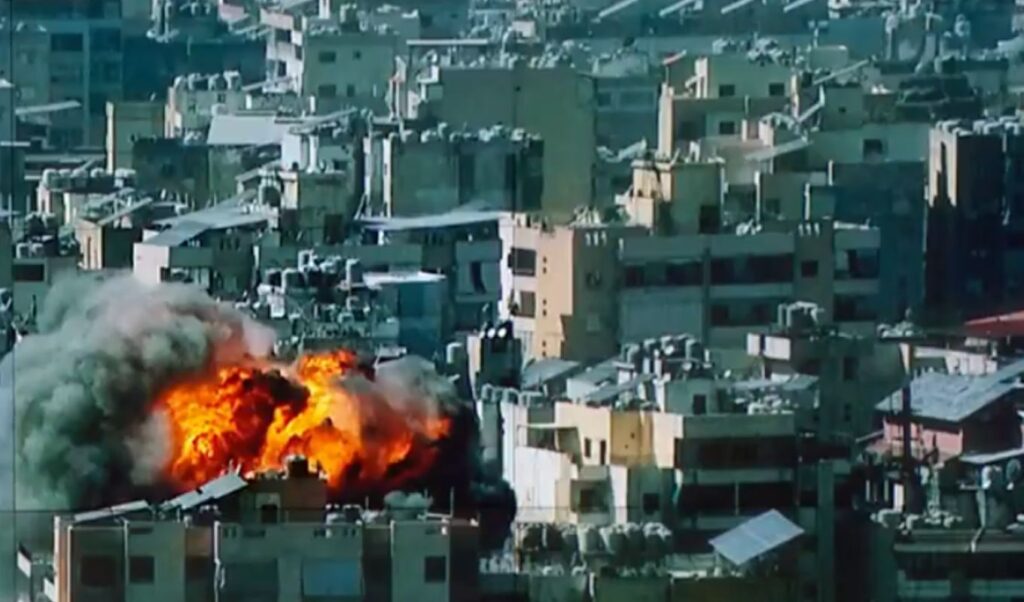
Confusion and tension prevail on the international stage following conflicting reports of a military incident in southern Iran. Iranian state television, citing local officials, reported that an American aircraft, which other domestic media identified as an MQ-9 Reaper drone, was “destroyed” near the city of Jam in Bushehr province, where the country’s only nuclear plant is located. This followed reports of air defense activation, explosions, and Iranian missile launches toward unspecified targets.
For their part, the US proceeded with immediate and categorical denial. An American official, speaking to Reuters, clarified that the claims about a shootdown were unfounded. Meanwhile, the situation becomes more complex in the Strait of Hormuz, with Iran’s Tasnim agency reporting information about exchange of fire, clarifying however that these were warning shots by Iranian forces toward ships moving in the area without prior coordination.
BREAKING: MASSIVE CROWDS OF IRANIANS ARE OUT IN FULL SUPPORT IN AZADI SQUARE TEHRAN AS IRAN SHOOTS DOWN A US AIRCRAFT pic.twitter.com/dpoMJZ4B4b
— GBX (@GBX_Press) May 28, 2026
BREAKING: US Central Command denies US aircraft downed in Iran
🔴 LIVE updates: https://t.co/PLxZwJgGDm pic.twitter.com/J4gfICQASG
— Al Jazeera Breaking News (@AJENews) May 28, 2026
US and Iran reportedly reach draft agreement framework, pending Trump’s final approval
At a critical juncture, while the Middle East war has already completed four months, reports from Agence France-Presse (AFP) from Washington indicate that the US and Iranian governments have reached a preliminary agreement framework to end hostilities. However, final approval remains pending, as American President Donald Trump has not yet given the final “green light.”
On the other side, Tehran rushes to lower the tone. Iran’s Tasnim news agency, citing a source from within the Islamic Republic’s negotiation team, categorically denied the report, characterizing it as false and clarifying that the final text of the agreement is still being formulated.
Meanwhile, on the other main war front, in Lebanon, Israel expanded its army’s “operational zone” and continued deadly bombardments, although ending hostilities with the Tehran-aligned Hezbollah movement constitutes a demand from Iranian leadership, who consider it a necessary condition for closing a deal.
The Middle East war, which erupted on February 28th with the American-Israeli attack on Iran, has cost thousands of lives. It has also shaken the global economy, raising oil prices, mainly because the Iranian side effectively closed the strategically important Strait of Hormuz for international hydrocarbon trade.
While concerns intensified that negotiations were at risk of collapse, AFP sources in the American government reported that an agreement framework was formed with Iran, which provides for a sixty-day extension of the ceasefire in effect since April 8th, which however needs approval from President Trump. The development followed Iran-US exchanges of fire on Wednesday night, the most serious hostilities since the truce was declared.
The information was initially reported by the American website Axios, according to whose information the “memorandum of understanding” does not regulate the Iranian nuclear energy program issue – it will be negotiated within 60 days – but will include Tehran’s explicit commitment not to pursue nuclear weapons acquisition.
The two sides have made “significant progress” toward reaching an agreement, but Donald Trump is not yet ready to approve it, said Vice President JD Vance. “We are negotiating certain formulations. We have made significant progress,” Vance told reporters at Andrews Base. “We hope we will continue to move forward and that the president will be able to approve the agreement, but of course, that remains to be verified,” he added.
The US and Iran reached an agreement to extend their ceasefire and lift restrictions on shipping through the Strait of Hormuz, though US President Trump has yet to approve it https://t.co/UhuD2YNKYk pic.twitter.com/AAMHLYzSyi
— Reuters (@Reuters) May 29, 2026
“Unimpeded” access to Strait of Hormuz
Markets reacted rather restrainedly. European stock markets limited their losses, while Wall Street hit new records. As for oil prices, they remained essentially unchanged. Andreas Lipkow of CMC Markets commented characteristically “how many times did compromise seem within reach and how many times were investors deceived? Only when the ink of signatures dries will we see new positioning.”
Regarding the Hormuz issue, the protocol provides for “unimpeded” access to the strait, according to Axios information, citing two sources in the American government. In exchange, the American blockade of Iranian ports will be lifted and Tehran will regain the ability to legally sell its oil in international markets, thanks to suspension of American sanctions.
Conveying that he will not tolerate “any attempt to impose a toll system,” American Treasury Secretary Scott Bessent threatened to turn against Oman, a US ally and Iran’s neighbor, if the sultanate cooperates with Tehran for strait control.
Washington also announced new sanctions yesterday aimed at strangling resources drawn from Iranian oil sales.
There are issues where the two sides seem to struggle to agree. Beyond ending hostilities on all fronts, the Iranian government demands the release of $24 billion in resources frozen abroad. And regarding the country’s nuclear energy program, it refuses to remove from the country its stock of highly enriched uranium – while American President Trump demands its destruction.
Mutual accusations over ceasefire violations
Earlier yesterday, the two sides accused each other of ceasefire violations. Wednesday night into Thursday, US armed forces shot down four unmanned aerial attack vehicles, deemed to have “posed a threat in the Strait of Hormuz” and struck a “ground control station in Bandar Abbas” from where there was danger a “fifth” could be launched, according to an American official.
In retaliation, the Revolutionary Guards – the Islamic Republic’s ideological army – announced today that they targeted an American base. They did not clarify which one. However, Kuwaiti and US armed forces reported strikes, attributed to Iran, on the small Gulf emirate’s territory.
With the climate remaining tense, Tehran residents don’t hide their concerns. Matab, a 62-year-old hairdresser living in the Iranian capital, said she’s happy her daughter managed to leave the country because “we’re living hell here,” but she’s saddened that her son lives “day by day,” without prospects for tomorrow.
In Lebanon, at least 17 people were killed in Israeli bombardments in the country’s southern part and near Beirut. The Israeli army announced it is expanding the “operational zone” it conducts against the Hezbollah movement. The United Nations Interim Force in Lebanon (UNIFIL) denounced this “escalation,” despite the ceasefire supposedly in effect since April 17th.
The new strikes were launched one day before Lebanon-Israel talks in Washington at military staff level and about 24 hours before the new round of negotiations between the two countries’ governments, also in the American capital, on June 2nd and 3rd.