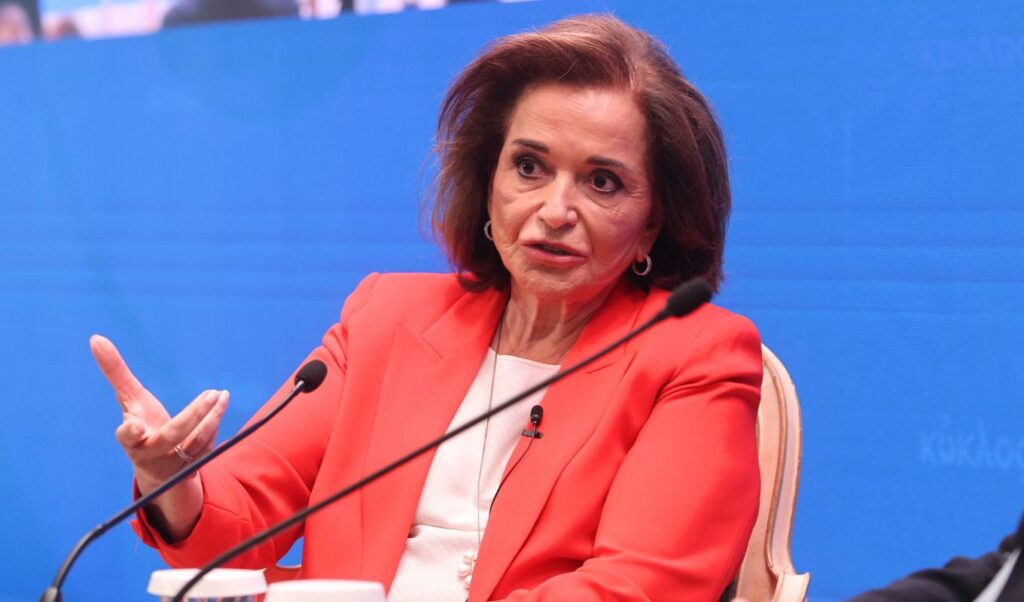
At the annual Conference “National Action Plan under conditions of global uncertainty,” organized by the Circle of Ideas in collaboration with the Delphi Economic Forum, Dora Bakogianni, chairwoman of the Committee on National Defense and Foreign Affairs and former Foreign Minister, expressed her concern about the deteriorating climate in Greece-Turkey relations, as well as the broader geopolitical realignments in the region, speaking to Athanasios Ellis, director of the English edition of “Kathimerini.”
Bakogianni: “We haven’t seen the bill yet, I’m waiting to see what they actually say”
Regarding the latest developments around “Blue Homeland” and Turkey’s provocations, Dora Bakogianni stated: “We haven’t seen the bill yet, I’m waiting to see what they actually say. In any case, it’s undoubtedly a crack in trust, perhaps that’s the most important thing, and an escalation in tension.”
As she noted, Turkey “always had the insecurity of encirclement” while she believes that Greece’s alliances create feelings of insecurity in Ankara. “Wrongly,” she added, noting that Greece “has no intention of making any aggressive moves.” She estimated, however, that both maritime spatial planning and Turkey’s internal situation contributed to the increase in tension.
“We don’t know if there’s a chance the Strait of Hormuz will open next month”
Dora Bakogianni argued that Greece has strong alliances and is not worried about relations with the US, citing as Greece’s “trump cards” among others, the Souda base, Alexandroupoli, and its energy role. She emphasized, at the same time, that “realpolitik imposes on foreign policy flexibility, many alliances, knowing where you’re going and what you’re seeking, and avoiding populism and national populism.”
Referring to developments in the Middle East, she noted that “we don’t know if there’s a chance the Strait of Hormuz will open next month,” while she characterized as “completely impossible” the possibility of NATO sending ships to the region, as Mark Rutte had mentioned. She estimated that these developments significantly change the balances and create new needs for European initiatives and possible dialogue with Russia.
“Turkey is an allied country that has received threats from Iran”
Regarding the deployment of German Patriots to Turkey, she supported that it’s a “logical move,” noting that Turkey is an allied country that has received threats from Iran. The former Foreign Minister favored national consensus mainly on Greek-Turkish issues, noting that parties that have governed the country largely share common strategic understanding on foreign policy issues.
“Political fragmentation is a phenomenon difficult to manage”
She also referred to the Prespa Agreement and conversations she had in the past with Nikola Gruevski about nationality and language issues, saying there was then a possible modus vivendi around nationality and language issues with solutions that had been proposed for formulations like “citizens of” and “makedonski.”
Finally, commenting on political developments and the creation of two new parties, she emphasized that “political fragmentation is a phenomenon difficult to manage” and estimated that it’s a development that “should worry us very much.”