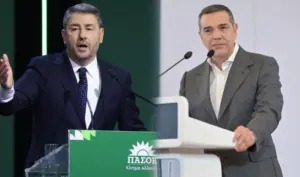
New Democracy maintains a clear advantage with a ten percentage point lead over the second party, according to the “To the Point” poll conducted for Voria.gr in the First Electoral District of Thessaloniki. The Voria Metrics survey shows a dynamic entry for Maria Karystianos’s new party, which is expected to be officially announced on Thursday, May 21st. In contrast, the new party of Alexis Tsipras, to be announced on Tuesday, May 26th, gains percentages above those of SYRIZA but shows limited momentum in First Thessaloniki and fails to move the needle among undecided voters. These undecided voters remain virtually stable whether with existing parties or with the addition of new ones, including a potential party by Antonis Samaras.
The poll was conducted using random stratified sampling across the six municipalities of First Thessaloniki with 964 voters. It was carried out between May 12-16, with a maximum margin of error of 2.8% (95% confidence interval).
New Democracy leads PASOK by 10 points in voting intention
In voting intention, New Democracy receives a relatively low 20.4%. Given that First Thessaloniki is the electoral district with the lowest percentages for the governing party, it’s clear that New Democracy appears to have no losses but remains at stable voting intention levels. However, its distance from second-place PASOK stands at ten points, as PASOK comes second with 10.5% in the Voria Metrics.
Third place goes to Greek Solution, marginally ahead of PASOK, receiving 10% in voting intention. This party has significantly increased its percentages in First Thessaloniki compared to the 2023 national elections and already matches its European election performance when it first became the third party.
The Communist Party follows in fourth place, reaching the percentages of both the European and parliamentary elections, with voting intention giving it 7.5%.
SYRIZA is limited to 5%, having lost its momentum. Two years ago in the European elections, it had received 14.43% in this specific electoral district and was the second party, while it held the same position in the 2023 national elections with 17.52%.
Freedom Sail follows with 3.8%, Voice of Reason very close with 3.5%, and Victory with 1.8%. For Freedom Sail and Voice of Reason, the percentages are close to those of the European elections, while Victory appears to have suffered a significant decline, having received 5.06% in First Thessaloniki in the European elections.
Another party is chosen by a significant 8.4%, while even more significant is the percentage of undecided voters (17%) and the non-negligible percentage of those who declare they will not vote (6.2%) and those who answer “no response” (6%).

Findings for Karystianos, Tsipras and Samaras parties
The “To the Point” poll findings are significant with the addition of three pending parties: those of Maria Karystianos, Alexis Tsipras, and Antonis Samaras.
Respondents show remarkable attitudes regarding their preferences, and it becomes evident that Karystianos makes the click, at least in First Thessaloniki, immediately gaining third place in respondent preferences.
Another significant finding is that undecided voters remain almost stable, that the two major parties (New Democracy and PASOK) are not significantly affected, while there’s a dramatic decrease in the percentage of those who answered “other party,” “will not vote,” and “no response” in the previous question.
In potential elections with the three new parties, New Democracy loses one point, falling to 19.4%. PASOK has even smaller losses, dropping from 10.5% to 9.8%. The difference between first and second remains close to ten points.
It should be noted that in the previous March Voria Metrics for all of Northern Greece, New Democracy recorded a loss of only one point with the entry of three new parties, reaching 22%. Another indication of New Democracy’s stable lead and PASOK’s stability in second place (two months ago in all of Northern Greece it received 10.3% with the addition of three pending parties).
Third place sees reshuffling. Maria Karystianos in the May poll receives 8.3% in First Thessaloniki, bringing her to third place. Compared to the March poll across Northern Greece, she has lost in both percentages and position. In that poll, she received 11.9% and second place. In any case, Karystianos’s party constitutes the most significant new entry for voters. But for which voters?
Fourth place in the First Thessaloniki poll is tied between Greek Solution and the Communist Party with 7.5% each. The Communist Party remains unaffected, while Greek Solution is heavily affected, losing 2.5 points from its percentage without new parties.
Tsipras’s low percentage based on existing expectations
Tsipras’s party follows with 6.3%, a percentage considered low based on expectations for center-left composition. In the First Thessaloniki poll, Tsipras’s strength appears to be SYRIZA, but not only that, as SYRIZA follows Tsipras’s party with 3% (without new parties it receives 5% as seen above).
Losing almost half its strength, SYRIZA is limited to 3%, the same percentage received by Freedom Sail and Voice of Reason. Both Zoe Konstantopoulou’s party and Afroditi Latinopoulou’s party lose percentages to new parties but don’t lose their entry to the next Parliament.
Samaras’s party follows with 2% voting intention in First Thessaloniki, a percentage that gives marginal parliamentary entry through projections, and Victory with 1.1%.
The decrease in undecided voters is just one point. From 17% in the measurement without the three new parties, their percentage drops only to 16.1%.
Conversely, more than half of those who declared they intended to vote for another party are distributed among the three new parties. The percentage answering “other party” drops from 8.4% to 4%. There’s a reduction, but not proportional, in the percentages of those declaring they “will not vote” (from 6.2% without new parties to 5% with new parties) and those declaring “no response” (from 6% to 4%).

Political leader popularity
In political leader popularity in First Thessaloniki, Maria Karystianos leads in positive opinions, with 42.5% of respondents expressing positive or somewhat positive views of her.
However, Kyriakos Mitsotakis gathers the most positive opinions at 16.9%, far ahead of second-place Maria Karystianos with 10.5%.
Zoe Konstantopoulou surpasses Mitsotakis in combined positive and somewhat positive opinions, reaching 32.1%.
In total positive and somewhat positive opinions, Mitsotakis receives 28.1%.
Third place in absolutely positive opinions goes to Dimitris Koutsoumbas and Kyriakos Velopoulos with 8.4%, with Konstantopoulou following closely (8.3%), then Alexis Tsipras (7.9%) and Nikos Androulakis (7.8%).
Koutsoumbas has a good fourth place overall with 27.2% positive and somewhat positive opinions.
Nikos Androulakis follows with 23.7% total positive and somewhat positive opinions and Kyriakos Velopoulos (22.2%), while Tsipras lags significantly (18.3%), being surpassed by Sokratis Famellos (18.8%).
Low figures also for Antonis Samaras (15.4% total positive and somewhat positive opinions), while even lower are Afroditi Latinopoulou (14.1%) and Dimitris Natsios (8.5%).
The most negative and somewhat negative opinions go to Natsios, Latinopoulou, Samaras, Tsipras, Androulakis, and Famellos, while Karystianos has the fewest.
Natsios has a significant recognition problem.
In absolutely negative opinions, Latinopoulou leads, followed by Velopoulos, Samaras, and Tsipras, all with percentages above 60%.

On the possibility of early elections
Regarding early elections, First Thessaloniki voters answer in large percentages (43%) that they want them at the end of the four-year term, but half demand early elections, with most wanting them immediately (32%).
Regarding voting criteria, economic concerns dominate. Almost nine out of ten will have economic stability as their main criterion, and equally many cite high prices. National issues, Tempi, OPEKEPE, and wiretapping follow.
First Thessaloniki voters also consider European Prosecutor Laura Kövesi’s actions in revealing the OPEKEPE case correct by an overwhelming percentage (76.9%).


On high prices
Regarding high prices and government measures to address them, Thessaloniki residents overwhelmingly consider them either inadequate or wrong. Characteristically, even the 30.9% who consider them correct don’t find them adequate, while only 3.4% find them correct and adequate.

In relation to the above question, when asked to describe their economic situation, half declared they struggle to meet all obligations, while 36.3% said they live comfortably but cannot save. Only 7.4% declare they live comfortably and can save, and a small percentage (6.4%) said they cannot meet their obligations.