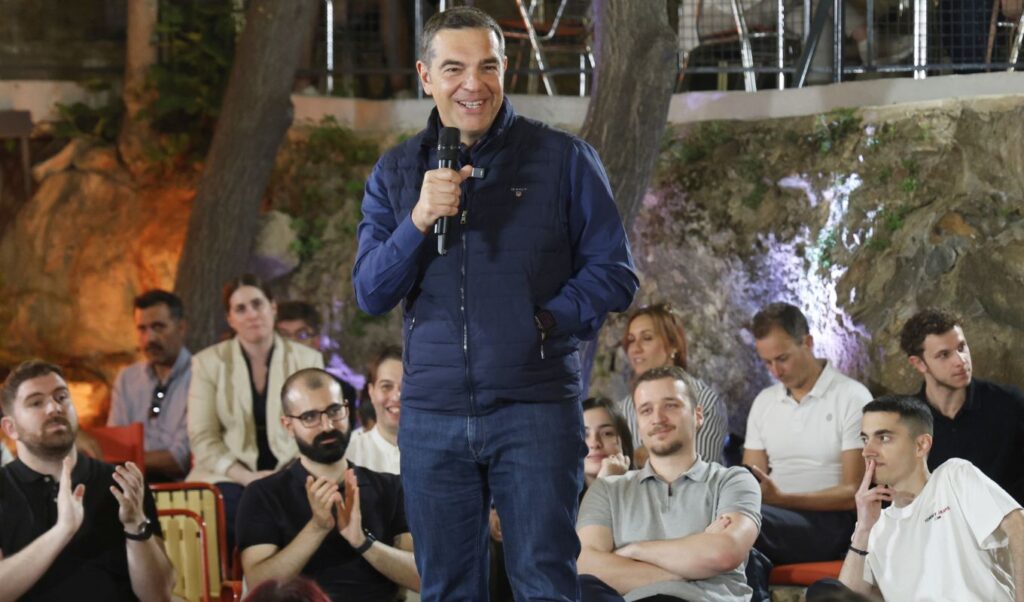
Former Prime Minister Alexis Tsipras stood alongside young workers and students Monday evening at an event organized by the “Unmute Now” group. The message sent by the former prime minister, after listening to what the younger generation had to say, was that they must turn out massively at the polls and participate in decisions about the future. “We will set our sails toward new horizons,” Tsipras said characteristically, while calling on his interlocutors at the event to join the founding of his new party next Tuesday (26/05) at Thiseio Square at 20:00.
Beginning his brief intervention, he commented with humor about the large turnout of young people: “It’s been a very long time since I’ve been among so many young men and women. The last time was probably when my little son took me and we went to Budapest to see Panathinaikos and went to Gate 13. The arguments weren’t, truth be told, quite so dialectical, but they had the same passion that you who spoke had.”
Employment, housing and university entrance exams at the center of Tsipras’s intervention
The former prime minister focused on three important issues that emerged from the discussion: employment, housing, and the national university entrance examinations, whose pressure came into current focus through the tragic incident with the two girls who lost their lives in Ilioupoli.
“I think the least we who were born in the analog era and moved to the digital era can do, listening to you who were born and raised in the digital era, is to stop telling you that we have the solutions and will tell you to learn them, and instead listen to you. That’s the least we can do…,” he initially noted.
At the center of his remarks were mainly the difficulties faced by working students, with the former prime minister criticizing the policy regarding “eternal students.” As he said, more and more young people today are forced to combine studies and seasonal employment, without substantial care from universities to facilitate their examination obligations: “And this is an issue we should highlight at some point. Instead of finding a formula to help these young people who are forced to work to make ends meet, what was attempted was the well-known legislation about eternal students, essentially punishing those people who have the social need, the economic need to go to work.”
He made special reference to the housing problem, noting that increasingly more young people remain in their family homes even after age 30, unable to meet housing costs. “The second very critical issue is housing. I don’t want to repeat everything. Many spoke eloquently about it. The issue is that today people aged 30, 34 with their partners are living in their childhood bedroom and this must stop at some point.”
Alexis Tsipras made special reference to the issue of national university entrance examinations, prompted by – as he said – the recent tragic incident in Ilioupoli with the two girls who lost their lives. The former prime minister questioned why the Greek state has not managed for decades to create a more humane and less stressful system of access to higher education: “I wonder why our poor state hasn’t managed to find in 62 years now a system less inhumane and more friendly to knowledge and to humanity than the university entrance examination system we’ve had for 62 years now. A system which you all know, because most, if not all, I think most have gone through it, generations and generations.”
Continuing his criticism, he argued that the national exams remain the only element of the state considered truly incorruptible, unlike – as he said – other aspects of public life where clientelistic relationships and “connections” dominate: “This state is so bankrupt that the only incorruptible thing it has to offer to future generations is the university entrance examination system. The only non-corrupt thing, everything else is corruptible. From connections to get military service preferences, to favors to get priority on the surgery waiting list, from acquaintances and connections to get work, to pull to get subsidies from OPEKEPE. This is Greek society and since we found the most incorruptible thing, let’s keep it.”
Alexis Tsipras also recalled that the SYRIZA government had legislated in 2019 the gradual abolition of this specific model, with the possibility of free access to certain schools, accusing the government of ultimately choosing to restore more competitive conditions through the base score of 10: “Which was abolished to establish the base of 10, to create even greater competition and to close schools throughout Greece. Because how else would private universities open?”