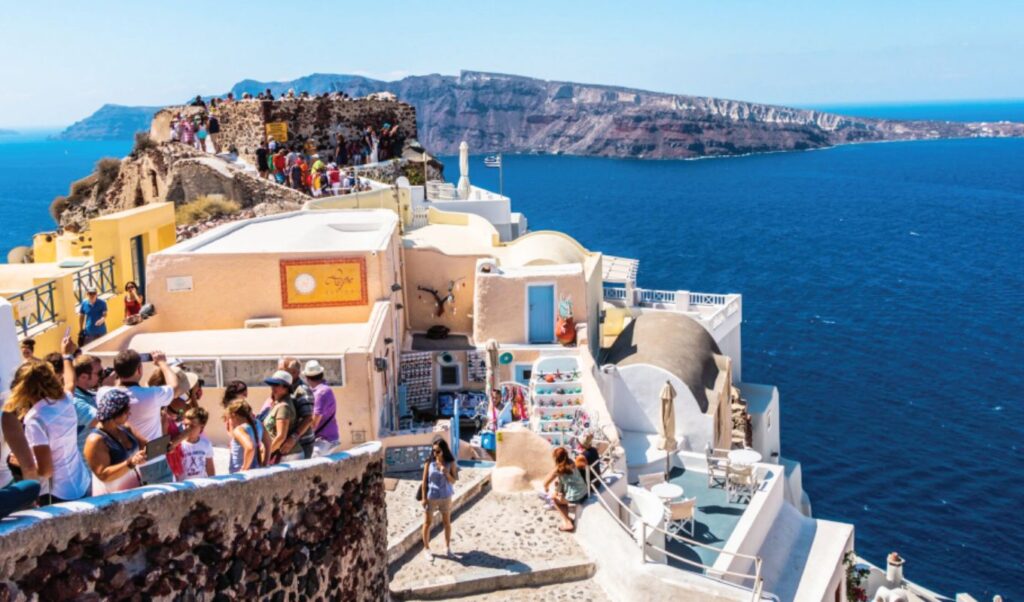
With a new, stricter framework of rules for tourism development, the government is attempting to redesign the map of Greek tourism, putting under the microscope mainly destinations that in recent years have been facing intense phenomena of overtourism. The new Special Spatial Framework for Tourism, which is being put to a new round of consultation with market stakeholders, aspires to function as a basic tool for controlling tourism expansion, connecting for the first time both new investments and short-term rentals with the actual carrying capacity limits of each area.
Multi-speed tourism: New construction limits and burden zones
In practice, the plan introduces different “speeds” of development, depending on the degree of burden of each destination, attempting to halt uncontrolled construction in areas where pressures on infrastructure, water supply networks and the natural environment have already exceeded safety limits. The biggest changes concern the country’s most popular islands and coastal destinations, where stricter conditions are now being imposed for new tourism investments. The strictest category includes destinations such as Mykonos, Santorini, Rhodes, Corfu, the Sporades, areas of Zakynthos, as well as parts of Crete and Pieria, where the Ministry of Environment and Energy considers that tourism development has now reached the limits of carrying capacity. In these areas, the minimum required area for new tourism developments is significantly increased, as the minimum plot size rises to 16 acres, while the size of new hotel units is also limited, with a maximum limit of 100 beds. The goal is to prevent the further creation of large tourist complexes in areas that already face serious pressures on water, energy, waste and transport infrastructure. At the same time, the new framework attempts to put the brakes on the continued expansion of tourism investments on islands that remain particularly attractive to the market, but already show signs of exhaustion.
This category includes Paros, Antiparos, Naxos, Syros, Sifnos, Folegandros, Koufonisia, Patmos, as well as areas of Kos. There, new developments will now require larger plots, as the minimum size rises to 12 acres, while units of up to 350 beds are permitted. This is essentially an intermediate zone, where the ministry attempts to contain the intensity of tourism expansion, before these specific destinations are led to saturation conditions similar to those already observed in the most burdened Cyclades. At the same time, the new Spatial Framework turns the focus of tourism development toward less burdened areas, which are considered to still have significant development potential. Islands such as Milos, Andros, Astypalea, Kalymnos, Karpathos, Anafi, Lipsi, Kimolos and Agathonisi are included in categories where tourism activity can continue to develop under more flexible terms. There the minimum plot size is set at eight acres and no restrictions are provided on the number of beds, although the ministry makes clear that development should be done more organized, so that the phenomena of over-construction and overtourism recorded in other popular destinations are not repeated.
Airbnb restrictions, coastal protection and shift to alternative tourism
Special emphasis is now also given to short-term rentals, which for the first time are officially included in the country’s spatial planning. The new framework creates the possibility of imposing special restrictions per area, depending on the level of tourism pressure and the carrying capacity of each destination. In the future, it will be possible to set limits on rental duration, designate zones where new Airbnb-type listings will not be allowed, or even impose restrictions on newly built properties. This direction is directly linked both to protecting the character of tourism areas and to the housing pressure that several local communities now face.
The concept of carrying capacity plays a pivotal role in the new model, as large tourism investments will now be mandatorily accompanied by special assessment reports on whether an area can withstand additional tourism burden without degrading the quality of life, natural resources and infrastructure. The measure mainly concerns small islands and areas with already increased tourism pressure, where problems of water scarcity, waste and traffic congestion have intensified in recent years.
At the same time, the coastal protection regime becomes stricter, as a ban on construction and interventions within 25 meters of the shoreline is provided, except for special access infrastructure. The ministry also gives special emphasis to water resource management, promoting the use of seawater in swimming pools and creating rainwater collection systems in new tourism facilities, especially on islands, where water adequacy has now become a critical issue during summer months. Through the new Spatial Framework, the government is attempting overall to shift the weight of tourism development toward other forms of tourism, emphasizing mountainous Greece, glamping, mountaineering shelters and the operation of ski centers throughout the year. The pursuit is to gradually reduce pressure on traditional “over-destinations” and diffuse tourism activity to more areas of the country.
Published in MoneyPro of Parapolitika