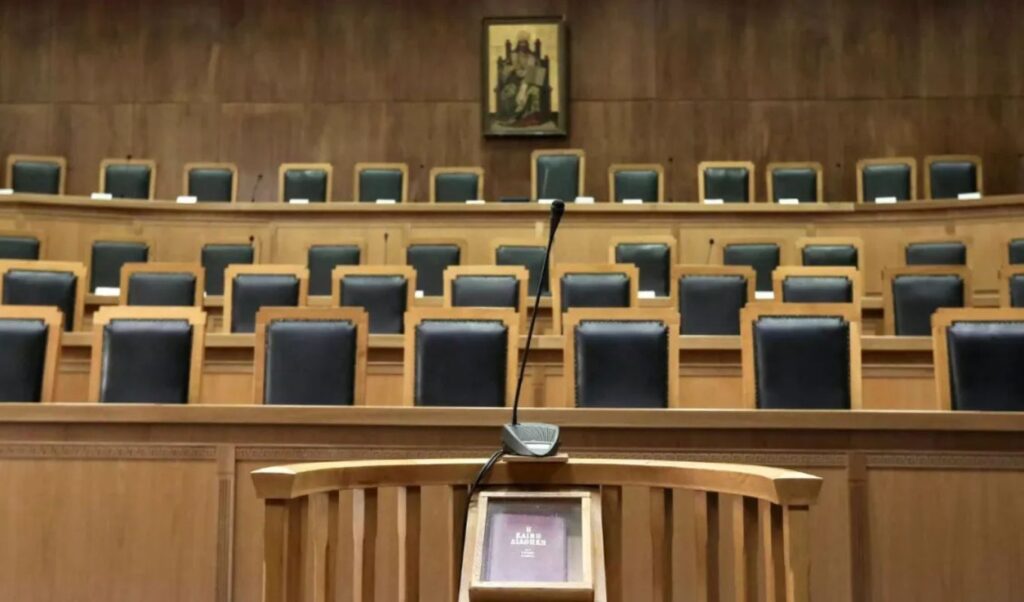
With constitutional reform in the spotlight, the Greek Prosecutors’ Union presents its own proposals. The prosecutorial officials propose specific changes aimed at, as they state, “strengthening the independence of justice and the prosecutorial institution, as well as more effective protection of the rule of law.”
Constitutional reform: The Greek Prosecutors’ Union positions
The Greek Prosecutors’ Union formulates the following proposals regarding provisions of Section E (Judicial Power):
A) Article 87 of the Constitution
For article 87, it is proposed to add a new paragraph numbered 2, while existing paragraphs 2 and 3 would be renumbered as paragraphs 3 and 4, respectively. The new paragraph 2 is proposed to have the following content:
“2. The prosecution is a judicial authority with functional autonomy and independence from the executive power, organized in a unified and indivisible manner, with the mission of ensuring legality, protecting citizens’ rights and safeguarding public order rules.”
This addition is deemed necessary, as the Constitution, while referring to prosecutors in articles concerning judicial power, makes no explicit mention of the prosecution institution and its mission, nor the guarantee of independence for its officials, as it does for judges in paragraph 1 of article 87. For this reason, it is required to adopt the formulation of paragraphs 1 and 2 of article 28 of Law 4938/2022, to establish the prosecution as a judicial authority in the constitutional text, as well as its mission, and to explicitly guarantee, rather than just interpretively derive, the independence of its officials.
The existing paragraph 2 of article 87, which according to the above must be renumbered as paragraph 3, is proposed to be modified as follows: “3 (formerly 2). Judicial officials in exercising their duties are subject only to the Constitution and the laws and under no circumstances are obligated to comply with provisions that have been enacted in violation of the Constitution.”
The replacement of the term “judges” with “judicial officials” is deemed appropriate to explicitly and emphatically establish in the Constitution that all judicial officials, including prosecutors, in exercising their duties are subject only to the Constitution and the laws and under no circumstances are obligated to comply with provisions enacted in violation of the Constitution.
B) Article 88 paragraph 5 of the Constitution
Regarding the age limit for retirement from active service of judicial officials provided in article 88 paragraph 5, the Greek Prosecutors’ Union, taking into account the standards in European legal systems, proposes increasing the age limit, which should not exceed the 70th year, with the possibility of optional continuation. The relevant provision should be accompanied by a transitional clause, similar to that of paragraph 1 of article 118, to ensure gradual implementation of new mandatory retirement limits and smooth career progression for serving judicial officials.
C) Article 89 paragraph 4 of the Constitution
Paragraph 4 of article 89 is proposed to be replaced as follows: “Judicial officials are prohibited from participating in government. Law determines the conditions and guarantees under which the appointment of judicial officials to independent authorities and the assignment of duties to them in public services after their retirement is permitted.”
This proposal fits within contemporary European concerns about strengthening institutional neutrality guarantees for justice and aims to maintain citizens’ trust in judicial independence, as otherwise we face potentially unfair results, depriving the public of the opportunity to utilize morally and scientifically distinguished judicial officials.
D) Article 90 paragraph 5 of the Constitution
Paragraph 5 of article 90 is proposed to be replaced as follows: “5. Promotions to positions of president and vice-president of the Council of State, the Supreme Court and the Court of Audit are made by presidential decree issued following a decision of a special parliamentary committee of the Greek Parliament with an enhanced majority, among the three members of the respective supreme court who received the most votes in the relevant voting previously conducted by the respective plenary sessions, as law provides. The promotion to the position of Supreme Court Chief Prosecutor is made by similar decree, with selection among Supreme Court Deputy Prosecutors after a relevant vote by the Supreme Court Prosecution Plenary, as law provides. The promotion to the position of General Commissioner of the Court of Audit is made by similar decree with selection among members of the Court of Audit and the respective General Commission, as law provides. The promotion to positions of General Commissioner of administrative courts is made by similar decree with selection among members of the respective General Commission and presidents of administrative court appeals, as law provides.”
The Union reiterates its longstanding position that selection for the Supreme Court Chief Prosecutor position must be made exclusively among Supreme Court Deputy Prosecutors who received the most votes in the Supreme Court Prosecution Plenary voting, due to the prosecutor’s position as an autonomous, essential and necessary organ of justice, with a distinct role in its administration and guarantees of personal and functional independence. Moreover, the thirteen consecutive years of selecting prosecutorial officials for the Supreme Court Chief Prosecutor position already reflects in practical terms the special institutional character and autonomy of the prosecutorial function. The increase in Supreme Court Deputy Prosecutors to twenty-eight (28) now provides adequate and broad selection scope for filling this position.
It is noted that the binding nature of relevant voting by respective plenaries constitutes an essential guarantee of justice’s institutional autonomy and enhances meritocracy and transparency in selecting supreme court leadership.
The proposed replacement of the Cabinet by the Greek Parliament is positively evaluated, as is the constitutional guarantee of respective plenaries’ participation in selecting supreme court heads, as changes that enhance institutional transparency and further strengthen justice independence.
The above proposals by the Greek Prosecutors’ Union aim to substantially strengthen justice and prosecution institutional independence, fortify separation of powers, and enhance transparency in selecting supreme court leadership. They simultaneously seek explicit constitutional guarantee of the prosecution’s role as an autonomous judicial authority and further strengthening of judicial officials’ personal and functional independence guarantees.
The proposed changes fit within a contemporary European conception of the rule of law and aim to strengthen citizens’ trust in justice as a fundamental pillar of democratic governance. The Greek Prosecutors’ Union remains open to sincere, well-intentioned and fruitful dialogue for improving the existing regulatory framework on this matter.