It was back in 2010 when Greece and Libya, as countries with opposite coasts, had come close to signing a maritime zone delimitation agreement. However, talks were interrupted after Gaddafi’s fall. Taking advantage of the internal turmoil in the troubled country and its division, Turkey offered everything possible – mainly money and military support to Tripoli – and thus succeeded in signing the illegal and invalid memorandum in 2019 with the UN-appointed transitional Government of National Accord (GNA) of Libya. An agreement that violates the sovereign rights of Greece and third countries in the region.
The illegal Turkish-Libyan agreement and Athens’ diplomatic counteroffensive
As a result, the long-standing friendship between Greece and Libya suffered irreparable damage, despite the geographical proximity and historical presence of the Greek element in the Cyrenaica region. Recently, however, Athens is attempting a difficult diplomatic relaunch. Its goal is to drive a “wedge” between Tripoli-Ankara relations and invalidate the illegal Turkish-Libyan agreement.
The two sides agreed to increase trade transactions and further promote investments in the energy, construction, logistics and transport sectors
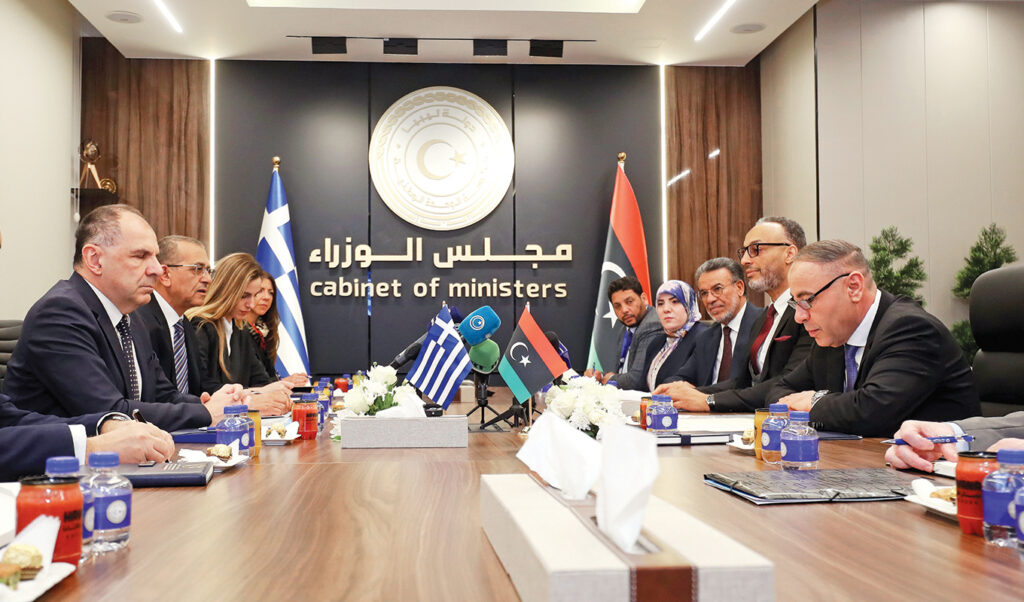
George Gerapetritis: High-level contacts in Tripoli – “We’re moving forward on Greek-Libyan EEZ”
This was the aim of George Gerapetritis’ recent visit to Tripoli. As our newspaper had first revealed, the minister sought to travel to Tripoli immediately after Benghazi (end of March), but weather conditions did not allow it. Behind the scenes, throughout this period the two sides exchanged proposed dates and thus the trip was scheduled. It’s worth noting that Mr. Gerapetritis spoke for two hours with the pro-Turkish transitional prime minister of Libya’s Government of National Unity, Abdul Hamid Dbeibah, and for about an hour and a half with the President of Libya’s Presidential Council, Mohamed al-Menfi. This was the third time in ten months that G. Gerapetritis met with the acting Foreign Minister, Al Taher Salem al-Baour.
According to exclusive information from “P”, the atmosphere behind closed doors was good, the Libyans were extremely hospitable, with traditional tea not missing from official meetings, while they also showed the required respect to the Greek delegation. Of course, the motives were also transactional. Tripoli expects two moves from Athens. First, to become Libya’s “voice” in the European Union and the UN, and second, for Greek companies to return to the troubled country to contribute to its reconstruction with investments in construction and energy sectors. In exchange, Athens aims to advance talks on maritime zone delimitation, as any agreement could serve as a bulwark against the illegal Turkish-Libyan memorandum.
Mr. Gerapetritis stated: “We decided to advance the discussion of technical committees concerning the delimitation of continental shelf and Exclusive Economic Zone, to cooperate in international organizations with an eye to the future, to be able to cooperate in an environment where the two countries will have mutually beneficial agreements” and added that “it is important for two countries that are directly and genuinely neighboring, like Greece and Libya, in a turbulent geopolitical environment in our region, to find themselves in excellent cooperation and promote issues that concern them. As well as to promote relations of peace and prosperity.”
New round of maritime zone negotiations
The first round of technical talks between the relevant committees for maritime zone delimitation took place in September 2025, in Athens. According to exclusive information from “P”, the second round will take place in Tripoli, within the next few months. Certainly, however, within the current year. From the Greek side, Deputy Foreign Minister Alexandra Papadopoulou will lead the delegation.
Investments, trade and reconnection of the two countries
Athens and Tripoli have already shown their intentions, starting with feasible rapprochement moves. For example, direct flights between Athens and Tripoli/Benghazi have begun, which constitute a substantial step for business mobility and tourism, while both sides have expressed the will to strengthen contacts through the re-establishment of a joint committee to update existing bilateral agreements and develop new agreements on matters of mutual interest between the two countries. On Monday, in fact, the two sides agreed to increase trade transactions and further promote investments in energy, construction, logistics and transport sectors, conduct a Greek business mission to Tripoli, while finally declaring they want to work on commercial and passenger maritime connections between Greece and Libya.
Turkey’s panic
Turkey’s reaction, besides being expected, was also immediate. The Turkish Defense Ministry with a post on X claimed that during the multinational Special Forces exercise Flintlock 2026, organized by Americans in Libya, a Turkish UAV type AKINCI TIHA took off from Turkey and joined the exercise, “following the maritime jurisdiction zone borders determined in the agreement signed in 2019 between Turkey and Libya.” This was an attempt by the neighboring country’s ministry to keep the Turkish-Libyan memorandum in the spotlight and simultaneously prove that – based on the agreement – Turkey is proceeding with military moves.
Published in Parapolitika