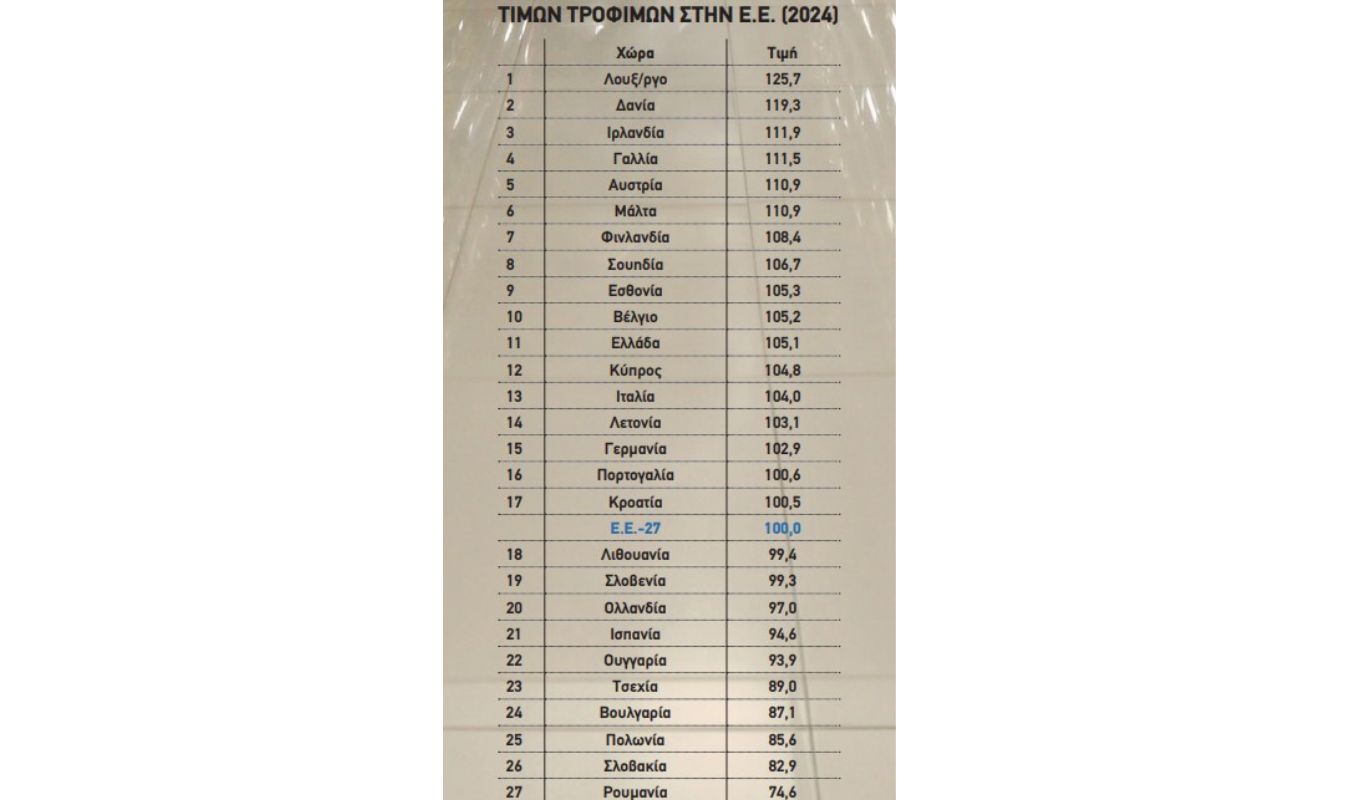
Greece is now among the most expensive countries for food purchases according to official Eurostat data. According to statistics presented by the European Statistical Service, food prices in Greece are 5.1% higher than the EU average. The food price level index, presented by Eurostat, shows Greece at 105.1, with the average prices in the 27 European countries normalized to 100.
Read: “Bonus” of up to 400 euros per month for 200,000 pensioners – Who gets it and when
Greeks pay more for food
Eurostat data shows that Greeks pay more for food, even compared to developed Northern European countries like the Netherlands and Germany. In the latter, food costs about 2% less than in Greece, while in the Netherlands it’s even cheaper, averaging more than 7% less. It should be noted, however, that both aforementioned countries are major food producers, both in unprocessed (agricultural and animal) products and processed foods. The Netherlands is one of the largest producers of agricultural and animal products.
Higher food prices also apply in our country compared to “similar” countries like Portugal and Spain. However, the price level is similar to that of Italy (also a very large food producer) and Cyprus, which imports almost all of the food it consumes.
Which countries pay the most
The countries that pay the most for food are clearly the wealthiest, such as Luxembourg, Denmark and Ireland. In Luxembourg, prices are at least 25% higher than the European average and about 22% more expensive than Germany. On the other hand, countries that pay the least for food are those that joined the EU most recently, such as Romania, Slovakia, Poland and Bulgaria. The price level index shows the price level of a given country relative to another (or relative to a group of countries like the European Union), by dividing Purchasing Power Standard (PPS) units by the current nominal exchange rate of the currency.
Among the “poorest” in Europe
Greece, on the other hand, while remaining relatively expensive for food, is now considered among the “poorest” in Europe. Per capita disposable income in PPS ranks our country in 25th place in the EU with 20,639 euros for 2024. The EU average for the same year was 29,639 euros and in the Eurozone 31,135 euros.
Countries that in the past viewed Greece and its way of life from afar have today surpassed our country’s level of prosperity. Among them are Estonia, Poland, Romania – countries of the former Eastern Bloc that now show higher levels of prosperity than our country.
Only two countries still lag behind Greece in terms of citizen prosperity: Latvia and Bulgaria. In Latvia, adjusted gross disposable income in 2024 was marginally below 20,000 euros, and in Bulgaria, for the last year with available data (2022), the corresponding income was marginally above 15,000 euros.
It should be noted that per capita gross disposable income in PPS is the basic indicator expressing a citizen’s prosperity. It is the money remaining in their pocket after taxes and other state benefits and is available for spending on goods and services.
Food prices have increased significantly in Greece over the last 4-5 years. According to ELSTAT, inflation over the last five years in our country reached a cumulative 25%, with food as the main driver, which increased by approximately 39% over the same period. Housing goods and services followed with cumulative inflation of 33% over the last five years, and hospitality and restaurant services with a cumulative increase of 31%.
The smallest contribution to the inflationary crisis experienced by the country during 2021-2025 came from information and communication services. This was the only category of goods and services from ELSTAT that had a negative effect (about -6%) on the country’s general inflation. In all other 9 categories of goods and services that shape inflation, we had increases from 8% to 39%.
Annual food inflation at 4.5% for March
Now food, along with energy, are the goods that significantly raise the cost of living for Greeks. Annual inflation in food for March reached 4.5%, reminiscent of previous years. And everything indicates that inflationary pressure on food is a phenomenon that has not yet fully reached supermarket shelves.
The increases consumers see today, mainly in unprocessed foods (e.g., vegetables and meat), are the result of reduced production, drought and other such factors. The Iranian crisis factor has not yet fully entered the equation, at least not 100%.
Published in Sunday’s Apogeumatini