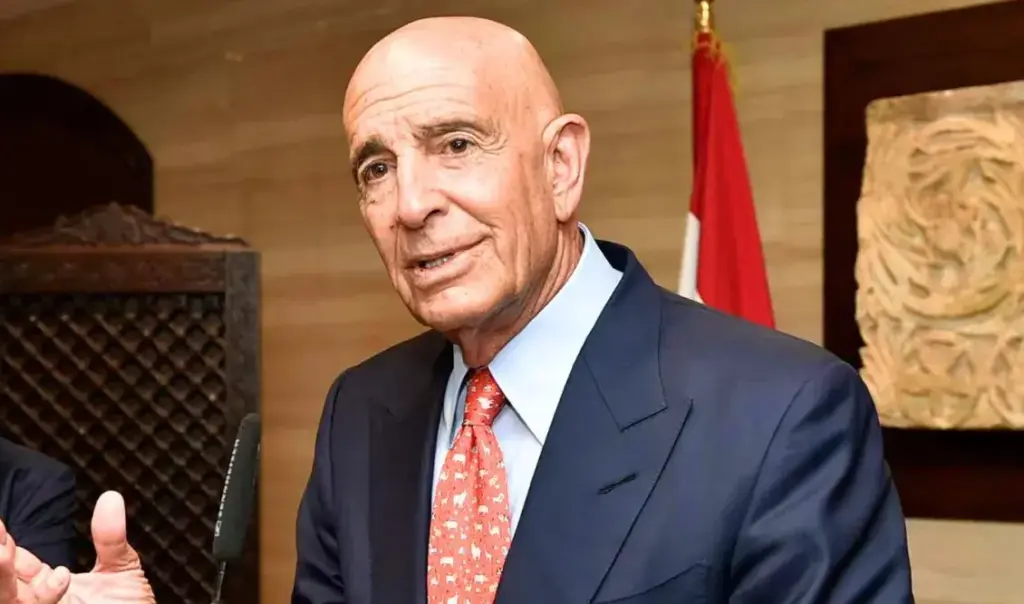
Many analysts interpret the rhetoric of US Ambassador to Turkey Tom Barak as a systematic attempt to beautify Turkish positions and promote Ankara’s interests within the American political system. His stance at the Antalya Diplomacy Forum is indicative of an approach aimed at immediate normalization of Washington-Ankara relations, bypassing the thorns that led to American CAATSA sanctions.
Tom Barak: Goal is Washington-Ankara rapprochement – F-35s and S-400s in focus
At the center of his Turkey-friendly argumentation, Tom Barak repeatedly raises the issue of F-35 fighter jets that Turkey seeks to acquire but is prevented from obtaining due to its possession of the Russian S-400 system. Barak openly argues that the sanctions issue over the S-400s will be resolved soon. He even invokes Donald Trump himself, claiming that from the former president’s perspective, Turkey’s reintegration into the F-35 program is “okay.” This rhetoric attempts to downplay the seriousness of purchasing the Russian weapons system, despite the fact that American legislation explicitly states that Turkey must not possess or operate S-400s to return to the F-35 program.
Questions about the comparison with Greece
His attempt to justify the Turkish stance through comparison with Greece raised questions in diplomatic circles. The American Ambassador to Turkey used for the first time yesterday the argument that Greece also possesses the Russian S-300 system while having procured F-35s, deliberately ignoring the enormous technical and strategic differences between the two systems and the conditions under which they were acquired. This rhetoric seeks to create a climate of “equal distances” and present Turkey as wronged by Washington.
Eftychidis analysis on US-Turkey relations
International relations expert Thrasyvulos Eftychidis argues to parapolitika.gr that at some point Turkey will likely acquire the F-35s once it manages to remove the S-400s from its territory, and emphasizes that Tom Barak’s pursuit is to keep Turkey’s doors open to America, something he appears to be achieving so far. As he says, “Tom Barak enjoys, thanks to his position in Turkey, taking frequently pro-Turkish positions. There are very many Greek Americans who have asked President Trump to withdraw him from Turkey as he maintains an extremely pro-Turkish stance. In this context, he once again repeated his positions. Because this is a repetition, it’s not the first time he’s made such statements. But essentially we have seen that sanctions on Turkey have not been overturned either by Congress or by the State Department. Turkey is considered an important ally for the United States due to its position, its borders with Iran, its proximity to the Middle East, to Syria, etc. But beyond that, there is the firm position that says that to proceed with F-35s, the issues with the S-400s must be resolved. Even the comparison that Barak made with the Greek S-300s is incorrect, since the technical capabilities of the S-300s are different from the technical capabilities of the S-400s that Turkey possesses. In any case, the permanent American position is that the issue must be resolved either with the return of the specific weapons system to Russia or with its sale. Turkey must therefore, to re-enter the F-35 program, have the S-400s removed from its territory. It’s a possibility, I don’t rule out it happening sometime in the future because Turkey is a very large country, a very good customer for the United States and we might reach that point. For now, it doesn’t appear to be happening.”
At yesterday’s Antalya Diplomacy Forum, the American ambassador showed that the Turkey-friendly stance extends to regional issues, such as that of Gaza. Tom Barak stated that he supports Turkish involvement in a peacekeeping force in Gaza, emphasizing that Turkey is a crucial player because it doesn’t consider Hamas a terrorist organization. In this way, he upgrades Ankara’s role as a “mediator” who can persuade Hamas for a ceasefire, essentially adopting the Turkish perspective on the organization.
Mr. Eftychidis argues that “Israel is categorically opposed. Turkey has an articulated position for participation in Gaza. Even Turkey’s Foreign Minister Hakan Fidan in his speech yesterday at the Antalya Diplomacy Forum spoke of a Turkey of power and peace, but few are those who believe what Turkey says anymore.” What is certain is that Turkey has secured a strong supporter of its interests in the region. However, for many, Tom Barak’s statements do not compose the profile of a diplomat but of a politician who functions more as an advocate of Turkish aspirations rather than as an impartial representative of the US.