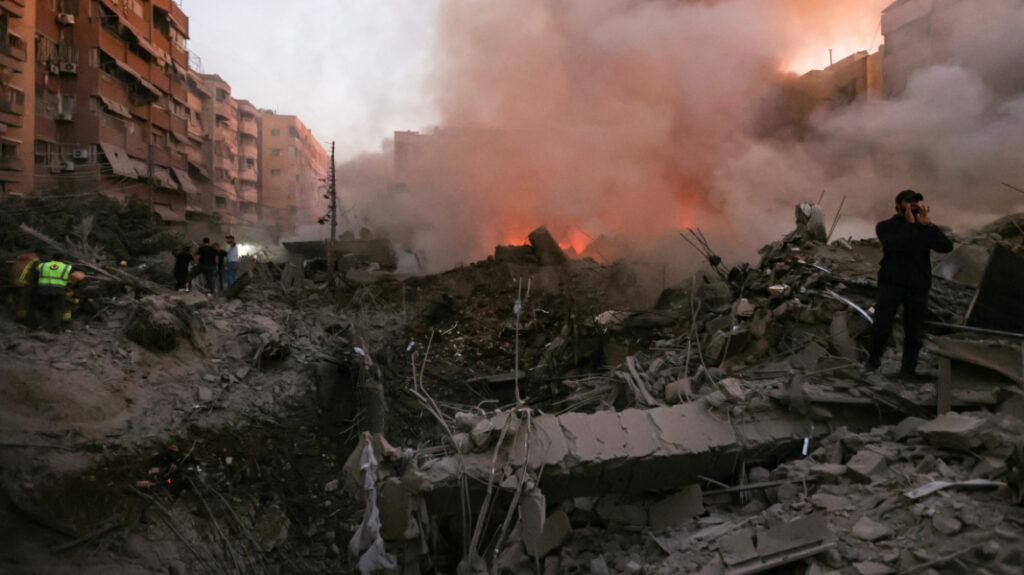
The Middle East remains a scene of escalation with the question “when will the war end” persistently hovering over the geopolitical chessboard and ongoing bombardments casting a heavy shadow over the global community. While Israeli strikes continue and Iranian retaliation doesn’t stop, this affects the United Arab Emirates, which remains on high alert. Meanwhile, Donald Trump’s plans for Iran raise concerns about the implementation and outcome of American operations, as the US president has put on the table the possibility of seizing oil and uranium from Iran, not even ruling out the occupation of Iran’s fuel hub, Kharg Island. In his latest message, the Republican posted on his social network, Truth Social, as the US strikes ammunition depots in Isfahan with 2,000-pound bunker buster bombs.
Read: Middle East war: US strikes Iran ammunition depots in Isfahan with 900kg bunker buster bombs (Video)
It’s worth noting that, according to the latest developments, explosions were heard in Dubai, with authorities announcing that their air defense systems are responding to missile threats. Terrified residents in Dubai continue to receive alerts on their phones to seek shelter and remain in safe locations. The alerts being sent to other Gulf states are issued mainly during nighttime hours, while it’s known that the United Arab Emirates reports that most attacks are intercepted.
Regarding the Strait of Hormuz, it remains closed with Iran maintaining control of the situation as oil prices rise sharply in recent days.
Middle East: When will the war end?
Meanwhile, Israeli Prime Minister Benjamin Netanyahu stated that the US-Israel war with Iran has “certainly exceeded the halfway point,” but later clarified that this statement referred to missions and not duration.
Netanyahu added that “thousands” of members of Iran’s Revolutionary Guards have been eliminated and that his country and the US were close to completely destroying Iran’s factories and nuclear program.
Meanwhile, Tehran has launched a new wave of attacks, as announced by the Israel Defense Forces (IDF), just hours after the military detected missiles fired from Iran toward Israel.
Attacks also continued throughout the Gulf region, including Dubai, where authorities say an oil tanker was set on fire following an Iranian drone attack.
Iran’s plan to impose tolls on the Strait of Hormuz
Meanwhile, a parliamentary committee in Iran approved plans to impose tolls on traffic through the Strait, according to the Iranian Fars news agency, which is connected to the Islamic Revolutionary Guard Corps (IRGC).
The relevant committee adds that, according to the plans, American and Israeli ships, as well as other countries that have participated in sanctions against Iran, will be banned from passing through the Straits.
Donald Trump, according to the Wall Street Journal, told his associates that he is willing to end the military campaign against Iran, even if the Strait of Hormuz remains largely closed.
When asked about this, the White House cited statements by US Secretary of State Marco Rubio that the Strait of Hormuz will “reopen one way or another.”
The situation in Gulf countries
Gulf countries remain on high alert. In Dubai, a fire broke out after debris from intercepted projectiles fell shortly before 04:00 local time. Four people were injured in the incident, which occurred near an abandoned house in the Al Badia area.
Meanwhile, a tanker fully loaded with two million barrels of oil was anchored in Dubai when it was set on fire following an Iranian drone attack, according to authorities.
In Saudi Arabia, six houses sustained damage from debris from a downed drone, but no one was injured, the country’s civil defense authority reported in a statement.
Kuwait’s military also announced on platform X earlier in the morning that it was intercepting drone and missile attacks over its territory.
The Israeli military reports launching a new wave of attacks on the Iranian capital, Tehran.
The IDF also reports that the attacks targeted the “infrastructure of the Iranian terrorist regime.”